
AI news ·
Pope Leo XIV warns that AI in warfare risks "spiral of annihilation" in speech at Rome's Sapienza University
Pope Leo XIV warned that AI-driven weapons risk a "spiral of annihilation," condemning the removal of human accountability from military decisions. He spoke at Sapienza University on May 14, ahead of releasing his first encyclical on AI ethics.
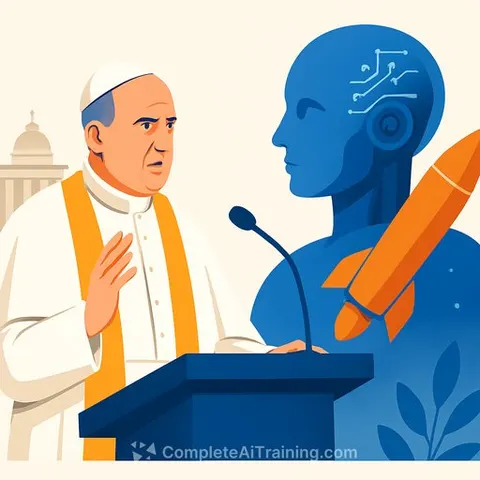
Pope Warns AI-Driven Warfare Risks "Spiral of Annihilation"
Pope Leo XIV condemned the use of artificial intelligence in modern warfare during a visit to Sapienza University of Rome on May 14, calling for global vigilance over weapons development and AI systems that remove human accountability from military decisions.
"What is happening in Ukraine, in Gaza and the Palestinian territories, in Lebanon and in Iran describes the inhuman evolution of the relationship between war and new technologies," the pope said before students and academics in the university's main lecture hall.
The remarks preceded the release of his first encyclical - a major teaching document - focused on the ethical questions artificial intelligence poses for humanity. The pope urged researchers and policymakers to redirect investments away from weapons and toward education, health, and diplomacy.
Military Spending Grows While Investments in Education Decline
Leo highlighted the "enormous" growth in military spending worldwide, particularly in Europe, where defense spending increased 14% in 2025.
"Let us not call 'defense' a rearmament that increases tensions and insecurity, drains investments in education and health, contradicts trust in diplomacy and enriches elites who care nothing for the common good," he said.
The pope called for AI systems to preserve human choice in decisions about warfare. "Study, research and investments should go in the opposite direction," he said. "They should be a radical 'yes' to life, yes to innocent life, yes to young life, yes to the life of peoples who cry out for peace and justice."
Government officials and policymakers working on defense and technology issues may find the AI Learning Path for Policy Makers relevant to understanding the ethical dimensions of AI deployment in high-stakes contexts.
Pope Addresses Young People's Anxiety Over Performance Pressure
Leo spoke directly to students about the psychological toll of modern society's emphasis on measurable output and competitive performance.
Young people suffer from "extortion of expectations and the pressure to perform" that reduces individuals to metrics, he said. "We are a desire, not an algorithm."
The pope rejected what he called the "pervasive lie of a distorted system which reduces people to numbers, aggravating competitiveness and abandoning us to spirals of anxiety."
Climate and Resignation
Leo also addressed climate change, noting that despite stated commitments, "the situation does not seem to have improved."
He urged students "not to give in to resignation, but instead to transform restlessness into prophecy" and to pursue justice and environmental stewardship.
Historic University Visit
The papal visit marked the first to Sapienza since St. John Paul II traveled there in 1991. Pope Benedict XVI declined an invitation to the university in 2008 following protests by faculty and students over his previous comments as a cardinal regarding the church's historical treatment of astronomer Galileo Galilei.
Four Palestinian students brought to study at the university through an agreement between Sapienza, the Diocese of Rome, and the Community of Sant'Egidio greeted the pope after his speech.