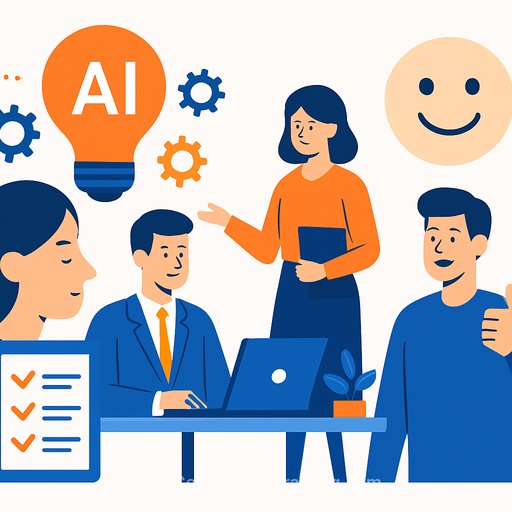
AI in HR: Practical Wins You Can Use Today
AI in HR isn't a future bet. It's already helping teams run payroll with fewer errors, make better calls with data, and deliver faster support to employees. The big value isn't flashy-it's fewer risks, clearer insights, and a smoother experience for everyone.
Below are five areas where AI is paying off right now-and how HR leaders can put it to work.
Payroll Accuracy and Compliance
In fiscal year 2024, the U.S. Department of Labor recovered over $202 million in back wages for roughly 152,000 workers. With damages, the total approached $273 million. Payroll mistakes are still common-and expensive.
Modern payroll platforms use embedded AI "agents" that:
- Flag anomalies before payroll is finalized.
- Proactively surface paycheck questions to employees and admins.
- Run post-payroll validations to catch irregularities humans miss.
The outcome: fewer adjustments, faster resolutions, and stronger compliance. Your team spends less time chasing errors and more time on strategy.
Takeaway: Payroll AI isn't replacing accountants-it's preventing the mistakes that keep them up at night.
See DOL Wage and Hour enforcement data
Workforce Analytics and Decision Support
Many teams are data-rich but insight-poor. AI is closing that gap. A recent survey shows 38% of HR leaders are piloting or implementing generative AI, with top use cases in:
- HR service delivery chatbots (43%)
- Document generation and HR operations (42%)
- Recruiting and skills data management (41%)
By automating routine reporting, AI frees HR and finance to focus on interpretation. "Guided analytics" turns complex data into plain language and recommended next steps. Examples:
- Highlight scheduling inefficiencies that drive overtime costs.
- Forecast turnover risk by department.
- Recommend hiring timelines based on historical volume.
Takeaway: AI doesn't replace intuition. It strengthens it with faster, clearer evidence for every decision.
Employee Engagement and Self-Service
Employee experience is now a competitive advantage. AI helps by improving access to information and personalizing support. Forty-three percent of organizations use AI for HR-related tasks (up from 26% a year earlier), and 77% of employees using AI say it helps them get more done in less time.
AI assistants embedded in your HR stack can:
- Answer policy and benefits questions 24/7.
- Pull verified info from handbooks, plan summaries, and knowledge bases.
- Cut the back-and-forth of email threads and tickets.
The result: faster answers for employees, and more strategic time for HR.
Takeaway: AI doesn't depersonalize HR-it gives teams the time to be more human where it matters.
Compliance Monitoring and Predictive Risk Management
Compliance problems are quiet until they're expensive. AI reduces exposure by continuously monitoring data for patterns that signal risk. Leading platforms can flag:
- Potential employee misclassification.
- Overtime or scheduling violations.
- Missed tip credits or break-time gaps.
When an irregularity appears, the system alerts HR or payroll early-before a claim or audit. This matters, given the Wage & Hour Division recovered more than $1.5 billion from 2021-2023, and another $202 million in 2024 alone.
Takeaway: AI turns compliance from reactive cleanup to proactive prevention-and protects your reputation.
Recruiting: Speed Meets Quality
Hiring eats time. AI helps from job posting to candidate engagement. According to LinkedIn's 2025 Talent Trends Outlook, 73% of talent-acquisition pros say AI will change how companies hire, and those already using it report saving nearly 20% of their week.
Where it helps most:
- Write job descriptions that use inclusive language.
- Screen for skills match, not just keywords.
- Automate candidate updates to keep people engaged.
This lets recruiters stay focused on relationships and quality conversations-the parts no algorithm can replace.
Explore LinkedIn Talent Trends
Takeaway: The best recruiters will use AI-not to hire faster, but to hire smarter.
The Bigger Picture: Human + Intelligence
AI is already embedded across HR operations-from reducing payroll errors to anticipating turnover risk. Think of it as a quiet partner helping your team operate with more accuracy, transparency, and trust.
The impact still depends on people. The organizations that win will:
- Use AI responsibly with transparent data practices, governance, clear controls, and ongoing audits.
- Train leaders and employees, then review usage to mitigate risk.
- Keep human oversight at the center. Automation supports empathy and experience-it doesn't replace them.
The future of HR isn't artificial. It's intelligent, informed, and human.
Next Step: Build Practical AI Skills Across Your HR Team
If you're ready to turn these use cases into daily workflows, start with focused training and repeatable playbooks.
- AI for Human Resources - role-focused content to upskill HR, payroll, and talent-acquisition teams.
- AI Learning Path for Business Unit Managers - practical guidance for managers overseeing HR-driven operations and cross-functional teams.
- AI Learning Path for CHROs - advanced curriculum on workforce analytics, governance, and AI leadership.
Your membership also unlocks: