NHS Turns to Predictive AI to Manage Staff and A&E Pressures This Winter
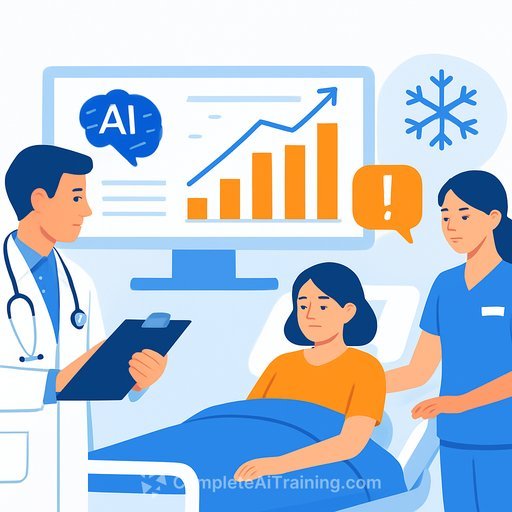
The NHS is using predictive AI to forecast emergency department demand and staff accordingly as hospitals face record winter flu cases. The system is live across 50 organizations in England and gives managers early warning of surge periods so they can plan shifts with more precision.
Health Innovation Minister Dr. Zubir Ahmed called it evidence that the "AI revolution is here." The pitch is simple: better forecasts, fewer last-minute rota changes, and less pressure on frontline teams.
How the Forecasting Works
The tool ingests historical A&E attendance, seasonal health data, and external signals like Met Office temperature forecasts to predict demand by day and time. It factors in patterns such as weekday spikes and trends from previous winters to create short-term and medium-term forecasts.
With more than 18 million flu vaccines delivered this autumn-hundreds of thousands more than in 2024-the NHS expects heavy traffic. Forecasts help leaders deploy extra staff for surge windows and avoid costly overstaffing during quieter periods.
According to a recent government update, there are 170 monthly active users across the 50 organizations on the system. Early adopters include NHS Coventry and Warwickshire Integrated Care Board and NHS Bedfordshire, Luton, and Milton Keynes Integrated Care Board. The tool is available to all NHS trusts in England to standardize demand planning.
For reference on weather inputs, see the Met Office. For the broader public sector AI agenda, explore the UK government's AI in the public sector collection or resources on AI for Government.
Why HR Leaders Should Care
This is workforce planning with teeth. Predictive demand models feed rostering rules so you can increase staffing where it matters, reduce agency spend, and protect staff from burnout caused by chronic understaffing.
The lesson is transferable outside healthcare: if your demand is variable and partially predictable, AI can turn scheduling into a proactive, data-driven routine. For analogous forecasting techniques used in logistics and retail, see the AI Learning Path for Supply Chain Managers.
What Changes on the Ground
- Smarter shift patterns: Add cover before forecasted peaks; trim during lulls without risking service levels.
- Fewer fire drills: Less last-minute calling-in; clearer expectations for teams.
- Better resourcing conversations: Data-backed forecasts help justify budget, overtime, or agency use.
- Standardized planning: Common tooling across organizations reduces variation and improves comparability.
Beyond Forecasting: The NHS AI Stack
The AI push spans operations and admin. A trial of Microsoft 365 Copilot across 90 NHS organizations and 30,000 workers found average time savings of 43 minutes per day. At scale, that implies up to 400,000 hours saved monthly-83,333 hours from note-taking and 271,000 hours from summarizing 10.3 million emails.
Microsoft also rolled out a national agreement making Microsoft 365 available to 1.2 million staff. On the clinical side, Dragon Copilot was tested across seven organizations with 200+ clinicians to capture consultations and draft documentation, moving AI closer to point-of-care workflows.
Playbook for HR: Bring Predictive Scheduling to Your Org
- Start with demand signals: Historical attendance/footfall, seasonality, promotions, weather, local events, school calendars, and day-of-week effects.
- Define constraints early: Contracts, skill mix, compliance rules, shift lengths, rest periods, and union agreements.
- Integrate with rostering: Push forecasts into your WFM/HCM tools so schedules update automatically as forecasts change.
- Set guardrails: Audit trails for forecast changes, bias checks by location and role, and clear human override paths.
- Measure the right KPIs: Fill rate by skill, overtime hours, agency spend, schedule stability, absenteeism, and service-level metrics (e.g., wait times).
- Pilot then scale: Run a 6-8 week pilot on one site or function. Compare forecasted vs. actual demand and quantify savings.
- Communicate early: Bring managers, clinicians, and staff reps into the design. Show how forecasting leads to fairer, more predictable rotas.
Risk and Governance Checklist
- Data quality: Fix missing or mislabeled demand data; document known anomalies (e.g., strikes, extreme weather).
- Explainability: Provide reason codes for forecasts (weather shift, historical pattern, holiday effect).
- Privacy and security: Keep data aggregated where possible; apply role-based access and regular audits.
- Change management: Train schedulers and line managers; publish a weekly forecast briefing; gather feedback and iterate.
What This Signals for Other Sectors
The NHS is testing predictive staffing at unmatched scale: 1.2 million employees and a complex mix of roles. If it works here, retail, logistics, hospitality, and professional services can apply similar methods to frontline and back-office teams.
The goal is pragmatic: right people, right time, fewer surprises. Forecasting does the heavy lifting; your managers make better calls, sooner.
Quick Start Resources
- AI courses by job role for HR teams building forecasting and WFM capability.
Bottom line: treat AI forecasting as core infrastructure for workforce planning. Establish clean demand signals, plug them into scheduling, and hold the system to measurable outcomes. The NHS move shows it's achievable-and worth it.
Your membership also unlocks: