AI Shock To Work: What HR Must Do Now
In 2025, Lebanese language editor and proofreader Hamida Al-Shaker saw her career end without warning. First a 50 percent pay cut. Five months later, a layoff. No performance issue. Just a cheaper option: software.
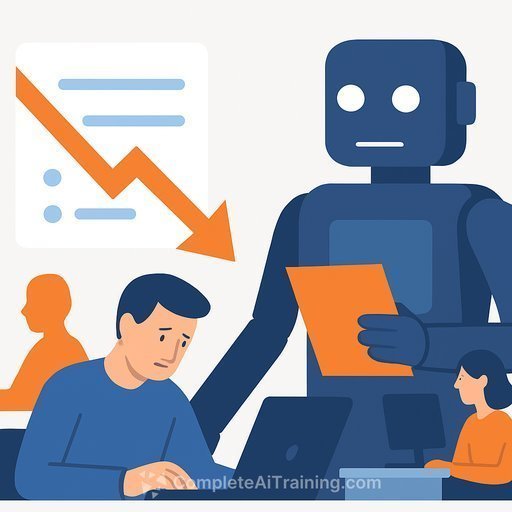
Her story mirrors a wider trend. Workers over 50, especially those outside tech-heavy roles, were hit hardest as AI tools took on fast, repeatable tasks once done by people. According to All About AI, around 14 million jobs have already been lost worldwide to AI. Projections suggest as many as 92 million more could disappear within five years.
What changed for employers
The math got simple. Enterprise AI subscriptions often cost less than a few months of one salary. For many managers, the decision writes itself: automate the repetitive tasks, keep fewer people for judgment, review, and client work.
That doesn't mean the work vanished. It moved. Drafting, summarizing, formatting, Translation, bookkeeping, and intake tasks shifted to tools, while final review stayed human. Speed and volume went up. Headcount went down.
Who's most exposed
- Customer service and call centers: intelligent chat and voice systems now handle most inquiries.
- Data and admin support: data entry, scheduling, file classification, and basic secretarial tasks are automating fast.
- Retail and supply chain: self-checkout, smart warehouses, and inventory systems reduce frontline roles.
- Manufacturing: robots and automated control systems continue to replace manual work.
- Accounting and finance: routine bookkeeping and reconciliations move to software.
- Content and media: drafting, summarizing, and rewriting are now AI-assisted at scale.
Voices from the field
Editors and communications leaders say the same thing: AI handles speed and volume, while review, editing, and analysis stay human to ensure quality. The jobs didn't "go away"; they changed. Those who can write, analyze, and build with AI-without losing accuracy-stand out.
Strategic advisors add a second point: new roles are opening in Data Analysis, cybersecurity, smart systems management, and digital solutions engineering. Old tasks fade; new tasks appear. That shift rewards people who reskill early.
A brief history check
Technology triggers anxiety every time it jumps. In 1959, General Motors unveiled the Unimate robot and warnings followed. The pattern is familiar: roles end, different roles emerge, and the mix of skills changes. Current projections suggest 92 million jobs could vanish, while more than 170 million new ones could be created. The risk is not change itself-it's being unprepared for it.
The hard truth for HR
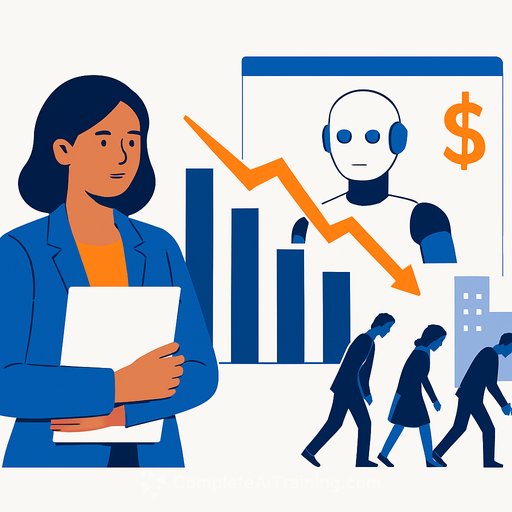
Many companies are cutting staff to reduce costs tied to salaries, insurance, and end-of-service benefits. A World Economic Forum report says 41 percent of companies plan workforce reductions by 2030 due to AI and automation. At the same time, AI is shortening content production time by 25-35 percent in some teams and improving accuracy. Productivity wins are real; the people costs-and the public trust costs-are real too.
Key players (useful for vendor shortlists)
- OpenAI (language models; enterprise APIs; partnership with Microsoft)
- Google DeepMind (Gemini, scientific and research AI)
- Microsoft (Copilot across Windows and Office; Azure AI)
- NVIDIA (GPUs and systems that run modern AI workloads)
- Meta (open-source models like LLaMA)
- Amazon Web Services (cloud AI services)
- Anthropic (Claude models focused on reliability and safety)
Your 90-day HR plan
- Days 0-15: See the work - Map tasks, not titles. Identify repeatable, rules-based work suitable for automation. Flag high-judgment steps that must stay human.
- Days 15-30: Redesign roles - Split jobs into "AI-assisted" and "human-critical" components. Update job descriptions, pay bands, and career paths accordingly.
- Days 30-45: Skills inventory - Build a skills graph: writing, analysis, data literacy, prompt quality, QA, client review. Assess managers first, then teams.
- Days 45-60: Upskill at speed - Launch focused, job-relevant training for the top 3 tasks per role. Keep lessons short. Measure gain in output quality and time saved.
- Days 60-75: Pilot safely - Run controlled pilots with human-in-the-loop review. Set accuracy thresholds, escalation rules, and audit logs.
- Days 75-90: Decide and scale - Keep, reskill, redeploy, or separate. Tie decisions to objective metrics, not gut feel. Communicate early and respectfully.
Reskill vs. replace: a simple rule
- Reskill when the task is structured and teachable, and the person shows learning velocity.
- Redeploy when a person has strong client, editing, or systems judgment skills that AI can't match.
- Replace when the work is almost entirely repeatable and quality improves with automation and human QA.
Guardrails you can't skip
- Accuracy - Human review on all external content, financials, and anything safety-related.
- Security - Block sensitive data from public tools; set retention limits; require SOC 2 and clear data-use terms in contracts.
- Compliance - Document model choices, prompts, and approvals. Keep an audit trail.
- Bias - Test outputs across demographics and languages. Build feedback loops into performance reviews and product QA.
- Attribution - Disclose AI use where appropriate, especially for clients and public materials.
What to track (and report to leadership)
- Time to produce (before vs. after AI)
- Quality score (human ratings, client revisions)
- Error rate and rework time
- Cost per unit of work
- Reskilling completion and on-the-job usage
- Employee sentiment and turnover in AI-touched roles
Mid- and late-career workers: retain your experience
- Pair experienced editors, analysts, and managers with AI for review and decision work.
- Offer micro-training on data literacy, prompt quality, and QA. Make it job-specific.
- Set clear pathways into client review, compliance, safety, and change leadership roles.
Ethics and the social contract
UN leaders have raised concerns about risks tied to AI, including misuse and safety. The public is watching how companies treat people through this shift. If you automate work, match it with serious reskilling, transparent communication, and fair separation when needed. That includes extended healthcare where possible, outplacement support, and clear references for affected staff.
Budget math you can use
- AI subscriptions vs. salary: many tools cost less than a few months of one headcount.
- Productivity: content and PR teams report 25-35 percent time savings with quality gains when review stays human.
- Redeployment: moving one high-judgment employee to review across multiple AI-assisted workflows often beats a full replacement cycle.
Case study: what could have helped Hamida
- Transparent notice that AI pilots were underway, with a timeline and training plan.
- A clear path into editorial review, client QA, or terminology management.
- Short, paid upskilling with real projects, not just courses. Weekly coaching. Defined quality targets.
- If separation was unavoidable: fair severance, strong references, and outplacement support.
Due diligence for vendors
- Data handling: training on your data or not; retention windows; deletion on request.
- Security: SOC 2, ISO 27001, SSO, role-based access, and regional hosting options.
- Quality: evaluation methods, benchmark results, domain adaptation, and guardrails for hallucinations.
- Control: audit logs, admin controls, and human-approval steps.
- Costs: per-seat vs. usage, and total cost vs. saving per workflow.
Useful references
- World Economic Forum reports on jobs and skills
- Reuters coverage of AI market growth and company revenues
Practical training paths
If you need structured options by role, see curated learning by job category: Complete AI Training - Courses by Job. Focus on data literacy, prompt quality, error checking, and workflow design.
Threat or opportunity?
Both. AI cuts routine tasks. It also creates new ones in analysis, safety, and systems management. Translation and writing can be 60 percent faster, but errors still happen-human oversight stays essential.
Hamida's story is a warning. The rules changed fast. HR's job is to make the shift fair, evidence-based, and skill-first-so fewer people are blindsided, and more people move into the work that only humans can do well.
Your membership also unlocks: