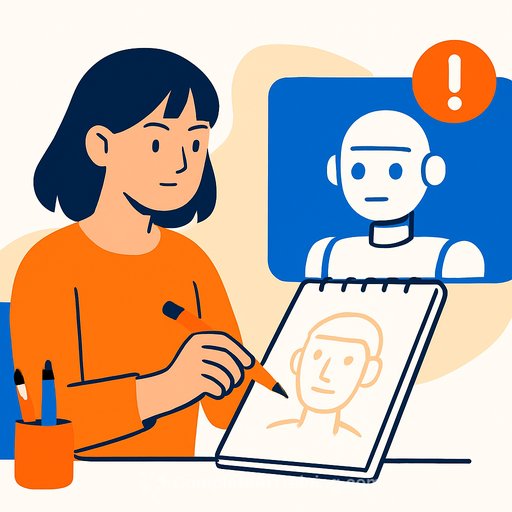
Why one game studio now asks artists to draw live - and what HR can take from it
A mid-sized Japanese video game developer has introduced a mandatory live drawing test to stop candidates from passing off AI-generated portfolios as their own. The move came after a few hires dazzled on paper, then struggled in production because the work they showcased was made by generative tools.
In an interview with a Japanese outlet, the company's lead graphic designer - identified as "Mr B" - said the new test adds time and HR workload, but prevents expensive mis-hires. He also noted other studios are adopting similar checks.
Here's the tension: he uses AI for speed on routine tasks, yet insists truly appealing characters still require human skill. Meanwhile, some executives are pushing for more AI to cut costs, putting pressure on hiring standards.
Key takeaway for HR
Work-sample tests have always been one of the clearest signals of real ability. In software, that looks like live coding. In design-heavy roles, a live sketch can serve the same purpose: verify fundamentals, observe process, and confirm the candidate can deliver under realistic constraints.
What makes a good live work-sample test
- Job-relevant tasks only: match the test to core duties (e.g., character ideation, silhouette studies, iteration).
- Standardized prompts and tools: same brief, time limit, and tool access for all candidates.
- Clear scoring rubric: rate on fundamentals (proportion, perspective, composition), creativity, problem-solving, and communication.
- Structured debrief: ask candidates to explain choices, trade-offs, and how they'd refine the piece.
- Reasonable duration: 30-60 minutes is usually enough to see process without draining teams.
Implementation checklist
- Define the must-have skills for the role and turn them into 1-2 short tasks.
- Create a simple rubric with 4-6 criteria, each scored on a 1-5 scale. Train interviewers.
- Pilot with current team members to calibrate difficulty and timing.
- Decide on in-person vs. remote, tool access, and reference materials allowed.
- Set up candidate comms: what to expect, how long it takes, what you're evaluating.
- Log results consistently in your ATS and review adverse impact patterns quarterly.
Remote options without sacrificing integrity
- Use shared whiteboards or standard design tools with version history.
- Allow optional camera-on or light screen-sharing; collect explicit consent and provide a non-video alternative for accommodations.
- Randomize prompts to reduce leakage while keeping difficulty consistent.
- Keep the test short to reduce monitoring concerns and tech friction.
Legal, fairness, and candidate experience
- Validate job relatedness and keep records. Align with selection guidance like the Uniform Guidelines on Employee Selection Procedures.
- Offer reasonable accommodations and ensure accessibility.
- Avoid tasks that produce commercial value unless you pay candidates or clearly separate the test from production work.
- Be transparent about data retention, who sees the test output, and for how long.
- Mind algorithmic tools used in evaluation. Review for potential adverse impact and bias. See guidance from the EEOC on AI and selection procedures.
EEOC: Uniform Guidelines on Employee Selection Procedures
EEOC: Assessing Adverse Impact with AI
Balancing AI and human skill
AI can speed thumbnails, color variations, and background fills. It cannot replace eye for appeal, style consistency, or thoughtful iteration under constraints. Calibrate your assessment to check both: allow limited AI for low-level tasks if that reflects real work, but keep the core skill (draftsmanship, composition, ideation) human-driven.
Scorecard you can reuse tomorrow
- Technique (anatomy/proportion/perspective): 1-5
- Composition/readability: 1-5
- Creativity and IP-safe originality: 1-5
- Process and iteration quality: 1-5
- Communication and rationale: 1-5
- Culture and collaboration signals: 1-5
Make pass/fail cutoffs explicit. Combine the test with a structured interview and portfolio review for a full picture.
Metrics to track
- Offer-to-productivity time (days to first shippable asset).
- Hiring manager satisfaction after 60-90 days.
- New-hire rework rate and QA defects tied to fundamentals.
- Diversity and adverse impact across test stages.
- Time-to-fill and candidate drop-off at the test step.
Cost vs. risk
Yes, a live test adds an hour to your process. It can save months of underperformance and thousands in backfills. If bandwidth is tight, batch assessments once a week, or run a short screen (15 minutes) before the full exercise.
For HR teams upskilling on AI
If you're formalizing policies around AI in hiring and skills testing, invest in team education so your recruiters and hiring managers speak the same language about tools, risks, and workflows. A curated catalog of AI learning paths by role can speed that up.
Explore AI learning paths by job
Bottom line
Live work-sample tests are a practical antidote to glossy AI-driven portfolios. Keep them job-relevant, fair, and standardized. You'll protect hiring quality without shutting the door on useful AI - and that's the balance the best teams are aiming for right now.
Your membership also unlocks: