
AI news ·
Qwen3-27B on a used RTX 3090 shifts the cost arithmetic for founders choosing between local and cloud AI
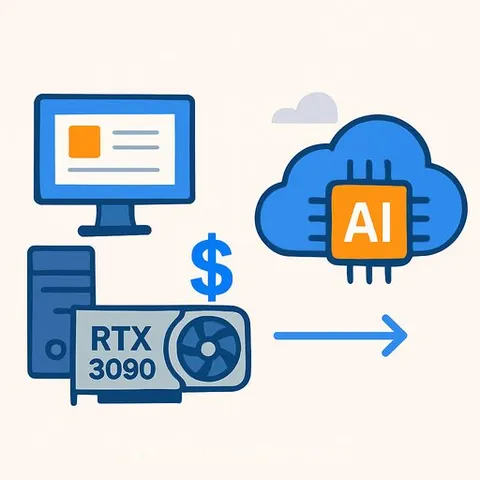
Running Qwen3-27B locally on a used RTX 3090 ($400-$700) can cut monthly AI costs from $5,000-$20,000 in API fees to near zero. The break-even math now favors local deployment for many startups sooner than expected.
Local AI costs just became harder to ignore for startups
A widely circulated benchmark claiming Qwen3-27B achieved 95.7% accuracy on SimpleQA while running on a single consumer GPU has triggered serious conversations about infrastructure spending. The benchmark itself deserves scrutiny. The cost arithmetic underneath it does not.
A startup running meaningful query volume through a frontier API at current GPT-4o pricing spends $5,000 to $20,000 per month depending on usage patterns. A one-time hardware purchase of a used RTX 3090 ($400-$700) running Qwen3-27B locally has marginal costs approaching zero after electricity. That gap exists regardless of whether the benchmark score holds up under independent verification.
What the benchmark actually measures
The LocalLLaMA post describes a quantized version of Qwen3-27B paired with an agentic search loop that retrieves web results before generating answers. The 95.7% SimpleQA score reflects system performance, not just model capability.
SimpleQA tests factual accuracy on questions with known answers that are well-indexed on the public web. An agentic pipeline retrieves search results and feeds them as context to the model. This tests retrieval and presentation accuracy more than the model's parametric knowledge. Swap in a lower-quality search provider or test on questions not findable through standard web search, and the score changes without the model itself changing.
Founders evaluating local AI need to know which capabilities transfer to their context. If your use case retrieves answers from public web content on factual questions, this setup is directly relevant. If you synthesize proprietary documents or reason over conflicting sources, the SimpleQA result does not measure the capability you need. Qwen3-27B has earned positive independent assessments on reasoning tasks from evaluators testing it without retrieval, providing separate confidence in the model's underlying capability.
The break-even calculation that matters
Early-stage founders at seed and Series A stage making infrastructure decisions face a shifted cost analysis. The conventional wisdom-use cloud APIs early, defer local infrastructure until scale justifies it-remains sound for teams without ML experience and for use cases where latency and support matter more than marginal cost.
It is less sound for teams with technical depth, data confidentiality requirements, or usage patterns where cloud API costs are already a visible expense at current scale. Qwen3's open-weight licensing eliminates per-token fees, terms-of-service restrictions, and vendor dependency. Tooling like Ollama and llama.cpp has matured enough that setup complexity is a one-time cost rather than ongoing operational burden for technically capable teams.
The practical step: estimate your expected monthly query volume 18 months from now, apply current API pricing, and compare it against amortized hardware costs plus operational maintenance time. For many startups planning AI-intensive features, that break-even point sits closer than assumed.
Whether local deployment is the right choice depends on factors beyond cost-latency requirements, reliability needs, regulatory constraints. But knowing where the break-even sits is the necessary starting point for making the decision with appropriate seriousness.
Operations teams making infrastructure decisions should calculate this explicitly rather than assuming cloud by default. The math has shifted in a direction that more founders need to see.