
AI news ·
Research identifies translators, writers, and historians among jobs most exposed to AI
Translators, writers, and consultants top the list of jobs most exposed to AI, per Microsoft's analysis of 200,000 Copilot chats. One in four workers is exposed to AI, ILO says.
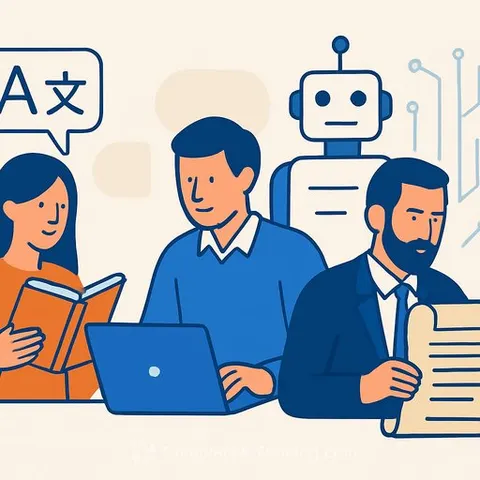
The first big wave of AI disruption is hitting information work, and the jobs most exposed are not the ones many expected. Microsoft Research analyzed roughly 200,000 anonymized Bing Copilot conversations and found that the most common work activities people used AI for involved gathering information and writing. The technology itself was often providing information, writing, teaching, and advising. Among the occupations ranked highest for AI applicability: translators, historians, writers, consultants, and call center agents.
The study, published on arXiv, ranked 10 occupations under the most immediate pressure from generative AI. Alongside writers and authors, the list includes interpreters and translators, historians, service sales representatives, computer numerically controlled tool programmers, broadcast announcers and radio DJs, customer service representatives, telemarketers, political scientists, and mathematicians. The common thread is language, information, explanation, persuasion, or structured problem solving-exactly the kind of work large language models can now take on in seconds.
The 10 jobs facing pressure
That list is not a prediction of mass layoffs, but it does highlight where AI can already handle parts of a workflow. For writers, that means drafting text, summarizing research, and generating ideas. Other jobs in the danger zone include journalists, editors, proofreaders, technical writers, and public relations specialists. Microsoft's research makes clear that the question is not just what AI can do, but what employers decide to hand over to it.
Many roles may simply be reshaped rather than eliminated. But when a machine starts handling the tasks that once defined a profession, the shift can feel sudden and personal. A marketing analyst who spent hours turning notes into summaries, or a financial advisor preparing client materials, now faces tools that complete the work in moments.
Degrees are not armor
A university degree offers no automatic protection. Microsoft found broad AI applicability across education levels, especially in jobs built around digital tools and information-heavy tasks. White-collar roles centered on language and data analysis could see significant transformation by 2030. The reason is simple: generative AI excels at absorbing scattered information and producing clean, structured output-the very activity that fills many professionals' days.
Still, AI applicability is not the same as job replacement. Employment and wage effects depend on business choices, not just technical capability. The same research warns that outcomes will vary widely based on how companies implement the technology.
The work less exposed for now
Physical, hands-on jobs look safer from generative AI in the near term. Construction, farming, health care support, building cleaning, transportation, and maintenance roles scored lowest in AI applicability. A chatbot can explain how to fix a roof, but it cannot climb the ladder. The human touch, spatial awareness, and real-world judgment required in many care and craft roles remain out of reach.
That does not mean those professions are immune forever. Robotics and AI-controlled machines could bring a second wave of disruption to warehouses, roads, and hospitals. For now, generative AI is far more comfortable inside a laptop than on a muddy job site.
A global shift is already underway
McKinsey Global Institute estimates that by 2030, between 75 million and 375 million workers may need to switch occupational categories-roughly 3% to 14% of the global workforce. The International Labour Organization reached a similar conclusion in 2025, finding that one in four workers is in an occupation with some exposure to generative AI, while 3.3% of global employment falls into the highest exposure category.
Clerical occupations remain the most exposed. The ILO says job transformation is the more likely outcome because most occupations still include tasks that require human input. The impact also varies by country. High-income countries show a 5.5% employment exposure to automation, compared with 0.4% in low-income countries. Infrastructure, skills, and adoption speed all shape how fast the technology bites.
Why this matters for writers
For writers, the safest move is not panic-it is attention. If a large part of your work involves turning information into words, answers, plans, summaries, lessons, scripts, or recommendations, AI is already at your desk. The valuable writer of 2030 will be the person who can use AI well, check its errors, understand the client, protect sensitive information, and make judgment calls a model cannot responsibly make on its own.
That means developing skills that go beyond generating text. Resources like AI for Writers Courses can help professionals learn to integrate these tools into their workflow without losing the human judgment that defines good writing. The goal is not to compete with the machine on speed, but to stay ahead on clarity, accuracy, and the kind of insight only a person can bring.