
AI news ·
Researchers predict cancer labs in 2036 will use diverse patient data and AI to tailor treatments
UK cancer researchers predict the "generic patient" will disappear by 2036, replaced by patient-specific models, AI as an experimental co-pilot, and leadership targets of 18% minoritised ethnic and 51% female PIs.
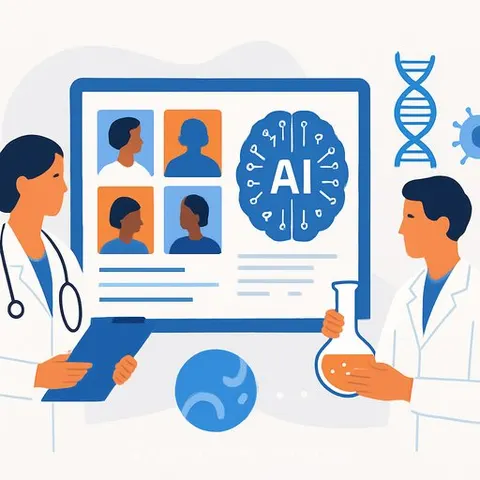
Two researchers from major UK cancer institutes have set out their predictions for how biomedical research will change by 2036. Their forecasts cover a shift toward patient-specific models, the integration of engineering and AI into discovery, and a push to make research leadership reflect the population it serves.
Ed Roberts, who runs the Immune Priming in Cancer lab at the Cancer Research UK Scotland Institute, and Albane Imbert, Head of the Making Lab at the Francis Crick Institute, described a research environment where the "generic patient" disappears and computational tools become active partners in experimental design.
The end of the generic patient
Roberts predicts that by 2036, diversity will be treated not as a variable to control but as the primary data point. "We are moving from a world where we ask if a drug works, to a world where we ask exactly whom it works for," he said, pointing to the interplay between genetics, socio-economic experience, and ethnicity.
This shift will change how animal models are used. Roberts said the lab of 2036 will pair high-dimensional patient datasets with next-generation genetically engineered mouse models so that mice used in research represent individual patient subsets. The data generated will feed into digital twin models and complement organoid and organ-on-chip studies.
"The lab of 2036 isn't just 'using fewer mice', it's making a more rounded research environment to increase the human-fidelity of our models," Roberts said.
He also argued that this approach is a clinical necessity, not only an ethical one. By parsing the impacts of different patient characteristics, researchers can build more inclusive experimental ecosystems and begin to close persistent disparities in cancer outcomes for minoritised groups.
Who asks the questions
Roberts tied the quality of research questions to who sits in leadership roles. He said the 2036 lab will be judged by the diversity of its Principal Investigators, not its PhD cohorts. Success, in his view, looks like a leadership tier that reflects the UK population: 18% from minoritised ethnic backgrounds, 51% female, and roughly 40% from working-class backgrounds.
Patients and the public will also be more thoroughly embedded in shaping and judging research programmes. Roberts said this keeps people informed about how science works and maintains public support for research charities and government science spending at a time of stretched resources.
Technology as a collaborative instrument
Imbert described a structural shift toward stronger collaboration between labs and technology platforms, with shared projects, expertise, and resources at national and international scale. She said the boundary between computational prediction and experimental validation is already blurring.
From a technology perspective, she identified spatial biology and multi-omics as the most transformative near-term approaches, allowing researchers to understand what cells are doing and where within intact tissue architecture. In vitro platforms - organoids, microphysiological systems, and organ-on-chip - will also play a growing role, particularly for cancer, because they can incorporate tumour microenvironment, immune, vascular, and neural components.
Imbert noted that US regulatory changes, including the FDA Modernization Acts 2.0 and 3.0, have formally legitimised submissions based on new approach methodologies. Producing validated, human-relevant preclinical data from these platforms should become a baseline expectation, she said.
Scalability remains a bottleneck. "Data generation remains a genuine bottleneck for organ-on-chip development," Imbert said. Meeting automation and high-throughput requirements will be essential to produce data compatible with downstream analysis and capable of generating insight into cancer mechanisms.
AI as an experimental co-pilot
AI sits across all of this work. Imbert described AI-driven hypothesis generation, foundation models trained on large-scale spatial and single-cell datasets, and iterative loops between prediction and validation as becoming central to research. "The boundary between computational prediction and experimental validation is already blurring," she said, "this is an opportunity to shape these tools into one of the most powerful collaborative instruments cancer research - and science more broadly - will ever have."
For researchers looking to build skills in this area, an AI Learning Path for Research Scientists covers applications of AI in scientific workflows. The broader AI for Science & Research topic area also tracks developments relevant to this shift.
Imbert said building integrated infrastructure - spanning in vitro platforms, spatial omics, computational modelling, and regulatory validation - is a defining challenge for the next decade. Meeting it will broaden discovery and shorten the path from bench to bedside, she said.
Why this matters for science and research professionals
The predictions point to concrete changes in how research teams will be structured and funded. If patient-specific in vitro platforms become a regulatory baseline, researchers will need working knowledge of organ-on-chip systems, automation, and computational modelling. If leadership diversity becomes a metric for judging labs, hiring and promotion practices will need to change well before 2036. The researchers describe a field where technical and biological expertise merge - and where professionals who can work across those boundaries will be positioned to lead.