
AI news ·
Rhode Island DHS proposes AI tools to handle calls and cut benefit errors, drawing union skepticism
Rhode Island DHS wants to use AI to handle routine calls, answer common questions, and prompt staff during eligibility interviews. Union leaders and lawmakers are pushing back, citing job concerns and the state's poor track record with tech projects.
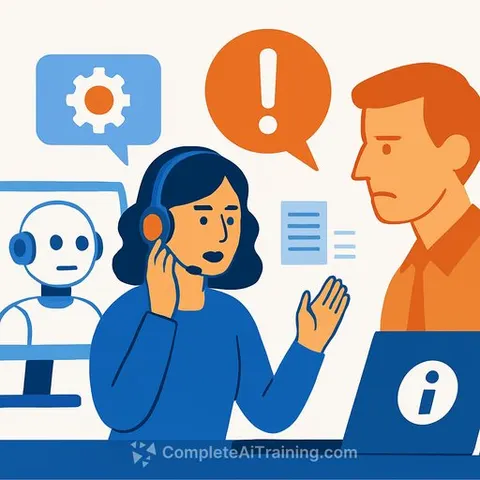
Rhode Island DHS Proposes AI Tools to Speed Up Benefit Applications and Reduce Errors
Rhode Island's Department of Human Services wants to use artificial intelligence to answer routine questions, route phone calls more efficiently, and help staff determine who qualifies for benefits like Medicaid and SNAP. The agency says the tools would reduce wait times and cut payment errors without eliminating jobs.
DHS Director Kimberly Merolla-Brito said the technology serves as "tools to support the workforce, not to reduce the workforce." But union leaders and state lawmakers are questioning whether the approach will actually improve customer service or if it introduces new problems.
How DHS Plans to Use AI
The agency wants to upgrade its current automated call system with natural language processing to better understand what callers need. Instead of routing calls based on simple keywords, the new system would recognize intent - so a caller asking about appointment dates would reach the right department faster.
DHS also plans to deploy a chatbot for frequently asked questions: office locations, dropbox addresses, appointment dates, and whether submitted documents arrived. The chatbot would not handle case-specific questions like why an application was denied.
A second tool would help staff during interviews. Real-time prompts would remind workers to collect all necessary documentation and verify applicants meet eligibility requirements.
Internally, DHS wants an AI policy engine that workers can query for current federal poverty limits, SNAP rules, and other guidelines. The tool would not access applicant data or make eligibility decisions on its own.
DHS would also use AI to record and analyze customer service calls, providing feedback to staff and identifying training needs.
Staff and Union Concerns
Matthew Gunnip, president of Service Employees International Union Local 580, questioned the premise: "At what point are we taking the human out of Human Services?"
Noah Chevalier, a DHS eligibility technician and union steward, said he remains skeptical that AI actually reduces wait times. "Most of the time we get a robot that doesn't really understand what we want to do," he said of his own experience calling customer service lines.
Chevalier also worried that relying on AI prompts could weaken critical thinking. Workers might stop researching original policy documents and instead trust summarized guidance that may be incomplete or misleading.
Sen. Samuel Bell, D-Providence, called the proposal to have AI monitor and analyze employee calls "Orwellian." He said constant surveillance - human or AI - creates an oppressive work environment and that the state's poor track record with technology projects compounds the risk.
Rhode Island's botched rollout of a new financial system last year left many skeptical of large IT initiatives. Bell said the state has "an abysmal record" implementing complex systems and questioned whether AI would simply introduce new errors.
Funding and Oversight Questions
Union representatives said they have a good relationship with Merolla-Brito but questioned whether AI is the right priority. Chevalier noted that DHS received funding specifically earmarked for AI, which may have influenced the decision.
"It's a buzzword," he said. "It's a thing."
Gunnip said agency heads come and go, so guardrails are necessary. "We're not talking about widgets here. We're talking about humans."
Merolla-Brito said any technology project must pass review by the Department of Administration and the state's AI Task Force, meeting standards for privacy, security, and accountability. She emphasized the system would use non-generative AI designed to assist staff, not make eligibility decisions.
"Technology moves fast," she said. "The state doesn't always have the most current tools that are out there. But we shouldn't be so far behind."
For customer support professionals, this case illustrates how AI for Customer Support raises practical questions about implementation, worker experience, and whether automation actually delivers promised benefits. Understanding these trade-offs matters as more organizations consider similar tools.