
AI news ·
Salesforce crowdsources its AI roadmap through weekly customer feedback sessions
Salesforce meets with customers weekly to shape its AI products, replacing traditional quarterly planning with rapid release cycles. The company's 18,000-customer base gives it a constant stream of real-world problems to solve.
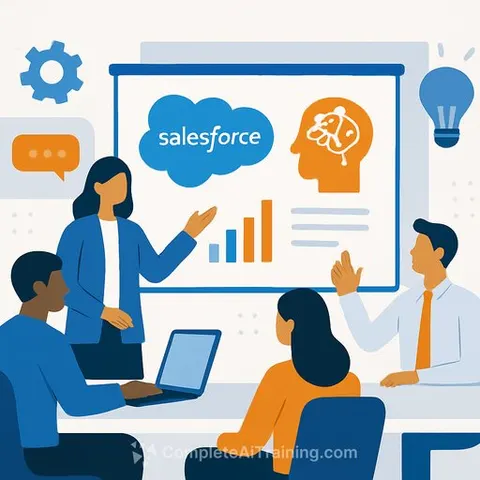
Salesforce Builds AI Products by Meeting Customers Weekly
Salesforce is crowdsourcing its AI roadmap in real time, meeting with some of its 18,000 customers as often as once a week to guide product development. The approach lets the software company move faster than competitors while the technology itself remains uncertain.
Most large enterprises work with customers for feedback. Salesforce's scale makes the practice notable-the company releases new products and fixes at a pace that requires constant iteration rather than quarterly planning cycles.
From LLMs to Agent Systems
When large language models arrived, enterprises wanted to adopt them but lacked the infrastructure to use them effectively. Salesforce identified this gap and launched Agentforce, its AI agent management platform, in late 2024.
The company then developed a bottom-up strategy built around themes-agent context, observability, and deterministic controls-rather than fixed product timelines. Direct feedback from rotating customer groups informs which problems can be solved at the language model layer and which require building components around the models themselves.
Jayesh Govindarajan, executive vice president at Salesforce AI, said the company classifies real-world problems customers encounter, then determines what the LLM can handle versus what needs additional infrastructure. "For things that we cannot solve at the LLM layer, we need to build that sort of agentic operating system components around the LLMs," he said.
Weekly Feedback Cycles Replace Quarterly Planning
The traditional product development cycle-six months of work followed by three to six months of feedback-no longer works in this environment. Salesforce pushes code weekly and uses testing gates to gather early feedback before broad releases.
Muralidhar Krishnaprasad, president and chief technology officer of Salesforce engineering, said the company had to restructure how it operates. "We can't wait three months or six months to get feedback, and then go figure out another six months of work. We are literally reacting to it, week by week, month by month."
Customers Shape Specific Features
Engine, a travel management platform, meets with Salesforce's operations team weekly. Founder and CEO Elia Wallen said the partnership gives Engine early access to tools and a direct line to influence product decisions.
When Wallen tested an AI voice agent booking a hotel in Chicago, he found the interaction felt unnatural and told Salesforce. The company changed the agent, and A/B tests showed improved results. "If somebody is willing to actually help curate and build products that we need, they can help us better and really understand our problem," Wallen said.
PenFed, a federal credit union, built an IT service management workflow using Salesforce's existing tools and agents. When Salesforce saw the success, it rolled the workflow into the broader platform for other enterprises to use.
Internal Use Drives Development
Salesforce employees are the company's biggest users of its AI tools. When ChatGPT launched, Salesforce reorganized teams and resources to create a dedicated AI group-a strategy the company has used successfully during previous technology shifts.
Krishnaprasad noted that agents weren't even part of industry terminology 18 months ago. "As the technology changes, we never know what's going to come out a month from now. We will adapt to it."
The Risk in Customer-Led Development
This approach assumes customers know what they need-a bet many enterprises haven't yet validated. Many companies are still determining what role AI should play in their business and haven't found measurable value from the technology.
Early access to beta features also doesn't guarantee long-term adoption or future contract renewals. Salesforce is betting that the problems its most engaged customers face today represent problems other enterprises will encounter tomorrow.
For product development teams, the model shows how to operate when the underlying technology shifts faster than traditional planning cycles. It requires flatter decision-making, frequent releases, and the ability to reverse course quickly.