
AI news ·
Salesforce turns AI efficiency gains into revenue by pursuing leads humans never had time to chase
Salesforce cut $100M in annual costs and influenced 3,200+ sales deals using AI agents. The company first automated support, then turned AI loose on thousands of ignored leads that human sales teams never had time to pursue.
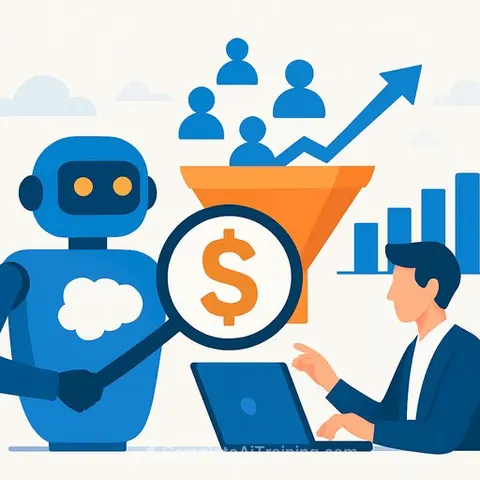
Salesforce Shows How AI Moves From Cost-Cutting to Revenue Growth
Salesforce has achieved $100 million in annualized cost savings and influenced over 3,200 sales opportunities using AI agents. The company's experience offers a rare example of how enterprises can measure AI's impact on both efficiency and growth-something few organizations can claim.
Most companies spent 2025 using AI to reduce operational costs. They automated support tickets, streamlined internal workflows, and cut labor expenses. The calculus was simple: improve margins without adding headcount.
The pressure from boards and investors has shifted. The question now is where AI shows up in revenue, not just cost savings. Salesforce's two-phase approach shows what that transition looks like in practice.
Phase One: Breaking the Capacity Constraint
For decades, customer support operated under one hard limit: the number of people available to answer questions. Salesforce began dismantling that constraint in 2025 by deploying AI agents across its help portal.
The agents handled routine inquiries, maintained conversation context, and escalated complex issues to humans. The goal was straightforward: answer common questions without human intervention.
In just over a year, the results appeared in measurable terms:
- Support caseload dropped 8% year-over-year despite customer growth-more than 170,000 fewer cases handled by humans.
- Salesforce expanded live chat support from one language to seven, with plans to reach 14 by year-end. The company had never achieved this in 27 years.
- Human teams shifted from reactive support to proactive work, helping customers prevent problems instead of just solving them.
- The company reduced support costs while maintaining customer satisfaction-a combination rarely achieved in service operations.
"When our capacity is infinite, we can be proactive and build more incredible customer experiences," said Jim Roth, President of Customer Success at Salesforce. "We can treat every customer like they're our most important customer."
This phase proved AI could handle operational work at scale. Revenue remained largely unchanged. The impact was efficiency, not growth.
Phase Two: Mining Untouched Leads
By 2026, executives asked a different question: Could AI agents also create revenue?
Salesforce tested this with what employees called "sawdust"-inbound leads that never received follow-up. The company generates massive interest through digital channels: content downloads, webinar registrations, information requests. Each interaction creates a lead.
Sales teams focus on high-scoring prospects. Marketing prioritizes defined segments. Thousands of lower-priority leads sit untouched in the system. They weren't worthless. They were simply uneconomical for humans to pursue.
Salesforce deployed an AI agent to engage these dormant leads autonomously. The agent sent personalized outreach, asked qualifying questions, identified buying signals, and routed promising prospects to human teams.
The results showed up in revenue metrics:
- The agent worked on hundreds of thousands of previously untouched leads.
- It influenced more than 3,200 sales opportunities.
- It created closed business from prospects that would otherwise have remained invisible.
This wasn't AI making an existing sales team faster. This was AI creating revenue from demand the company had written off.
What Other Companies Are Testing
Other organizations are now exploring similar uses of AI agents:
- Regular contact with existing customers who rarely engage.
- Identifying small upsell or cross-sell opportunities humans might overlook.
- Spotting early signals that a customer is ready to buy again.
- Reconnecting with past prospects who went quiet months or years ago.
In each case, AI agents pursue customers and opportunities that humans simply don't have bandwidth to chase.
The Shift in What Success Means
In 2025, success meant proving AI could reduce cost and improve efficiency. In 2026, success increasingly means proving AI can help grow the business.
Salesforce's experience shows how those phases connect. The same capability that transformed customer service-removing capacity constraints and enabling proactive work-is now being used to pursue revenue opportunities.
For a small group of companies, that shift is already producing measurable impact. For many others, it remains the next horizon. If you manage customer support operations, understanding how AI agents move beyond cost reduction to revenue generation will shape your role and your organization's AI strategy. Learn more about AI for Customer Support and AI for Sales to see how these tools are being applied across different functions.