AI tools boost smart job matching in China: practical lessons for HR
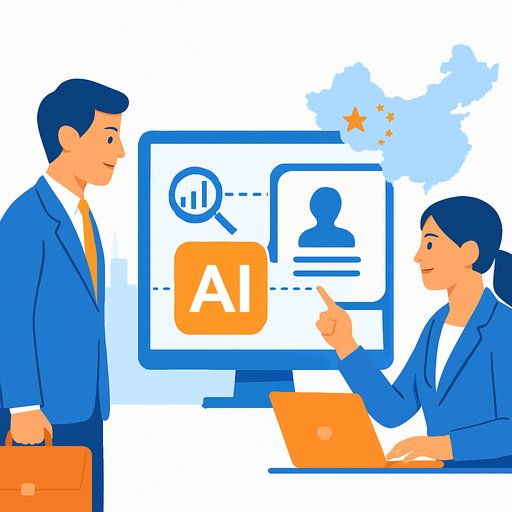
In an interview booth, postgraduate student Zhang Hui practiced with an AI interviewer, got instant feedback, and walked away with a clearer plan. She scanned a QR code, uploaded her resume, and received five job matches in under 30 seconds-plus an explanation for each fit. She then booked an in-person interview with one of the suggested employers. That's a clean, end-to-end path from practice to placement.
This isn't a demo. It's the direction HR is moving. At a national HR services conference in Wuhan, vendors showed how AI now supports resume screening, policy interpretation, and resume optimization-within a single workflow. The pace is set by outcomes, not features.
What the tech is actually doing
Wang Wei, CTO of Guangdong Chitone Human Resource Chain Co., Ltd., said one of their AI tools screens a resume in three to four seconds, lifting recruitment efficiency by at least 80 percent. His stance is simple: don't replace people-upgrade every step people touch. That means faster screening, clearer feedback loops, and better job-candidate matching.
Beyond campus recruitment, community-level "employment-at-your-doorstep" stations in Nanjing let residents browse local jobs, learn policies, and submit resumes from their phones. Interest is high: in half a day, more than 200 enterprises and HR teams made inquiries. Distribution matters-bring jobs closer to where people live.
Policy tailwinds and proven use cases
China's next five-year plan puts AI to work across industry, public well-being, and social governance, with HR as a key application area. According to Lei Chengpu from the Ministry of Human Resources and Social Security, mainstream use cases already include real-time matching, AI interview systems, labor-market monitoring, and personalized training recommendations.
Scale is the point: from 2021 to 2025, the HR services industry delivered over 300 million employment services annually and supported more than 50 million companies in hiring. Online platforms now publish hundreds of millions of job posts each year, with AI matching becoming a primary channel.
Mind the gaps: data and adoption
The big blockers: fragmented data standards, weak cross-platform sharing, and adoption hurdles for small and mid-sized firms. If your team can't align on a shared skills language and data flow, your AI will stall. Start with a clear skills and jobs taxonomy and consistent identifiers across tools.
For governance, anchor on fairness, transparency, and accountability. If you need a simple reference, review the OECD AI Principles and adapt them to hiring and internal mobility.
A 90-day pilot plan for HR leaders
- Week 1-2: Pick two role families with enough historical data. Define success (quality-of-hire, time-to-fill, candidate satisfaction).
- Week 3-4: Clean 12-24 months of labeled outcomes (hire/no-hire, performance, retention at 6-12 months). Standardize job and skill names.
- Week 5-6: Deploy AI screening + AI interview practice for candidates. Keep recruiters in the loop for overrides and notes.
- Week 7-8: Run A/B tests against current process. Track speed, pass-through rates by demographic group, interview-to-offer ratio, and new-hire ramp.
- Week 9-10: Audit for bias, false positives/negatives, and explainability. Tighten prompts, rules, and rejection reasons.
- Week 11-12: Publish a one-page policy, train hiring managers, and plan phase two (more roles, internal mobility).
What to build into your stack
- Data foundation: a shared skills and jobs taxonomy. If you need a public reference point, review ESCO.
- Connectors: bi-directional sync between ATS, HRIS, assessments, and learning platforms.
- AI interviewer + feedback: practice for candidates and structured insights for recruiters.
- Matching engine: explains why a job fits a person (and vice versa). No black boxes.
- Market analytics: real-time supply, demand, and pay signals to guide requisitions and training.
- Controls: bias checks, consent tracking, audit logs, and clear candidate-facing disclosures.
Metrics that matter
- Speed: time-to-eligible-candidate, time-to-first-interview, time-to-offer.
- Quality: interview-to-offer rate, 90-day retention, first-90-day productivity.
- Fairness: pass-through rates by group, adverse impact ratio, appeal/override rate.
- Experience: candidate NPS, recruiter satisfaction, hiring manager satisfaction.
- Cost: recruiter hours per hire, sourcing cost per hire.
Playbook for SMEs
- Start narrow: one role, one region, one channel.
- Use tools that explain matches and allow quick human overrides.
- Adopt simple data standards first: consistent job titles, skill tags, and rejection reasons.
- Template the process: JD intake, screening rules, interview rubrics, feedback times.
Candidate experience is a feature, not a perk
Zhang Hui's experience shows why: practice reduces stress, explanations increase trust, and fast scheduling converts interest into action. If your process can't give quick feedback and a reason for fit, candidates will opt out. Build for speed and clarity.
Action checklist for your next leadership meeting
- Pick two roles for a 90-day AI pilot with clear metrics.
- Agree on a shared skills lexicon across HR, recruiting, and L&D.
- Set policy on disclosures, data retention, and audit frequency.
- Train recruiters on prompts, overrides, and structured feedback.
- Publish candidate-facing guidance on how AI is used in your process.
Upskill your team
If your recruiters and HRBPs need practical training on AI use cases, workflows, and prompts, review these programs: AI courses by job. Start with short formats, then move to certifications once the pilot proves value.
The direction is clear. As Zhang put it, "If AI can help me understand myself better and find the right job faster, that's already a big step forward." For HR, the win is the same: faster signal, better matches, and a process people actually trust.
Your membership also unlocks: