Employees are hiding AI use - here's how HR can respond
AI adoption has sprinted ahead of policy. Without clear guidance, people are turning to "secret" AI to get work done - and that's where small productivity wins become big data risks.
The fix isn't another memo. It's a simple, enforceable system: clear rules, approved tools, real training, and leadership that backs all three.
Why employees keep AI use quiet
Mixed messages drive secrecy. Leaders say "use AI to be efficient," then warn about compliance penalties without drawing the line between safe and unsafe use.
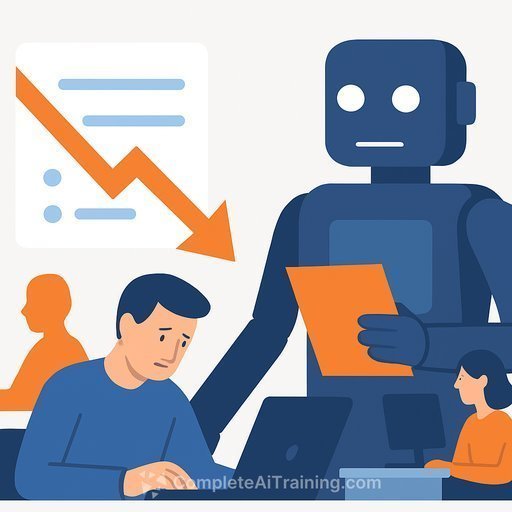
There's also fear. Many worry that visible AI use makes them look replaceable, so they use it quietly rather than ask for permission or clarity.
Surveys suggest the gap is real: a large share of office workers already use generative AI, and a significant portion do so secretly. That's less a behavior problem and more a leadership problem.
The risk isn't theoretical
Employees are using AI to draft internal reports, write performance feedback, and respond to clients. That means sensitive data is being pasted into unvetted tools that may store, reuse, or share inputs with third parties.
The result: compliance violations, confidentiality breaches, legal exposure, and reputational damage - all because guardrails weren't made explicit.
HR action plan: move AI use from hidden to healthy
- Set a clear stance. Publish a one-page position that says where AI helps, where it's restricted, and what's off-limits. Ambiguity is the enemy.
- Approve tools and use cases. Maintain an allowlist for work tasks and a blocklist for risky tools. Use enterprise-grade AI with admin controls for sensitive work.
- Define "never share" data. Ban entry of PII, health data, credentials, financials, client-identifiable info, and unreleased IP into public tools. Spell this out with examples.
- Make policy usable. Give a quick "Yes / No / Ask first" matrix employees can recall under pressure. Keep it short enough to read in two minutes.
- Upskill the workforce. Train people on safe prompts, data handling, bias checks, accuracy checks, and source verification - all tailored to their role. Consider structured learning paths for HR, legal, and people managers. If you need curated options, see our AI Learning Path for Training & Development Managers.
- Stand up governance. Form an AI working group (HR, Legal, Security, IT, Comms). Review policies quarterly and track incidents and adoption.
- Add technical controls. Enforce SSO, log usage, enable DLP, block risky browser extensions, control data export, and prefer tools with tenant isolation and region controls.
- Update contracts and consents. Clarify AI use with clients, candidates, and employees. Offer opt-outs where needed and document approvals.
- Vet vendors properly. Ask about data retention, training-data use, fine-tuning isolation, sub-processors, breach history, SOC 2/ISO 27001, and region-specific storage.
- Measure what matters. Track safe adoption, time saved, incident rates, and employee sentiment. Your goal: productivity up, shadow use down.
Policy starter: a simple "Yes / No / Ask" list
- Yes: Drafting internal outlines, rewriting non-sensitive text, summarizing public content, idea generation, first-pass job descriptions (with HR review), interview question banks.
- No: Entering PII, health data, financial records, credentials, client-identifiable info, legal strategy, security configs, or unreleased IP into public AI tools.
- Ask first: Client-facing content, performance feedback, policy documents, anything that feels sensitive or regulated.
Global consistency without the confusion
Different regions treat AI and data very differently. The EU sets strict rules on transparency and risk classifications, while other jurisdictions are looser. For cross-border teams, one standard beats many exceptions.
- Map all regions' AI and data rules.
- Adopt a single global standard that meets or exceeds the strictest jurisdiction you operate in.
- Keep local add-ons in an appendix; don't change the core playbook by country.
- Train by role and region; track attestations centrally.
- Review quarterly as laws evolve and tools change.
For reference on stricter regimes, see the EU AI Act.
Build trust and reduce replacement anxiety
People don't hide tools they feel safe using. Make it clear that AI augments performance, and that thoughtful, responsible use is recognized in performance reviews - not punished.
- Have leaders model responsible use in public forums.
- Celebrate safe wins and share templates that saved time.
- Offer office hours and an anonymous Q&A channel.
- Create a no-penalty disclosure window to move shadow users to approved tools.
- Use coaching first, then enforcement if patterns don't change.
90-day launch plan
- Days 1-30: Draft policy and "Yes/No/Ask" matrix, select approved tools, run legal and security review, set up logging and DLP.
- Days 31-60: Pilot with HR and 1-2 business units, run training, collect feedback, refine examples and FAQs.
- Days 61-90: Company-wide rollout, leadership briefings, publish intranet hub, require attestation, start monthly reporting on usage and incidents.
FAQs your team will ask (answer them upfront)
- Can I use my personal AI account? No. Use company-approved tools with SSO and logging.
- Can I paste client data? Only if the tool is approved for that data type and the client agreement allows it.
- What about accuracy? Treat AI output as a draft. Verify facts and sources before sharing.
- What happens if I mess up? Report it early. We fix issues fast and learn. Repeated or willful violations may lead to disciplinary action.
The bottom line
Secret AI use is a policy problem, not a people problem. Give employees a clear stance, safe tools, practical training, and supportive leadership - and secrecy fades while productivity rises.
If you need structured learning paths to speed this up, explore our curated Productivity resources.
Your membership also unlocks: