
AI news ·
Senior developer outlines 12 reasons he refuses to use generative AI for software work
A 30-year software developer says he'll risk his job before using generative AI tools, citing five concerns: addictive design, lost focus, warped thinking habits, harm to junior developers, and Big Tech dependency traps.
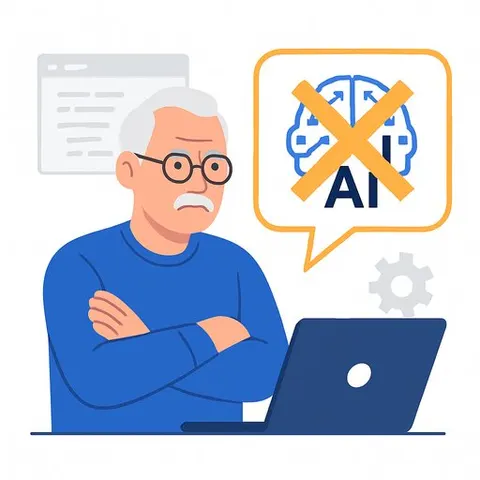
A 30-Year Developer Explains Why He Won't Use GenAI for Code
A senior software developer with three decades of experience has chosen to reject generative AI tools for his work, even at the risk of losing his job. His reasoning centers on five categories of risk: deceptive trust relationships, loss of creative focus, erosion of professional character, harm to junior developers, and dependence on Big Tech companies.
The decision runs counter to industry momentum. Many companies now expect developers to use tools like ChatGPT, Copilot, Claude, and Gemini. Resistance to this trend is unpopular.
The Trust Problem
GenAI chatbots are designed to form dependency relationships. Their non-deterministic output-sometimes right, sometimes wrong-triggers dopamine responses similar to social media and slot machines. Users experience surprise, anger, and fear in rapid cycles, creating addictive patterns.
The interface itself deceives. These systems mimic sentience, reasoning, and understanding through conversational style. They appear knowledgeable while operating on statistical pattern matching. The advice to treat them as "junior developers" or "interns" glosses over this fundamental deception and deepens reliance.
The Focus Problem
Expert developers enter a state of cognitive flow where code flows as naturally as language. This is where innovation happens. GenAI-powered workflows interrupt this state through constant mediation and context-switching, making multitasking the default mode.
Creativity requires deep expertise in a domain. When developers become curators of AI output rather than builders, they risk never developing the intimate knowledge that produces genuine innovation.
The Character Problem
Using GenAI changes how developers think and behave. The practice of "prompt engineering"-commanding AI agents like servants-shapes users toward impatience and tyrannical thinking patterns. Developers already write harsh directives to chatbots, reinforcing authoritarian habits.
As the saying goes: what we practice is who we become.
The Mentorship Problem
Senior developers who adopt GenAI risk harming those without expertise. Novices using these tools may never develop the skills to understand complex systems. They won't become senior developers themselves.
Team strength comes from debate, struggle, and shared problem-solving. Chatbots eliminate interpersonal friction and reduce the need to share knowledge. This erodes the tribal knowledge that makes teams competitive.
The Business Problem
Big Tech companies pursuing GenAI dominance have no profitable path at current prices. They're using low subscription costs as bait to create dependency. Once adoption is widespread, expect dramatic price increases.
These are not neutral tools. They're designed to increase corporate control over industries that depend on them. The companies behind them are fighting for survival, not serving developer interests.
The Alternative
The developer argues for betting on human intelligence, creativity, and discernment instead. No one knows how GenAI will ultimately affect the profession. But the incentives driving Big Tech adoption should concern anyone thinking beyond the next quarter.
For developers considering their own stance on these tools, understanding both the efficiency gains and the longer-term costs matters.
- Addictive workflow patterns exploit dopamine systems
- Deceptive design creates false trust relationships
- Interruptions prevent cognitive flow and creativity
- Character formation through commanding AI agents
- Novice developers may never develop expertise
- Team knowledge sharing gets replaced by AI output
- Pricing models depend on creating dependency
This critique doesn't claim GenAI tools lack capability. It argues that the costs to individual developers and teams may outweigh the short-term productivity gains-and that companies and professionals should weigh those costs explicitly rather than assume adoption is inevitable.