
AI news ·
SK Telecom partners with South Korea's defence ministry to build military AI models
SK Telecom will build military AI models under South Korea's Defence AX programme, adapting its A.X K1 and K2 large language models for defense use. The move comes as North Korea pushes its military branches to develop AI-based combat systems.
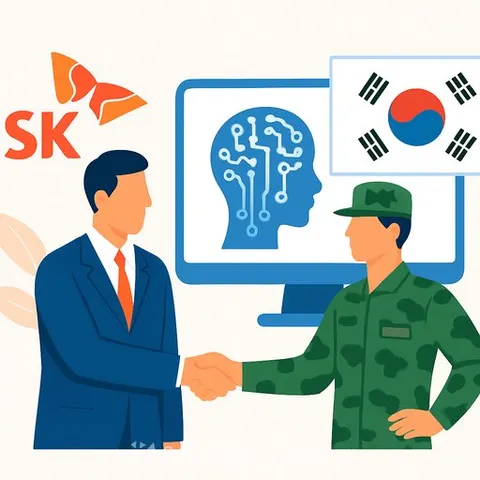
SK Telecom to develop military AI models under South Korean defense program
SK Telecom has partnered with South Korea's Ministry of National Defence and Ministry of Science and ICT to build artificial intelligence systems for military use. The Defence AI Transformation (AX) programme marks the operator's entry into defense-focused AI development and reflects Seoul's push to strengthen its domestic AI capabilities.
Under the agreement, SK Telecom will adapt its large language models for defense applications. The company plans to create lightweight versions of its A.X K1 model-Korea's first LLM with more than 519 billion parameters-and its A.X K2 model, currently in development. Both will be trained on defense-specific data.
SK Telecom brings GPU infrastructure and large language model development capabilities to the project. The Ministry of National Defence will provide access to GPUs through the government's National AI Project and supply training data. The arrangement suggests the military may eventually use Seoul's planned "AI highway," which aims to deploy 15,000 advanced GPUs by 2028.
The company declined to specify what its defense models will do. Military AI applications range widely-from operational planning and predictive maintenance to signal analysis and autonomous resupply vehicles, according to the UK Ministry of Defence's AI Playbook. Lethal autonomous weapons systems remain a separate concern.
South Korea's motivation appears tied to North Korea's military AI ambitions. Last summer, the Korean People's Army ordered all military branches, including nuclear forces, to develop plans for AI-based combat systems. Whether that represents genuine capability or propaganda, Seoul has reason to treat the threat seriously.
For IT and development professionals, this deal illustrates how AI infrastructure and model deployment are moving into critical infrastructure sectors. Understanding GPU management, model optimization, and large-scale training pipelines has become relevant to defense and government technology work.
Choi Dong-won, director general of the AI infrastructure policy bureau at MSIT, said the collaboration combines "the private sector's outstanding technological capabilities with the government's GPU infrastructure" to strengthen Korea's AI ecosystem.