
AI news ·
Small businesses turn to AI tools to offset persistent labor shortages
69% of small businesses struggled to find qualified workers in early 2024, per the U.S. Chamber of Commerce. Many are adopting AI to boost output from existing staff rather than cut headcount.
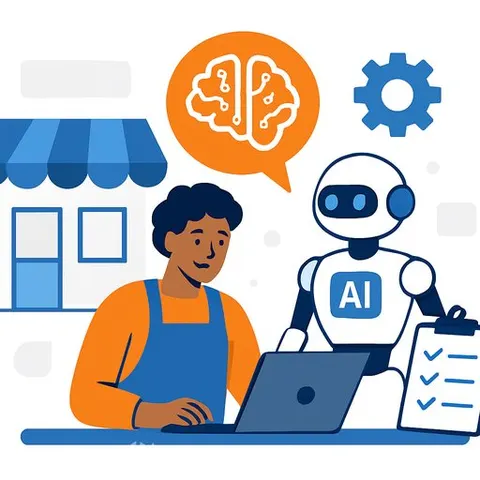
Small Businesses Turn to AI to Fill Labor Gaps, Not Replace Workers
Sixty-nine percent of small businesses reported difficulty finding qualified workers in early 2024, according to a U.S. Chamber of Commerce survey. Rather than shrinking operations, many are adopting AI tools to make existing employees more productive-a strategy known as the "augmented worker" model.
The approach differs fundamentally from automation that eliminates jobs. Instead, AI handles routine tasks so employees can focus on higher-value work. Sales teams use AI-powered customer relationship management platforms to prioritize leads. Chatbots answer routine customer questions. Inventory systems forecast demand automatically.
This shift addresses two problems simultaneously. Businesses reduce the impact of labor shortages. Employees escape repetitive work, which surveys show improves job satisfaction and retention.
Where AI Makes the Biggest Difference
Retail, hospitality, and manufacturing have felt labor shortages most acutely. A McKinsey report found that AI and automation could increase productivity by up to 40% in these sectors by 2030.
Small businesses adopting these tools early gain competitive advantages. AI-powered analytics provide insights previously available only to larger corporations. Predictive analytics forecast demand swings, optimize supply chains, and personalize marketing. Customer service teams use AI to analyze feedback in real time and detect sentiment trends, enabling employees to address concerns before they escalate.
The financial case is clear. Companies using AI to augment their workforce see 20-30% productivity improvements within the first year. Employee turnover drops as monotonous work disappears. Recruitment costs fall.
Data from the National Small Business Association shows 45% of small businesses that integrated AI tools reported revenue growth within 12 months, compared to 18% of those that did not.
Financing Remains a Hurdle
Upfront costs block many small businesses from adopting AI. Lenders now recognize the strategic value and offer favorable terms. Some provide deferred payment plans, lower interest rates for technology investments, and grants specifically for AI integration.
Small businesses are also exploring alternative financing: revenue-based financing, crowdfunding, and government programs. Federal and state initiatives provide grants, tax incentives, and technical assistance to offset costs.
Overcoming Adoption Barriers
Limited technical expertise, data privacy concerns, and upfront costs create resistance. Experts recommend a phased approach: identify high-impact areas first, then expand gradually.
Technology vendors increasingly tailor platforms for small business needs, emphasizing ease of use and integration with existing systems. Ongoing support reduces implementation risk.
Data security and privacy matter. Small businesses must implement cybersecurity measures and ensure regulatory compliance. Transparent communication about how AI collects and uses data builds employee and customer trust.
Involving employees early in adoption helps. When workers understand that AI supports rather than replaces them, resistance decreases. Training and feedback channels foster acceptance.
What Comes Next
AI capabilities will expand beyond operational efficiency. Natural language processing, machine learning forecasting, and real-time data visualization will support strategic decision-making, not just routine tasks.
Employees will increasingly collaborate with AI systems to identify business opportunities, optimize product development, and customize customer experiences. This human-machine partnership will define competitive advantage.
Small businesses that adopt AI augmentation now will attract and retain talent more easily, adapt faster to market changes, and drive sustainable growth. The strategy is not a temporary fix for labor shortages-it's a foundation for long-term resilience.
For product development professionals, understanding how AI augments rather than replaces human capability is essential. AI Learning Path for Product Managers covers the strategic and analytical dimensions of AI adoption, while exploring AI Agents & Automation shows how these tools integrate into workflows.