
AI news ·
South Korea launches AI task force to combat insurance fraud as annual losses reach record 1.16 trillion won
South Korea's insurance fraud losses hit a record 1.16 trillion won in 2025, with total exposure estimated at 9 trillion won. The government is now building an AI detection platform, with a completed plan due by September 2026.
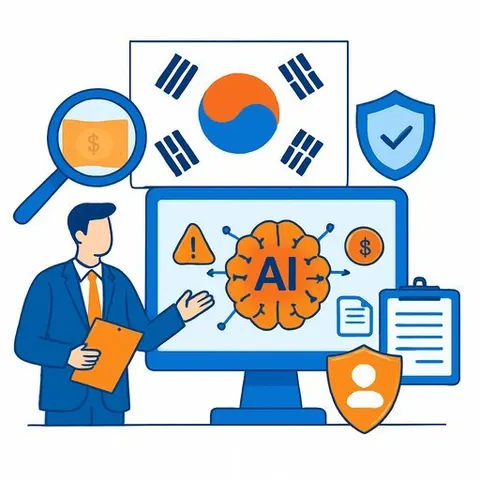
South Korea launches AI task force as insurance fraud losses hit record high
The South Korean government is forming a multi-agency task force to build an AI-based fraud detection platform as confirmed insurance fraud losses reached 1.16 trillion won in 2025-the highest on record. The Financial Services Commission convened the opening meeting on June 4, 2026, bringing together regulators, police, health agencies, and industry associations.
The confirmed figure masks a larger problem. Regulators estimate total fraud exposure-including undetected cases-at around 9 trillion won, nearly eight times the amount insurers actually paid out on fraudulent claims.
The detection gap widens
Confirmed fraud payouts have climbed steadily. Insurers paid 1.08 trillion won on fraudulent claims in 2022, rising to 1.12 trillion won in 2023, then 1.16 trillion won in 2025. Yet the number of identified fraud suspects declined 3% year-on-year to roughly 105,700 in 2025.
Long-term non-life insurance products-covering indemnity and general health plans-accounted for 44.7% of detected fraud. Auto insurance followed at 22.4%, life insurance at 21.8%, and general non-life at 11.2%.
The financial impact extends beyond insurers. "Such leakage of insurance payouts leads to higher premiums," an FSC official said. "When insurance fraud involves health insurance benefits, concerns rise about depletion of the health insurance fund."
Fraudsters are using AI tools
Criminal networks involving medical institutions, auto repair shops, brokers, and agents are coordinating at larger scale and deploying new technology. Generative AI and deepfake technologies have lowered the barrier to document forgery.
Using a smartphone, individuals can now alter identification cards, medical certificates, and vehicle damage photographs at any point in the claims process. When medical records or receipts are manipulated at the pixel level through AI generation, the font inconsistencies and spacing irregularities that human reviewers catch simply do not appear.
Repeatedly printing, outputting, and re-photographing a digitally altered file makes tampering progressively harder to identify through conventional means.
A structural gap compounds the problem. Information sharing between financial sector bodies-such as the Korea Credit Information Services and private insurers-and social welfare agencies like the National Health Insurance Service remains limited. The infrastructure to cross-verify data across these agencies has not been built.
How the task force is organized
The government structured the task force around three subcommittees covering legal and institutional issues, data, and infrastructure. The division allows parallel progress across regulatory, technical, and operational dimensions.
The subcommittees are tasked with:
- Creating a legal basis for collecting and sharing insurance fraud data centrally
- Determining which additional data categories should be prioritized for detection
- Building real-time data exchange capability between insurers and government agencies
- Designing AI tools capable of identifying fraud patterns and generating risk indicators
The task force has committed to protecting policyholder privacy. Conventional fraud detection techniques, such as comparing submitted documents against originals, will continue alongside AI-based methods.
Timeline and next steps
The FSC set a September 2026 deadline for completing the platform development plan. From October onward, the government intends to begin legislative and technical follow-through, including amendments to relevant laws and platform upgrades.
Kim Jinhong, Director General of the Financial Industry Bureau, said a functioning system would enable "pre-emptive prevention, real-time detection, and post-fraud action." He projected the system would reduce fraud across the board, enhance trust in the insurance industry, lower premiums, and prevent leakage from the health insurance fund.