
AI news ·
South Korean CEOs name AI as the biggest variable for business in 2027
61.1% of 144 South Korean CEOs named AI as the top factor reshaping corporate management by 2027, ahead of interest rates and regulation. Nearly two-thirds plan to give AI a core role in next year's business strategy.
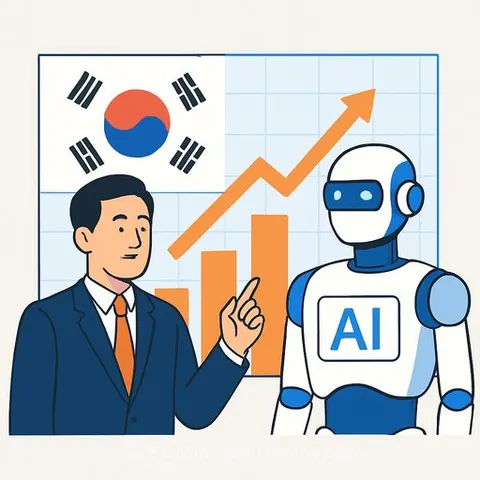
AI tops the list of CEO concerns for 2027 planning
Six out of 10 South Korean CEOs named artificial intelligence as the variable most likely to reshape corporate management next year, ahead of interest rates, regulation, and trade policy. The finding, from a HUNET survey of 144 CEOs, signals that AI has moved from an efficiency tool to a core input in business planning.
When asked which factor would have the greatest impact on corporate management in 2027, 61.1% selected "advances in AI technology and changes in industrial and business structures." Global economic conditions and interest rates followed at 36.1%, with domestic politics and regulation at 33.3%, consumer trends at 27.8%, and US-China trade and tariff policy at 22.2%.
CEOs see a stable economy, but their own industries face pressure
Expectations for the South Korean economy next year lean positive. Some 47.2% of CEOs said the economy would grow, while 27.8% expected it to hold at current levels. That means 75% of respondents see either growth or stability in 2027. Only 22.2% predicted a decline.
The outlook for their own industries is more cautious. A combined 63.9% expect their sectors to grow or remain stable - 11.1 percentage points lower than the national outlook. Nearly 28% said their industries would contract.
AI moves into business-planning and transformation
AI's influence shows up in how companies are actually building their 2027 plans. The largest share of CEOs, 47.2%, cited AI and technological change as the most important factor in preparing next year's business plans. The domestic economic and policy environment came in at 44.4%, followed by the global economic outlook and management strategy at 38.9% each.
Adoption is accelerating. Some 41.7% of respondents said they would "reflect AI in their major businesses and management strategies" in next year's plans, while 22.2% said they would "incorporate it as a core strategy in their business plans." Combined, 63.9% plan to give AI a role at least as significant as a major management strategy.
AI Transformation (AX) - using AI to change organizational and business structures - is already underway at many firms. Some 38.9% said AX was "underway in some businesses or divisions," and 19.4% said it was "already being pursued companywide." Another 22.2% are considering it.
A HUNET official said, "AI has become a key variable that determines companies' business plans and management strategies, going beyond the technological dimension. Business plans for 2027 should go beyond simply adopting AI and examine how AI will change companies and their business models."
For executives building AI strategy on this timeline, the AI Learning Path for CEOs covers enterprise adoption and organizational transformation. The survey data also aligns with broader coverage under AI for Executives & Strategy.
HUNET will hold its business-planning forum FORESIGHT KOREA 2027 on October 1, with AX as the theme. The event includes 31 lectures across macroeconomics, management, marketing, and human resources.
Why this matters for executives and strategy leads
The survey makes one point clearly: if AI is not already in your 2027 planning process, you are in the minority. Nearly two-thirds of CEOs in South Korea are treating AI as a core strategy, not a pilot project. The question for strategy leads is no longer whether to adopt AI, but how it changes the operating model, the org chart, and the revenue plan. The CEOs who answered this survey are already asking that question. The gap between companies that have started AX and those still "considering" it will widen next year.