
AI news ·
Special ed teachers use AI to cut paperwork and spend more time with students
Special education teachers are using AI to cut IEP writing time, with 57% doing so in 2024-25, up from 39% the prior year. The shift is giving teachers like Mary Acebu hours back each day to spend with students.
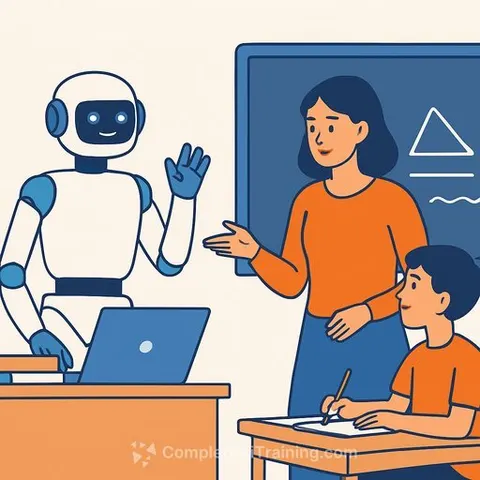
Special education teachers turn to AI to reclaim classroom time
Mary Acebu used to arrive at her classroom before sunrise and leave after dark, often carrying paperwork home. She'd spend 45 minutes developing three or four individualized education program (IEP) goals per student, flipping through a 5-inch-thick binder of California education standards to find the right matches.
Two years ago, she started using AI tools vetted by her district. Now she arrives 30 minutes before students and leaves when the final bell rings.
"I have time to talk to the kiddos and really build those relationships," said Acebu, a special education teacher at Riverview Middle School in Bay Point, California, "instead of sitting here in front of my computer."
Her experience reflects a sharp shift across the country. According to a survey by the Center for Democracy and Technology, 57% of special education teachers nationwide used AI to help develop IEPs in the 2024-25 school year, up from 39% the previous year.
The paperwork burden
Special education teaching has long carried a crushing administrative load. In the 2024-25 school year, 45 states reported special education teacher shortages, with turnover especially high in schools serving low-income students like Riverview.
Federal law requires detailed IEPs for each of the over 8 million students with disabilities in the country. These documents outline annual goals and the services students need to reach them. Teachers must know each student's learning style intimately and understand complex education law to write effective IEPs.
Paul Stone, who has taught special education at Riverview for 22 years, said his student load jumped this year. "I don't want to say it's killing me, but it has put a huge stressor on my mental health and my life," he said.
After Acebu showed him how to use her customized chatbot, Stone tried it. "It's an amazing time-saver so far," he said. He uses it to summarize complicated data for parent meetings and to draft IEP goals. "I still have to go through and check it all," he added.
Research backs the time savings
Studies from the University of Virginia and University of Central Florida found that when used appropriately, AI can help teachers write IEPs of equal or higher quality than teachers produce alone.
The time freed up matters for students. "The more face time a student with a disability has with a teacher, that often yields better outcomes for them, both educationally, functionally - just across the board," said Olivia Coleman, a researcher and professor at UCF studying AI in special education.
In Acebu's classroom, the benefit is visible. King, an eighth grader, couldn't read at the start of seventh grade. He reads confidently now and attends math class without additional support. He created a board game called Turtle Catastrophe for a science project that was accepted at a local science fair.
"That's the dream of every special educator," Acebu said. "But guess what? That takes a lot of hard work."
Guardrails matter
Not all teachers use district-approved tools. Some rely on free platforms like ChatGPT and Claude, raising privacy concerns. Acebu's district entered agreements with companies offering education-focused AI tools including MagicSchool AI and Google, which promise to protect student data.
Still, risks remain. Ariana Aboulafia, lead author of the Center for Democracy and Technology's report, called AI tools "a Band-Aid" for overworked teachers. She flagged three main concerns: student privacy breaches, AI bias against people with disabilities, and the 15% of teachers who rely entirely on AI to develop IEPs.
"There must always be a human in the loop," Aboulafia said.
Acebu emphasizes this point with her colleagues. "You're double-checking everything," she said. "You have to put that human touch. That's the final step."
Acebu, named her district's teacher of the year, recently earned her doctorate in instructional technology and sits on her district's AI task force. She represents a growing number of educators learning to use these tools responsibly.
For teachers facing burnout, the time savings are real. Whether AI proves a sustainable solution or merely delays addressing systemic understaffing remains an open question.
Learn more about AI for Education or explore the AI Learning Path for Teachers to understand how educators can safely integrate these tools into their practice.