
AI news ·
Pope Leo XIV warns that AI in warfare risks "spiral of annihilation" in speech at Rome university
Pope Leo XIV warned that AI in warfare risks pushing humanity toward "a spiral of annihilation," speaking at Rome's Sapienza University on May 14. He called for global military spending to shift toward education, health, and peace instead.
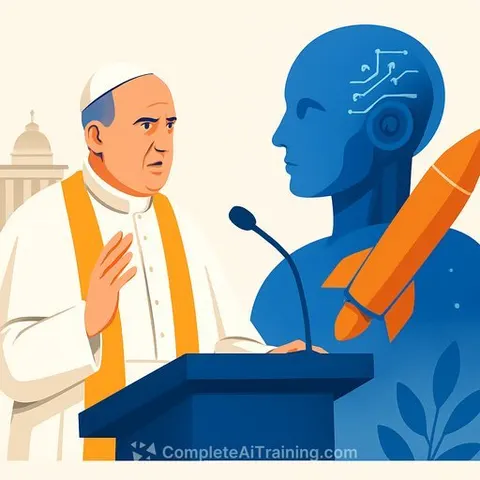
Pope Warns Against AI in Warfare, Calls for Shift in Global Investment
Pope Leo XIV told students and academics at Rome's Sapienza University on May 14 that artificial intelligence in modern warfare threatens to push humanity toward "a spiral of annihilation." He condemned the world's rising military spending and called for investments to prioritize education, health, and peace instead.
"What is happening in Ukraine, in Gaza and the Palestinian territories, in Lebanon and in Iran describes the inhuman evolution of the relationship between war and new technologies," the pope said during a two-hour visit to the campus.
AI Must Preserve Human Responsibility
The pope's central concern centered on AI systems and their role in removing human responsibility from critical decisions. He urged vigilance to ensure technology does not "worsen the tragic nature of conflicts."
"Study, research and investments should go in the opposite direction," he said. "They should be a radical 'yes' to life, yes to innocent life, yes to young life, yes to the life of peoples who cry out for peace and justice."
The remarks come ahead of Leo's first encyclical-a major church teaching document-focused on the ethical questions AI poses for humanity.
Military Spending Diverts Resources
The pope highlighted what he called the "enormous" growth in global military spending, particularly in Europe. Defense spending in the region grew 14% in 2025 alone.
"Let us not call 'defense' a rearmament that increases tensions and insecurity, drains investments in education and health, contradicts trust in diplomacy and enriches elites who care nothing for the common good," he said.
For policymakers and government officials, these concerns intersect directly with decisions about how AI shapes defense policy and national security strategy.
Young People Face Pressure to Perform
The pope addressed the psychological toll on young people, describing widespread suffering caused by "the extortion of expectations and the pressure to perform" in modern society.
He rejected what he called "the pervasive lie of a distorted system which reduces people to numbers, aggravating competitiveness and abandoning us to spirals of anxiety."
"We are a desire, not an algorithm," the pope said.
Historic Campus Visit
The visit marked the first papal appearance at Sapienza since Pope John Paul II visited in 1991. Pope Benedict XVI declined an invitation to the university in 2008 following protests over his previous comments about the church's historical treatment of Galileo.
Four Palestinian students, brought to study at the university through an agreement involving Sapienza, the Diocese of Rome, and the Community of Sant'Egidio, greeted the pope after his speech.