
AI news ·
Submitting AI-generated text without disclosure is plagiarism, universities say
More than 40 universities now consider undisclosed AI-generated work as plagiarism. Their test checks for disclosure, adherence to course rules, and evidence of original thought.
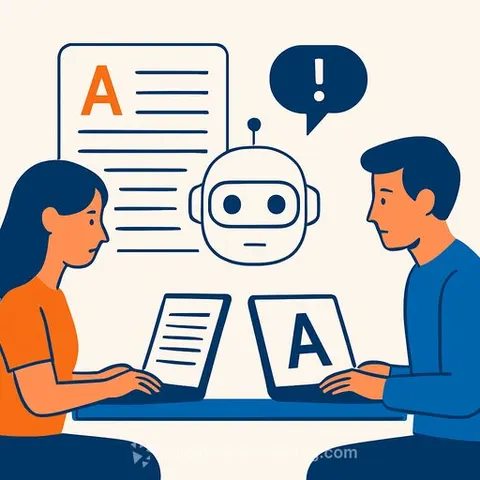
AI-generated text is not automatically plagiarism, but handing it in as your own original work - without disclosure or significant revision - now falls under academic misconduct policies at a growing number of universities. For writers, the same principle applies: whether publishing articles, marketing copy, or client deliverables, passing off AI output as entirely human-created risks reputational damage, search penalties, and integrity violations.
What plagiarism means in 2026
Most academic integrity offices now treat undisclosed AI use like quoting a source without citation. The University of Cambridge updated its policies in 2025 to state that submitting AI output as one's own work is academic misconduct. NYU, Stanford, and dozens of other institutions followed. The rule is straightforward: AI output is not your own work, and representing it as yours crosses the line.
The three-part test universities use
After reviewing AI policies from over 40 universities published in late 2025 and early 2026, a clear pattern emerges: most institutions ask three questions to decide if AI use becomes misconduct.
- Did you disclose AI use? Where disclosure is required, failing to mention AI is like omitting a citation. Some universities want a simple statement; others require the tool name and how you used it.
- Did you follow course-specific rules? A professor's ban on AI for writing overrides a permissive university policy. Ignoring it is misconduct.
- Does the work show your own critical thinking? Submitting an AI draft with light edits is a problem. Rewriting it heavily with your own analysis and research is usually accepted.
How AI detection works - and fails
Tools like Turnitin, GPTZero, and Originality.ai report a probability, not a verdict. A "35% AI-generated" score prompts closer scrutiny, not automatic guilt. Instructors are trained to weigh it alongside the student's writing history, drafts, and source notes.
False positives remain a problem. A 2025 University of Maryland study found that detectors wrongly flagged human writing as AI in 12% of cases when the writer was a non-native English speaker. This is why documentation - keeping drafts, notes, and AI chat logs - is your strongest defense.
Grey areas that trip up writers
Not every AI use case is clear-cut. Here's how most universities classify common scenarios:
- Proofreading and sentence-level improvements: Generally permitted, like using Grammarly. Risk: low.
- Generating an outline, then writing from scratch: Usually fine if disclosed. Risk: low.
- AI drafting full paragraphs, then editing them: Likely misconduct unless the instructor explicitly allows it. Risk: high.
- Submitting AI text with minor rewording: Almost universally considered plagiarism. Risk: very high.
These distinctions matter for freelancers and content teams. A marketing writer who uses AI to brainstorm headlines and then writes the article can usually justify that as proper tool use. One who pastes an AI-written draft and massages it into shape is on riskier ground, especially if the publisher or client forbids AI assistance.
Before you submit any written work
A pre-submission process can protect you from both accidental plagiarism and false AI flags.
- Read the brief, syllabus, or client contract to confirm the AI policy for this specific assignment.
- If you used any AI tool, write a disclosure statement describing the tool and how you used it.
- Run your text through a plagiarism scanner like PlagiarismScan.io to catch accidental matches with published sources.
- Verify every direct quote has quotation marks and a source reference.
- Keep your drafts, research notes, and any AI conversation logs as documentation.
- Read your work aloud to check whether it sounds like your own voice, not a generic AI pattern.
Many professional writers now check drafts through plagiarism detectors before submission. With AI capable of reproducing phrasing similar to existing articles, this quality-control step has become standard practice.
What this means for professional writers and publishers
The same questions follow AI-assisted copy into the business world. Google's Search Essentials say AI content won't be penalized unless it's duplicate, unoriginal, unhelpful, or untrustworthy. If your article mirrors 10 others on the same topic because the AI trained on them, search rankings will drop.
For writers, this makes originality verification as critical as it is for students. Running AI-assisted drafts through a plagiarism check before publication protects both your search visibility and your professional reputation. As universities and clients tighten AI rules, many writers turn to resources like AI for Writers to stay current on ethical tool use.
What's expected by 2027
University policies are still shifting, but a few directions are clear. Standardized AI disclosure templates are under discussion, and many institutions will likely adopt similar language within two years. Detection technology is moving toward "writing fingerprinting" - comparing a student's work against their own established patterns rather than hunting for AI text in isolation. Some courses are already being designed to require AI use, then ask students to critique and improve the output.
Why this matters for writers
Writers who treat AI as a tool - for research, structuring, or polishing - while keeping final output clearly their own are unlikely to run into trouble. The risk comes from hiding the tool's involvement. Document what you used, keep evidence of your own writing process, and check originality before hitting send. In a market where editors, universities, and search engines all scrutinize authorship more closely, that habit will become as routine as running spell check.