
AI news ·
Teachers welcome AI as a classroom tool but fear it will make them redundant, review finds
Many language teachers want to use AI but lack training and fear job loss, a new review in Language Teaching Research found. Emotional responses to the technology may shape adoption as much as technical skills.
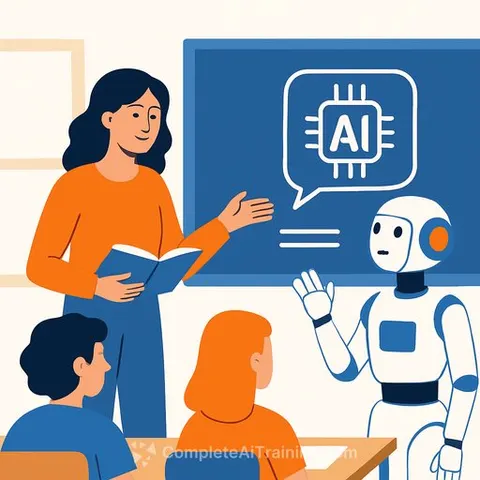
Teachers Want AI Tools, But Fear and Uncertainty Are Holding Them Back
Language teachers see artificial intelligence as a way to reduce workload and personalize instruction, yet many experience anxiety about job security and struggle with inadequate training. A new systematic review found that emotional responses to AI may matter as much as technical skills in determining whether the technology succeeds in classrooms.
Researchers analyzed dozens of studies on how language teachers understand and feel about AI, then proposed a framework linking emotional responses directly to how teachers perceive their ability to control the technology. The work, published in Language Teaching Research, identifies what institutions need to do to move beyond simply teaching teachers how AI works.
AI literacy is now a core job requirement
AI literacy has shifted from a supplementary skill to a central professional competency for language educators. Teachers now work with natural language processing, automated writing assessment, intelligent tutoring systems, chatbots, and generative AI platforms that affect lesson planning, assessment, and classroom interaction.
The review identified four dimensions of AI literacy that teachers need:
- Understanding AI: How systems function, their limits, and responsible use in language education
- Applying AI: Using tools for lesson planning, content generation, personalized tasks, and assessment
- Evaluating AI: Critically assessing AI outputs and refining prompts - a skill called "prompt literacy" that combines technical and pedagogical knowledge
- Addressing AI ethics: Managing concerns about algorithmic bias, inaccurate outputs, plagiarism, data privacy, and student autonomy
Ethical reasoning emerged as the foundation of AI literacy, not an optional addition. Teachers increasingly recognize that AI-generated content can contain errors, reinforce bias, or undermine academic integrity without careful oversight.
Barriers keep teachers from engaging with the technology
Many teachers lack the digital skills, training, and institutional support needed to integrate AI effectively. Schools often introduce AI tools without comprehensive professional development programs, leaving educators feeling unprepared despite recognizing the technology's potential.
Teachers are calling for structured learning that combines technical instruction with ethical guidance, classroom applications, and emotional support. The demand signals that technical training alone will not solve the adoption problem.
Teachers experience conflicting emotions simultaneously
The research identified four emotional categories shaping how teachers respond to AI. Challenge emotions - excitement, curiosity, enthusiasm - emerge when teachers see AI as improving efficiency or enabling personalized instruction. Many report that AI reduces repetitive work and simplifies lesson preparation.
But deterrence emotions are equally common. Teachers experience anxiety, fear, and stress when they perceive AI as technically difficult or insufficiently regulated. Some worry that AI might reduce the professional value of language teaching or fundamentally alter their roles.
Loss emotions - frustration, anger, exhaustion - appear when teachers feel they lack control over implementation or perceive institutional pressure to adopt tools they don't trust. Others fear AI could weaken teacher-student relationships or create unhealthy dependence on automated systems.
Achievement emotions - happiness and professional fulfillment - occur when AI tools improve learning outcomes or support innovative teaching.
Rarely do teachers experience purely positive or negative emotions. Most hold ambivalent views, seeing AI as both exciting and threatening, useful and risky. Teachers who feel capable of managing AI tools tend toward positive emotions, while those who feel overwhelmed develop anxiety and resistance.
Institutional support shapes emotional outcomes
Schools and universities that provide collaborative support, peer learning communities, and structured training foster more positive emotional experiences. Institutions that implement AI without adequate support intensify emotional distress.
The researchers grounded their framework in Appraisal Theory, a psychological model showing how cognitive evaluations shape emotions. Teachers' emotional reactions depend on how they assess whether AI represents an opportunity or a threat, and whether they believe they can control its implementation.
When teachers perceive AI as supporting their pedagogical goals and feel they have sufficient control, they experience excitement and professional empowerment. When they see AI as threatening their identity or autonomy, they develop anxiety and resistance.
What institutions should do now
Technical training alone will not guarantee successful AI adoption. Institutions need modular AI literacy programs tailored specifically to language educators that combine technical instruction with ethical guidance, emotional awareness, and classroom-focused applications.
Professional learning communities where teachers openly discuss concerns and share practical experiences are equally critical. Teachers also need scenario-based ethical training to navigate realistic dilemmas involving plagiarism, data privacy, algorithmic bias, and AI-assisted assessment.
The research suggests that institutions treating AI adoption as a technical problem will continue to face resistance. Those addressing the emotional and ethical dimensions alongside technical skills are more likely to see genuine integration.
For educators looking to build AI competency, the AI Learning Path for Teachers offers structured training in classroom tools, lesson planning, and EdTech integration. You can also explore AI for Education resources covering curriculum integration and teaching optimization.