
AI news ·
Tech giants race to expand AI agents across productivity, ecosystems and context as coding tools go mainstream
Microsoft, OpenAI, and Alibaba all made major AI agent moves this week. The race centers on turning coding tools into full workplace systems that handle email, scheduling, and business tasks.
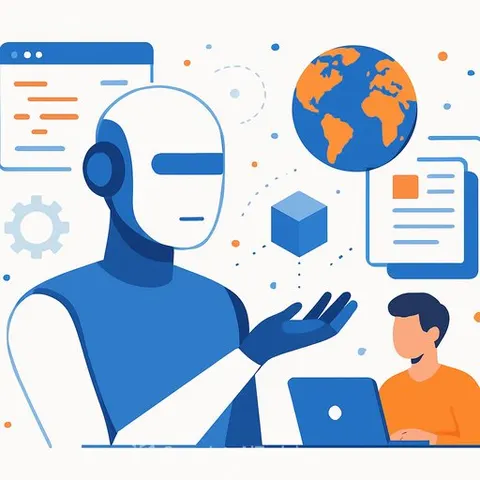
Tech Giants Battle Over AI Agents Along Four Fronts
Major technology companies are competing for dominance in AI Agents through product integration, ecosystem building, and user expansion into productivity work. The competition follows a clear pattern: generalize coding agents to handle broad business tasks, then build the infrastructure to support them at scale.
This week alone saw Microsoft advocate for an "Agent first" strategy, OpenAI merge ChatGPT with its Codex product, and Alibaba open its agent ecosystem to third-party companies. The shift signals that agents-AI systems capable of taking autonomous action-have become the central battleground for tech companies' AI strategies.
Productivity Work Is the Prize
Companies are positioning agents as workplace colleagues that handle routine tasks. Microsoft's Scout works within Microsoft 365, managing emails, calendars, and meeting conflicts. OpenAI's updated Codex can draft documents, edit spreadsheets, and generate reports across office applications.
The data justifies the investment. Codex's weekly active users grew sixfold since February, reaching 5 million users. Growth among knowledge workers outpaced developer adoption by threefold. Anthropic's second-quarter revenue is expected to exceed $1 billion, with most coming from enterprise customers.
ByteDance, Meituan, and Tencent are embedding agents into their existing consumer apps. Meituan's "Xiaotuan" agent served over 100 million users during a recent holiday period, handling food orders, entertainment bookings, and medical consultations. These companies are converting years of accumulated product capabilities into agent-callable functions.
Product Integration Runs Deep
OpenAI's decision to merge ChatGPT and Codex represents the most radical restructuring. ChatGPT becomes the main interface for agent work. Codex transforms into a general platform handling office tasks, research, data analysis, and business operations.
The strategy has organizational teeth. OpenAI restructured its teams in January to force closer collaboration between product and research staff. It then consolidated ChatGPT, Codex, and API teams under one leader.
Alibaba's Qianwen added takeout ordering, taxi hailing, and Taobao shopping as callable skills. Tencent converted document-processing capabilities into skills that other agents can access. This pattern repeats across the industry: existing products become building blocks for agents.
Third-Party Ecosystems Are Forming
Agents need access to hundreds of tools and services. No company can build this alone. The construction of third-party ecosystems is now underway.
Alibaba opened Qianwen to external developers, and companies like Luckin Coffee, KFC, and China Eastern Airlines launched skills within days. Tencent is building a WeChat agent ecosystem that will connect with mobile phone manufacturers including Honor and Xiaomi.
OpenAI's agent plugins currently cover 62 popular applications and 110 skills. The company plans to open the ecosystem to partners, allowing third parties to create and deploy plugins directly.
Context Accumulation Matters
Models perform better with detailed inputs. Agents need to understand who the user is, what they're doing, and what answers matter to them. This requires collecting and sharing context across multiple points.
On the user side, agents must distinguish which information to request and which to ignore. On the development side, feedback loops must connect product teams with model researchers so both groups align on what constitutes good performance.
Microsoft's Project Solara explores this through dedicated agent hardware-desktop terminals and portable devices designed to collect context about user activities. The hardware becomes a tool for gathering the information agents need to work effectively.
The System-Level Competition
These four trends-user expansion, product integration, ecosystem building, and context accumulation-form a connected strategy. Each company is attempting to generalize the coding agent, which started as a tool for developers, into a system that handles work across the entire organization.
This is a system-level competition because success requires restructuring products, teams, and business models simultaneously. The companies furthest along this path will likely define how AI agents operate in professional settings for years to come.
For product development professionals, the implications are direct. Understanding how generative AI and LLM systems integrate into products, how to build ecosystems around them, and how to structure teams for collaboration will determine whether your organization leads or follows in agent adoption.