
AI news ·
The blurring line between human and AI writing fuels literary paranoia
People correctly identify AI-generated text only about 60% of the time. One debut novel was withdrawn after online rumors of AI use.
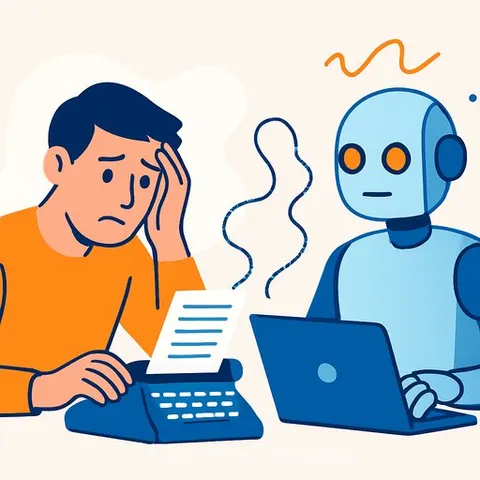
Most people can correctly identify AI-generated text only about 60% of the time, according to forensic linguist Claire Hardaker. As large language models blur the distinction between human and machine writing, literary scandals and paranoid readers are forcing writers and technologists to confront an uncomfortable question: what makes human language human?
Hardaker's online test, Bot or Not, asks users to spot AI-written hotel reviews. Three sample reviews show why it's hard: one is authentic - a real human's brief praise of a London hotel - while two are synthetically generated, yet all three read like unremarkable travel feedback. Respondents often rely on shortcuts such as the presence of clichés, em dashes, or the "rule of three," but these signals also define much of human prose. Charles Dickens loved em dashes; Julius Caesar famously used the rule of three. "People have learned very simplistic rubrics and now just madly apply them everywhere," Hardaker said.
That uncertainty has inflamed suspicion. A debut horror novel was withdrawn by its publisher after online rumors of AI use. Another book, a study of AI's impact on truth, contained hallucinated quotations. Media organizations field readers' complaints that human errors like a duplicated word are evidence of machine authorship. "I can't imagine a human editor/proofreader missing something like this," one reader wrote, reflecting a growing distrust of all text.
The large language models (Generative AI and LLM) that power tools like ChatGPT are trained on vast human-written text, but humans are now absorbing machine patterns. This interplay creates a linguistic hall of mirrors where it's nearly impossible to prove an individual piece of writing is AI or human without an admission.
Commercial screening tools offer no reliable escape. Hardaker, who serves as an expert witness in forensic linguistics, is "extremely sceptical" of their efficacy. Some detectors flag neurodivergent writers as AI. Others can be fooled by a writer adopting a bombastic register - something that can as easily come from a human steeped in AI output as from a machine.
Linguistic fingerprints of AI
Researchers have identified vocabulary that LLMs overuse: "delve," "showcase," "boast," "underscore," "garner," "align," "surpass," and "intricate" all spiked in frequency after ChatGPT's release. One study traced the sudden popularity of "delve" in scientific papers to AI influence. Paradoxically, the word may have spread because it didn't seem like an AI word, making it a favorite of the underpaid human workers who train models through reinforcement learning and treat certain words as proxies for quality.
Beyond word choice, LLMs lean on attributive adjectives ("the uncomfortable chair") over predicative ones ("the chair was uncomfortable") and use fewer pronouns, reflecting their lack of a social self. Different models even exhibit dialects: Gemini likes "here's a breakdown," while Deepseek often opens with "Certainly!"
These habits are leaking into human language. Unscripted conversations showed spikes in "delve" and "boast" post-ChatGPT. But the effect is complex: after "delve" was called out on social media, its use in academic abstracts fell, suggesting a self-conscious correction.
Can a machine write a masterpiece?
Peter Stockwell, professor of literary linguistics at the University of Nottingham, sees language as a stack: words, phrases, clauses, narrative. "AI is really good at the lower levels," he said. "But, the higher up you go, the less good it is." It can sequence events but struggles with compelling twists or tellable narratives. The arc of a story - the secret sauce of great fiction - remains opaque even to linguists.
That opacity ties to human embodiment. "We can't build a machine to do something when we don't know how it works," Stockwell said. Humans have bodies, adrenaline, dopamine, and social needs that shape language. LLMs lack that wetware.
Originality, too, is a sticking point. "The whole point of an LLM is that it's trained on existing language. So it's always retro," Stockwell said. You can prompt an AI to write like Virginia Woolf, but you cannot ask it to be the next great literary innovator, because innovation arises from social friction and annoyance with the status quo - forces an AI cannot feel.
Writers divided on AI as a tool
Novelist Jennifer Egan has quarantined herself from the technology entirely. "I feel a danger of infection," she said. She is aware that her books were used to train AI without consent, and she refuses to contribute more data. She now second-guesses her own stylistic habits - em dashes and triads - that overlap with known AI tells. Her advice to younger writers: "Stay the fuck away. I mean, OK, use it to write emails. Even use it to get research ideas. But if you want to be a writer: learn to write."
Jeanette Winterson takes a different view. "Every writer can make their own choice. Humans are tool-using animals. That has been our success story. At present all AI, including generative AI, is a tool. Would I work with an LLM? Of course! Why not?" But she draws a hard line where meaning arises from inner reality. "Machines do not share our reality, not least because they don't have a limbic system. Humans cannot have a thought without a feeling."
The fear that AI will homogenize language is grounded, but historical patterns suggest a backlash. After the first world war's bureaucracy, surrealism and Dada erupted. "So there always seems to be that sort of kicking against the norms," Stockwell said. Human innovation resists the conservative status quo that AI embodies.
Why this matters for writers, developers, and IT professionals
For developers and IT professionals, these insights matter for prompt engineering, content moderation, and building tools that respect human voice. Knowing that LLMs favor attributive adjectives or certain filler words allows for more precise prompting to avoid generic outputs. For writers and editors, recognizing AI's homogenizing effect underscores the need to cultivate idiosyncratic style. Training programs such as AI for Writers offer structured learning on integrating generative tools without surrendering originality. Ultimately, the ability to distinguish human creativity from machine pastiche isn't just an academic exercise - it's a career skill.