
AI news ·
The use of artificial intelligence in book writing divides authors and publishers
Hachette pulled the novel Shy Girl after a tool flagged 70% of the text as AI-generated. The case exposes how flawed detection software threatens writers.
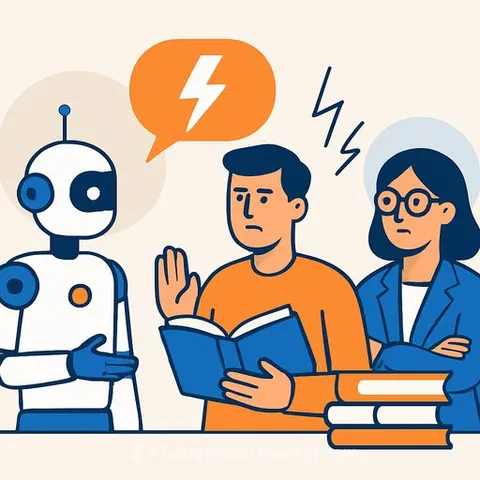
Hachette Book Group pulled the horror novel Shy Girl from the UK market in November 2025 after a literary analysis tool claimed 70% of the text was AI-generated. The decision, following the sale of 1,800 copies, threw a harsh spotlight on the risks writers face when using AI-and on the unreliable tools that can destroy a career.
Detection tools and false accusations
The novel's author, Mia Ballard, said the editor she hired was the one who used AI, but the damage was done. The case highlights a deeper problem: AI detectors boast false-positive rates of only 1%, but that number masks the unequal burden of errors. Tim Requarth, a neuroscientist at New York University and author of the Substack newsletter The Third Hemisphere, said that for non-native speakers, "your personal false-positive rate can be much higher, which exposes you to unjust accusations." He added, "The harm of those accusations falls hardest on people who are already more likely to have their credibility questioned."
Continuous exposure to AI-generated text is also homogenizing expression. Requarth observed that "AI sounds increasingly like a human, but humans are sounding increasingly like AI." For writers exploring these tools, separating genuine assistance from hype is essential, and resources on AI for Writers offer a practical starting point to understand what AI can and cannot do.
Where publishers draw the line
Most publishers have yet to adopt a formal stance on co-creation with machines. Judith Feher-Gurewich, founder of U.S. publisher Other Press, said she has never encountered an author who confessed to using AI. "If they're trying to invent a style experimentally, I might consider it. Honestly, I don't know how I would react." She added that she publishes unique voices, and she is convinced one of her authors, Antonio Muñoz Molina, "would never use AI to help write; it would confuse him immensely. He follows his thought."
The European AI Regulation, approved in 2025, now requires AI-generated texts to be labeled. Some certifications claim to guarantee human authorship, but no reliable verification exists beyond the author's word. The lack of dependable detection leaves writers in a precarious position-accusations can be as damaging as proven misuse.
The writer's dilemma
Canadian writer Stephen Marche published Death of an Author in 2023, a novel developed with AI tools including ChatGPT, Sudowrite, and Cohere. He considers himself 100% the author, describing AI as a resource "like a camera is for a photographer." Marche, who used elaborate prompts to shape the narrative, emphasized that the skill of crafting those prompts-what many call Prompt Engineering-is becoming a central part of the writer's toolkit. The New York Times reviewed the book and called it a feat, but three years later, Marche said, "the literary world practically made it impossible to publish works created with AI."
He added that the industry has created a situation where it "refuses to acknowledge the power of this new technology while it erodes the very foundation of writing." Nobel laureate Olga Tokarczuk had to clarify that she used AI only for research after acknowledging she relied on it for her latest novel, underscoring the pressure to distance oneself from the tools even when using them peripherally.
The creative boundary
Writer Miguel Ángel Hernández draws a clear line. "For me the red line is using it for creative writing. I don't find it ethical or sensible, because it works with what has already been written, with conventions, and it tends to homogenize sentence structure. It flattens language and generates a style. It pulls sentences into a universe that no longer belongs to the author."
Italian philosopher Andrea Colamedici pushed the experiment further when he used AI to create Hypnocracy: Trump, Musk, and the New Architecture of Reality under a fake name, deceiving the industry. The episode prompted a question from L'Espresso director Emilio Carelli: "If the book's theses are correct-or at least have managed to spark an intense cultural debate-what does it matter that they were written by artificial intelligence?"
Why this matters for writers
Writers today operate in an environment where transparency invites controversy and secrecy invites detection. The practical line between using AI for research, editing, or creative generation is blurry, and the tools that claim to police it are unreliable. Marche's advice is pragmatic: "If AI is used in fascinating and powerful ways, it will be fascinating and powerful. If it's used in a boring, hackneyed, lazy and corrupting way, the work it produces will be boring, hackneyed, lazy and corrupt." For writers, the decision is not just about whether to use AI, but how to use it in a way that preserves their voice while navigating a publishing world that has not yet caught up.