
AI news ·
Trump and tech CEOs head to Beijing as lawmakers push for firm AI stance ahead of Xi summit
Trump travels to Beijing on May 14-15 to meet Xi Jinping, with AI policy and chip exports topping the agenda. Elon Musk, Tim Cook, and other executives join the delegation as lawmakers push for clear safety limits on AI systems.
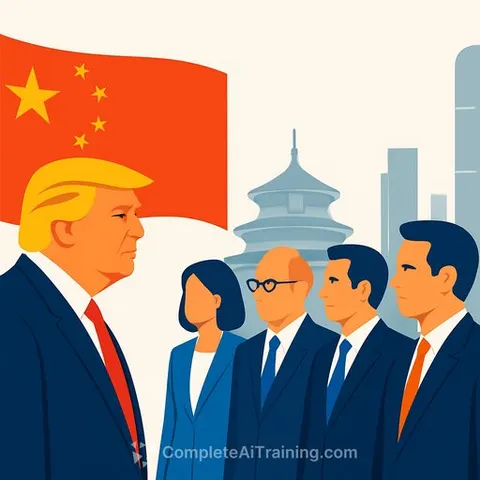
Trump Prepares Beijing Summit on AI as Lawmakers Push for Stronger Safety Stance
President Donald Trump will travel to Beijing on May 14-15 to meet with President Xi Jinping, with artificial intelligence policy and semiconductor trade expected to dominate discussions alongside economic and geopolitical issues.
The delegation includes Tesla CEO Elon Musk, Apple CEO Tim Cook, BlackRock CEO Larry Fink, and Boeing CEO Kelly Ortberg. Treasury Secretary Scott Bessent is organizing the U.S. side of the summit.
The talks come as the administration reevaluates export restrictions on advanced AI chips and systems to China. Policy experts say the meetings could establish a framework for bilateral discussions on AI safety risks-without necessarily reducing competition between the two countries.
A Shared Security Problem
Kyle Chan, a fellow at the Brookings Institution's China Center, argues that both nations face common vulnerabilities from increasingly powerful AI systems. "The United States and China are both potential targets for such attacks," Chan wrote.
Chan expects the two countries can address these risks while competing vigorously. "This does not require broad trust, strategic alignment, or compromise on national interests," he said.
Edgard Kagan, senior adviser at the Center for Strategic and International Studies, expects discussions to include a possible framework for future talks on AI risk and safety.
Capitol Hill Demands Clarity
Lawmakers are pressing the administration to take a firm position on AI safeguards. Sen. Bernie Sanders said the talks must "make clear that humans, not machines, come first."
Sanders proposed limited cooperation in technical information sharing, model safety standards, and potential "AI redlines." He also raised the prospect of restrictions on uncontrollable superintelligent systems, comparing the discussions to Cold War-era nuclear arms agreements.
Sen. Thom Tillis warned that Chinese AI companies have been distilling American models-a technique involving thousands of queries to mimic proprietary systems cheaply. "We're still maintaining a quantitative edge on innovation, but there is a pacing threat going forward," Tillis said.
The Semiconductor Question
Advanced chip exports will likely feature in the talks. In December, Trump announced that Nvidia could export certain H200 AI chips to approved customers in China under a policy requiring the United States to receive 25% of associated profits.
The decision drew bipartisan backlash. Congressional members and experts warned the move could become a major national security concession.
For executives, the summit signals a critical moment in AI governance. Understanding how the administration balances competition with safety frameworks-and how that shapes export controls and supply chains-will affect strategic planning across industries. AI for Executives & Strategy resources can help leaders assess these policy shifts and their business implications.