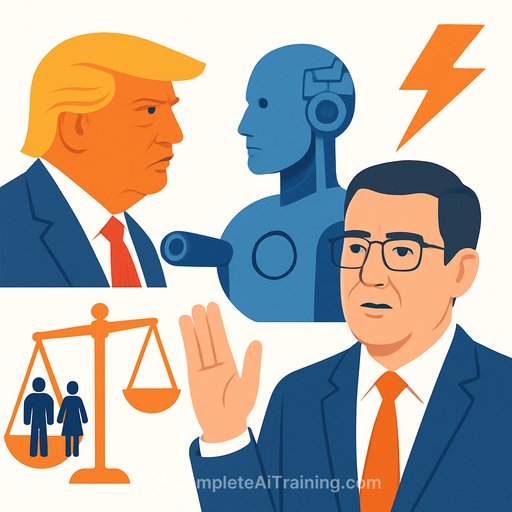
AI, Inequality, and the Future of Your Job: What Acemoglu Gets Right
Many see Donald Trump as the core threat to U.S. democracy. Economist Daron Acemoglu argues he's a symptom-a fever from a long-brewing infection: decaying institutions and a growth model that sidelines workers. The wildcard now is AI. Used well, it broadens opportunity. Used poorly, it accelerates inequality and erodes trust.
For customer support teams and writers, this isn't an abstract debate. It's your workload, your rates, your job security. The right move isn't fear or blind optimism-it's designing work so AI complements you, not replaces you.
The two shifts that matter
1) Inequality is compounding. Acemoglu warns that AI-led job displacement will deepen an already historic wealth gap. Traditional policy hasn't closed it. Tax proposals get headlines, but the deeper fix is participation: workers across skill levels need a path into the value being created.
2) Job destruction is real-and rising. He points to mounting layoffs and flags the obsession with "human-level" AI as a distraction with harsh side effects. Others counter that innovation always disrupts before it creates better jobs, and that overregulation could kneecap U.S. competitiveness. Both can be true-and your strategy should reflect that tension.
What this means if you work in Customer Support
Support is often the first place companies over-automate. That's a mistake. The fastest wins come from pairing AI with humans to raise quality and speed at the same time.
- AI does triage, you do judgment. Route tickets by intent and urgency with AI, then handle edge cases, empathy-heavy issues, and revenue-saving saves.
- Use AI as a drafting tool, not an autopilot. Summaries, macros, and suggested replies are fine. Final tone and resolution quality stay human.
- Make quality the metric. Track CSAT and first-contact resolution for AI-assisted vs. human-only tickets. If AI drags those down, dial it back.
- Continuously train the knowledge base. Use AI to spot gaps in articles, flag outdated steps, and propose updates. You approve the changes.
- Keep a human-in-the-loop policy. Anything with legal, safety, billing disputes, or churn risk gets escalated automatically.
Want practical workflows and upskilling paths? See AI for Customer Support.
What this means if you're a Writer
Writers are feeling the squeeze: more content, less time, lower rates. The counter is differentiation plus smart assistive workflows.
- Research and outline with AI-write with your voice. Let models collect sources, map arguments, and propose angles. You handle narrative, nuance, and truth.
- Build a style system. Create voice rules (diction, cadence, taboo phrases, fact-check steps). Feed that to your assistant so drafts stay consistent.
- Fact-check ruthlessly. Require citations for claims, dates, and numbers. No citation, no claim. Add a final human pass on anything medical, legal, or financial.
- Differentiate with what AI can't fake. Original data, interviews, field notes, and lived experience. That's your moat.
- Own outcomes, not word count. Pitch and price by results (opens, signups, revenue influence), not just deliverables.
Looking for tools and playbooks that keep you billable and in demand? Explore AI for Writers.
Why inequality is your problem even if you keep your job
When value pools concentrate, budgets tighten for everyone else. Support teams face headcount freezes. Writers see rate compression. That's how inequality shows up at work.
You can't set tax policy, but you can push for shared gains. If AI lifts team output by 30%, propose tying a slice of that to raises, bonuses, or training funds. Otherwise, you do more-and the surplus walks upstairs.
For context on inequality data, see the OECD's income inequality indicators.
Job destruction vs. job design
Acemoglu's point isn't "stop AI." It's "stop treating replacement as the default." The fastest business wins often come from complementarity: let machines handle prediction, retrieval, and drudge work; let humans make judgment calls, build trust, and set standards.
This isn't theory. Teams that adopt AI with clear guardrails ship more, with fewer mistakes. Teams that chase full autonomy burn customer trust and spend months fixing brand damage.
For a research lens on tech and work, check the MIT Work of the Future reports.
A pro-worker AI playbook you can start this week
- Map your workflow. List steps from intake to delivery. Mark: automate, augment, or human-only. If AI touches it, define the escalation path.
- Set quality gates. Require human review for anything risky. Track accuracy, CSAT, and revisions caused by AI mistakes.
- Build reusable prompts and checklists. Standardize how your team uses AI for triage, summaries, outlines, and edits. Keep them short and specific.
- Instrument everything. Compare output per hour, error rates, and customer outcomes before/after AI. Use data to negotiate workload and pay.
- Create a red team. Quarterly, stress-test your AI setups for bias, hallucinations, and edge cases. Document failures and fixes.
- Keep a skills plan. Pair AI literacy with human moats: domain expertise, interviewing, negotiation, product knowledge, and voice.
Talk tracks for your manager
- "What percentage of our work will be AI-assisted this quarter, and how are we measuring quality?"
- "What's our policy for human review on sensitive tasks?"
- "If AI lifts throughput, how do we share those gains-training budget, bonuses, reduced backlog?"
- "Which tasks are complementary-first vs. replace-first, and why?"
- "What data are we using to fine-tune prompts or tools, and who approves changes?"
For Support teams: high-ROI use cases
- Smart routing and summaries. Faster handoffs without losing context.
- Knowledge base upkeep. AI flags stale content; you confirm fixes.
- Customer sentiment alerts. Escalate at-risk accounts before they churn.
- Compliance helpers. Policy-aware suggestions that never auto-send.
For Writers: high-ROI use cases
- Outline generation from briefs. You lock structure, then draft.
- Voice QA. Automated checks for banned phrases, tense, and tone drift.
- Source expansion. Rapid pulls of studies and quotes to validate claims.
- Variant testing. Headlines, intros, and CTAs tested against goals.
Keep your edge
- Own the hard parts. Empathy, negotiation, synthesis, and taste get scarce as autocomplete spreads.
- Document proof of value. Case studies with before/after metrics: CSAT, time-to-resolution, conversion, retention.
- Stay close to the problem. Talk to customers and editors. The closer you are to outcomes, the harder you are to replace.
The takeaway
AI can widen the gap or widen participation. Policy debates will rage, but your daily choices matter right now. Use AI to extend your judgment, not delete it. That's how you stay useful, get paid, and ship work you're proud of.
Your membership also unlocks: