
AI news ·
Trump's China visit shifts US-China tensions from tariffs to AI competition
US chip export controls pushed Chinese AI firms toward domestic alternatives like Huawei's Ascend chips, with DeepSeek dropping NVIDIA's platform entirely. Now NVIDIA is adapting to China's ecosystem-not the other way around.
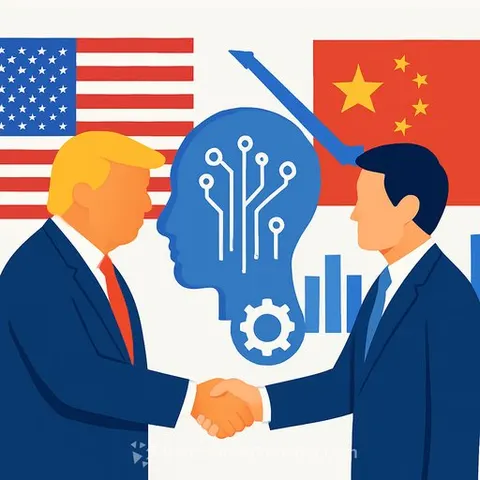
US-China AI Competition Shifts From Tariffs to Technology
NVIDIA CEO Jensen Huang's appearance on President Donald Trump's plane during a May 2026 state visit to Beijing signaled a fundamental shift in how the United States and China view their relationship. The center of gravity has moved from tariffs to artificial intelligence, semiconductors, and the technological systems that will define the next decade.
The Trump administration has made tech containment central to its China strategy. In April 2025, it prohibited NVIDIA and AMD from exporting advanced chips-the H200 and MI300X-to China. The H200 itself was already a downgraded version, designed after earlier export restrictions took effect.
Export Controls Failed to Stop China's AI Development
The restrictions have not achieved their intended effect. AI systems don't depend on access to a single advanced chip. They distribute computing power across enormous numbers of processors working in parallel. China can build competitive AI systems using larger quantities of less advanced chips.
After successive rounds of US restrictions, demand for domestic alternatives surged. Huawei's Ascend AI chips saw increased adoption across Chinese companies. DeepSeek optimized its newer models around Huawei's CANN architecture rather than relying on NVIDIA's CUDA platform.
By mid-2025, NVIDIA had successfully lobbied for partial relaxation of export rules. But the damage was done. Chinese AI companies had already begun shifting toward domestic architectures. When NVIDIA realized Chinese frontier models might move away from CUDA entirely, the company moved to ensure compatibility with China's evolving ecosystem.
This reversal-NVIDIA adapting to China instead of Chinese firms adapting to NVIDIA-illustrates how export controls can backfire.
Complete Decoupling Remains Unrealistic
Full technological separation in AI is structurally impossible. The field rests on shared theoretical foundations. Research papers circulate globally. Open-source communities operate across borders. Developers collaborate on platforms like GitHub without regard to national boundaries.
Chinese AI models are often open-source and dramatically cheaper than American alternatives. This creates a paradox for Washington: restricting Chinese AI systems inside certain US institutions doesn't prevent their growing international adoption.
Complete decoupling would impose enormous costs on both sides. The United States might maintain an edge in frontier-model capabilities, but without Chinese competitors, American companies would face higher costs and a more fragmented innovation ecosystem. China would lose short-term access to advanced technologies but would accelerate self-reliance even further.
Why Managed Competition Matters
AI is not simply another commercial industry. It's a general-purpose technology that can become an instrument of escalation. Under manageable competition, major powers retain incentives to ensure AI remains beneficial. Under escalating fragmentation, those incentives disappear.
If the US and China fracture into rival blocs with incompatible standards, AI development risks becoming subordinated to strategic hostility rather than productivity or human welfare.
The world experienced one Cold War. The stakes around artificial intelligence suggest both countries have reason to prevent a second one.
For managers navigating this environment, understanding the structural limits of technological separation is essential. AI strategy decisions must account for the reality that China and the United States will continue competing in AI-and that healthy rivalry can accelerate innovation. The question is whether competition remains bounded or slides into technological conflict with consequences far beyond either country alone.