How Government AI Training Could Upskill 10m UK Workers
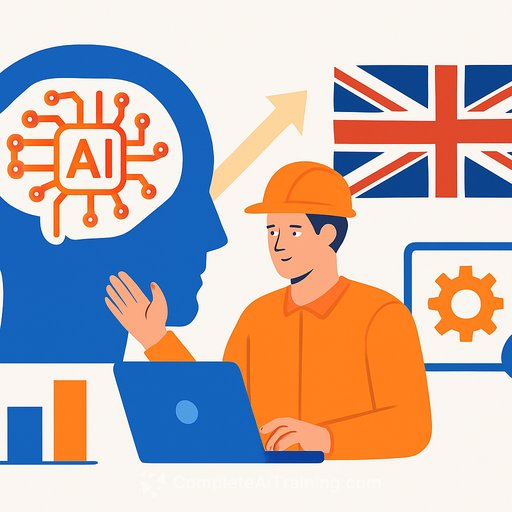
The UK Government has launched foundational AI training for every worker. The goal is simple: build practical skills, free people from routine tasks, and create more high-skilled jobs. The plan aims to upskill 10 million people this decade and make Britain the fastest AI adopter in the G7.
Industry-developed courses are now live on the government's AI skills hub and open to all UK adults online. The training sets a baseline for what good AI upskilling looks like, giving both employees and employers confidence to use AI at work.
Why this matters for government and HR
Since June 2025, one million courses have been delivered. The next target: 10 million workers by 2030, including two million employees in small and medium-sized enterprises (SMEs). For policymakers and HR leaders, this is a lever to boost productivity, service quality, and career mobility at scale.
As Liz Kendall, Secretary of State for Science, Innovation and Technology, puts it: "We want AI to work for Britain and that means ensuring Britons can work with AI. Change is inevitable, but the consequences of change are not. We will protect people from the risks of AI while ensuring everyone can share in its benefits. That starts with giving people the skills and confidence they need to seize the opportunities AI brings, putting the power and control into their hands."
The adoption gap you can close
Only 21% of UK workers feel confident using AI at work. Just one in six businesses use AI today. That gap carries a cost - a University of Birmingham study suggests the skills shortfall could lead to a US$37.17bn loss.
Demand is rising fast. Randstad reports job ads referencing "AI Agent" skills are up 1,587%. Meanwhile, 68% of CEOs say they plan to increase AI spending in 2026. Smaller organisations are still slower to implement AI, which makes accessible, government-backed training even more important.
Signals from industry
Google strengthened its focus on AI infrastructure by appointing Amin Vahdat as Chief Technologist for AI Infrastructure in December 2025. In an internal memo, Google Cloud CEO Thomas Kurian said the move "establishes AI Infrastructure as a key focus area for the company."
Leaders see what's coming. Many employees don't - only one in five believe AI will affect their work. Closing that perception gap is half the job.
Workforce transformation needs structure
IBM research indicates 56% of employees will need upskilling to work effectively with AI. That's a majority. HR teams need a clear plan to deliver it.
Nickle LaMoureaux, Chief HR Officer at IBM, said it well: "AI is not magic. It's amazing, impressive technology that can totally transform your business. But it takes hard work, behaviour change, culture change, business process change and sometimes leadership change."
Ryan Roslansky, CEO of LinkedIn, adds: "The future of work is not off on the horizon. It is here now, moving fast, shaped by the choices we make today. AI is already changing how we learn, how we create and how we move forward. The real question is not what the technology can do. The real question is what we choose to do with it."
What the training enables
The government's courses aim to help people use AI confidently in everyday tasks and set standards for responsible use. For many teams, the first wins are administrative: summarising documents, drafting emails, note-taking, scheduling, basic data prep, and project tracking.
These use cases free time for higher-value work. At scale, that productivity shift matters - the government estimates up to US$192.88bn in annual economic output could be unlocked with an AI-ready workforce.
An implementation playbook for HR and public sector teams
- Map tasks, not just roles: Identify repetitive work across job families where AI can assist (admin, reporting, case triage, citizen communications).
- Start with safe pilots: Choose three common processes, define "before/after" workflows, and run 6-8 week sprints with clear success criteria.
- Set guardrails: Publish a short AI use policy covering data sensitivity, approval steps, record-keeping, and review requirements.
- Upskill managers first: Equip line managers to coach teams on prompts, review outputs, and measure impact.
- Create AI champions: Nominate early adopters inside each department to support peers and escalate lessons learned.
- Integrate into work: Add AI tasks to SOPs, templates, and checklists so the new way becomes the default.
- Track outcomes weekly: Confidence levels, adoption rates, time saved per task, error rates, and cycle times.
- Scale what works: Standardise winning prompts, libraries, and workflows across similar teams.
SMEs: keep it lightweight
- Use simple, well-documented tools that work in the browser.
- Start with one admin process per team; expand only after you see time saved and quality gains.
- Share prompt packs and checklists across the business to reduce rework.
Policy levers that accelerate adoption
- Offer standard templates for AI policies, DPIAs, and procurement to reduce overhead for smaller organisations.
- Provide micro-credential pathways employees can complete in weeks, not months.
- Recognise department-level achievements to signal progress and maintain momentum.
Metrics that matter
- Training completion rates and post-training confidence scores.
- Task-level time savings and error-rate reductions.
- AI adoption by job family and team.
- Service-level improvements: response times, backlog reduction, citizen satisfaction.
Where to start
If you're planning your rollout, assemble a small working group, pick three pilot processes, and schedule the first training cohort. Keep it simple. Make the wins visible. Then scale.
For curated learning paths and course discovery:
- AI for Government
- AI Learning Path for Policy Makers
- AI Learning Path for Training & Development Managers
Bottom line
The training exists. The demand is here. The organisations that move first - with clear guardrails and practical use cases - will capture the gains in productivity, service quality, and talent growth.
Make AI useful at the task level, and the strategy takes care of itself.
Your membership also unlocks: