
AI news ·
URI researcher finds shift in how scientists attribute findings to AI systems rather than themselves
Scientists increasingly write "the model found" instead of "we found," a shift a URI professor says quietly moves accountability from researchers to machines. Analysis of 20M+ abstracts shows the trend accelerating after 2018.
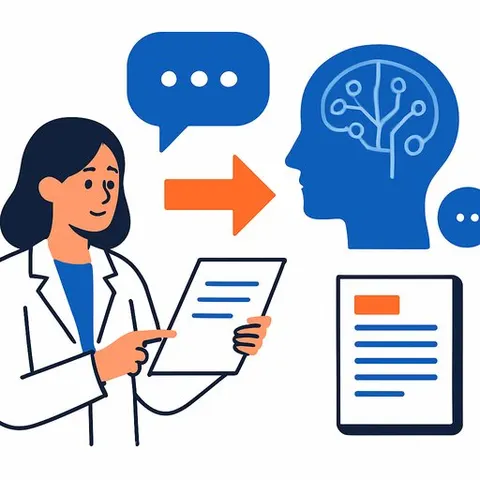
How AI is Reshaping Scientific Language - and Who Gets Credit
Nic Fisk, an assistant professor of cell and molecular biology at the University of Rhode Island, has spent the past year examining a linguistic shift across scientific research: researchers increasingly write "the model found" instead of "we found."
That word choice matters more than grammar. It raises a question about accountability in science. If a computational system receives credit for a finding, who bears responsibility for its accuracy?
Fisk analyzed more than 20 million scientific abstracts from PubMed to move beyond anecdotal observation. The study tracked how often papers attributed agency to researchers versus computational tools, and how passive voice usage changed over time.
The results showed a noticeable shift beginning around 2016, accelerating after 2018 and again after 2021. The change was not explained by passive voice alone but appeared closely tied to the rise of machine learning and AI tools in research.
"We're attributing agency to methods much more," Fisk said. The concern is not whether researchers are conducting rigorous work. Rather, it is whether they are unintentionally relocating responsibility from themselves to computational systems.
Fisk made this argument at a recent philosophy conference at Boston College focused on language, speech, and rationality. While other participants debated whether AI systems can truly understand language, Fisk explored how AI is changing the way scientists describe their work.
Agency and Accountability
"If you are not an agent, if you do not have control, you cannot have responsibility," Fisk said. This principle sits at the center of traditional scientific practice, which emphasizes falsifiability and human accountability for interpretation and testing.
Similar questions about how disciplines assign agency emerged in Fisk's other research. At the University of Rhode Island's Innovative Education conference, Fisk and collaborator Annemarie Vaccaro analyzed how education research constructs categories such as disability, race, and ethnicity.
They found that peer-reviewed education papers tend to describe disability in negative terms and frame it as a deficit, while policy documents and teaching resources more often treat disability as an identity. The difference illustrates how academic norms shape what is treated as an object of study.
Disciplinary Norms Shape Research Identity
At a Women in Bioinformatics meeting, Fisk argued that interdisciplinary collaboration can clarify assumptions that often remain implicit within a single field. When researchers from different disciplines work together, they must explicitly define terms and methods because collaborators do not share the same assumptions.
Fisk connected these findings to clinical decision-making in oncology at a Rhode Island biomedical conference on AI in health care. They described an association between how physicians conceptualize cancer-either as something internal to the patient or as an external invader-and the treatment strategies they favor.
While the analysis does not establish causality, the findings suggest that metaphors used in clinical language may shape or reflect treatment decisions.
What Makes a Scientist
Fisk emphasizes that scientific identity is shaped less by technical background than by the questions researchers choose to pursue. One of their students, Gift Asefon, recently received a best poster award for breast cancer imaging research despite beginning the project without prior programming experience.
"It isn't the skill set that defines a scientist," Fisk said. "What makes a scientist is asking the questions you want the answer to."
That emphasis on science as a human practice becomes especially important as artificial intelligence becomes more embedded in research. Language matters. When humans say "we found" instead of "the model found," they are deciding who is responsible for the results.
For researchers working with AI tools, understanding these linguistic choices-and their implications for accountability-is essential to maintaining scientific integrity.