
AI news ·
US Army runs tabletop exercise simulating AI-driven cyberattacks on military networks in Indo-Pacific scenario
The US Army ran a tabletop exercise simulating AI-driven cyberattacks on Army networks in a hypothetical Indo-Pacific conflict. Adversary agents adapted tactics in real time, outpacing human attackers in speed and scale.
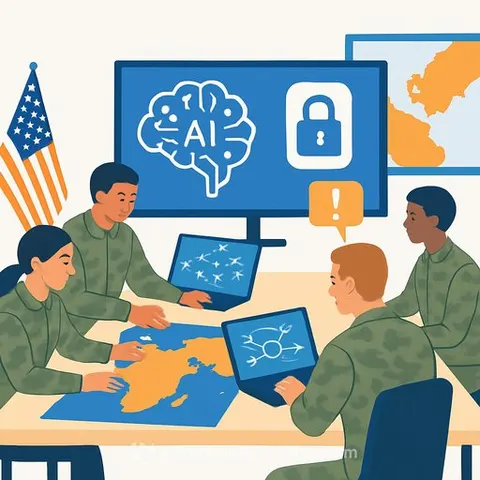
Army Tests Defenses Against AI-Driven Cyberattacks in Indo-Pacific Exercise
The US Army ran a tabletop exercise simulating enemy AI agents attacking Army communications and data networks in a hypothetical Indo-Pacific conflict. The simulated adversary launched multiple waves of attacks, adapted tactics in real time, and executed operations faster than human attackers could.
This was the Army's second AI-focused tabletop session. The inaugural event last September brought roughly 15 CEOs from major AI firms to discuss defensive solutions.
What the Exercise Revealed
Autonomous AI agents used in attack simulations can scale reconnaissance activities and iterate on attack vectors at machine speed. This increases both the volume and velocity of probing compared with human-only teams.
Adversarial agents that evaluate defenses and adjust tactics in near real time typically exploit configuration drift, exposed APIs, and gaps in telemetry. The speed advantage was a key finding: defenders had less time to detect and respond than they would against conventional attackers.
Practical Implications for Operations Teams
Security teams managing these risks need three core capabilities. First, automated detection systems that can identify attacks as they unfold. Second, high-fidelity telemetry across networks and systems. Third, rapid-response playbooks that reduce the window in which an adaptive agent can operate.
Continuous purple-teaming exercises and adversary emulation frameworks-approaches from civilian security operations-are being applied in military settings. These methods help teams practice against realistic, adaptive opponents rather than static scenarios.
What to Monitor
Watch for public reporting on the exercise's telemetry requirements and the degree of automation used in defensive responses. Any published findings from the Army or participating companies will outline applied mitigation techniques.
Also track policy and doctrine updates addressing autonomous cyber operations. These will signal how the military is adapting its approach to threats that operate at machine speed.
For operations teams, this exercise demonstrates real-world adoption of autonomous adversary simulations. The focus on telemetry and automation reflects operational needs that extend beyond military contexts.
Learn more about AI Agents & Automation and explore how autonomous systems are reshaping security operations. Operations professionals managing cybersecurity risks can also review the AI Learning Path for Cybersecurity Analysts, which covers threat detection and SOC optimization.