
AI news ·
U.S. copyright law offers no clear answer on AI-generated works as courts and Congress remain divided
No federal law defines who owns copyright in AI-generated works, leaving courts split and companies unable to get clear registrations. The U.S. Copyright Office bars purely machine-made content from protection, but Congress has passed nothing.
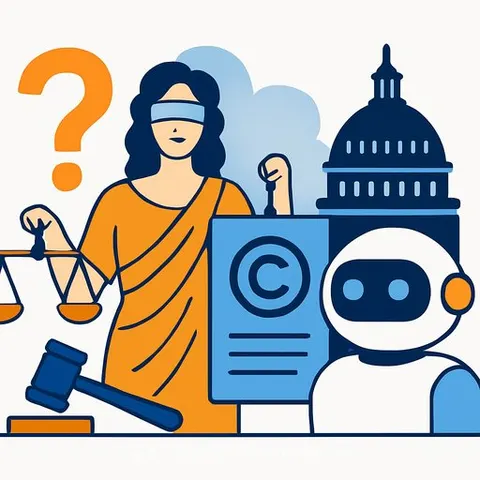
No Federal Law Governs AI Copyright. Courts and Congress Are Stuck.
Three years of court decisions, administrative rulings, and congressional hearings have produced no binding standard for who owns copyright in AI-generated works. The U.S. Copyright Office says purely machine-made content cannot be copyrighted. Congress has held hearings but passed no legislation. Federal courts are split. The result is a multi-billion-dollar gray zone affecting illustrators, studios, and anyone licensing creative work.
As of April 2026, the legal status of AI-generated content remains undefined by statute. That uncertainty has created tangible commercial problems: publishers and studios cannot obtain clear copyright registration for AI-assisted projects. Insurance underwriters now require contractual disclosures about AI use. Companies that have already distributed AI content face potential retroactive legal exposure if future court rulings or legislation shift ownership claims.
What the Copyright Office Has Actually Ruled
The U.S. Copyright Office has been the most consistent institutional voice. Its position: purely AI-generated works cannot be copyrighted because copyright law requires human authorship.
That principle was tested in Thaler v. Perlmutter. Stephen Thaler, whose company developed the AI image-generating system DABUS, sued after the Copyright Office refused to register his AI-generated image titled A Recent Entrance to Paradise. In August 2023, U.S. District Judge Beryl Howell upheld the rejection, writing that "human authorship is an essential part of a valid copyright claim" under existing statute. Thaler appealed to the D.C. Circuit, where the case remained active in early 2026.
The Office has drawn a distinction for hybrid works - those where a human uses AI as a tool but makes meaningful creative decisions. In 2023, it granted partial registration to Kristina Kashtanova's graphic novel Zarya of the Dawn: the text and arrangement were protected, but individual AI-generated images produced through Midjourney were not. That line between human selection and machine generation has become the operative framework in Copyright Office guidance.
In July 2024, the Copyright Office released the first part of its Copyright and Artificial Intelligence report, examining digital replicas and the limits of existing law. Subsequent parts addressed training data and the copyrightability of AI outputs. The Office stopped short of recommending new legislation, instead calling on Congress to act.
Congress Has Held Hearings - and Passed Nothing
The Senate Judiciary Subcommittee on Intellectual Property held multiple hearings through 2024 and 2025. Testimony came from musicians, visual artists, authors, and technology executives. No AI copyright bill has passed either chamber as of this writing.
Sen. Thom Tillis (R-NC) circulated draft frameworks that would create a tiered system of protection based on the degree of human creative input. Technology companies - including OpenAI and Google - argued in submitted testimony that such a system would be administratively unworkable.
The Authors Guild, Screen Actors Guild-AFTRA, and the Recording Industry Association of America have each submitted formal positions calling for strong human-authorship requirements and explicit prohibitions on copyright claims for purely machine-generated output. Their collective membership represents hundreds of thousands of working professionals whose livelihoods depend on licensing and royalty income tied to copyright ownership.
Jane Ginsburg, a copyright law professor at Columbia Law School, told the Senate Judiciary Subcommittee in March 2025: "The current legal vacuum doesn't protect anyone - not the artists, not the developers, not the companies licensing AI output commercially. Everyone is operating on assumptions that the next court decision could invalidate."
The Commercial Fallout
Publishing houses, film studios, and advertising agencies routinely commission AI-assisted content but cannot obtain unambiguous copyright registration for it. Insurance underwriters have begun requiring contractual disclosures about AI use in creative projects, according to industry attorneys.
Companies that have commercially distributed AI-generated content without clear copyright registration face retroactive legal exposure if future legislation or court rulings create new ownership claims. Legal counsel across multiple industries has advised clients to document all human creative decisions in AI-assisted projects as a protective measure.
The National Endowment for the Arts estimated in a 2025 report that AI tools were being used in some capacity in roughly 38 percent of commercially released creative works in the United States. That figure underscores the scale of what remains legally undefined.
Several major litigation cases are testing the boundaries further. The New York Times, a group of visual artists, and record labels have sued AI developers including OpenAI, Stability AI, and Anthropic. These cases primarily address training data, but their outcomes will shape the broader legal landscape significantly. At least four separate federal district courts were handling AI copyright litigation in some form as of early 2026, creating conditions for a circuit split that would likely force Supreme Court review.
How Other Countries Have Moved Ahead
The United States is an outlier in its inaction. The United Kingdom's Copyright, Designs and Patents Act has contained a provision for "computer-generated works" since 1988, granting copyright to the person who makes the necessary arrangements for creation. While imperfect, it provides a workable legal framework the U.S. currently lacks.
The European Union's AI Act, which came into force in 2024, addresses AI liability and transparency but largely defers copyright questions to member states and existing EU copyright frameworks.
China's approach has been notably more permissive. The Beijing Internet Court ruled in November 2023 that an AI-generated image could be copyrighted by the human who directed its creation through prompt engineering. That decision drew attention from U.S. legal scholars as a potential model, though critics noted the ruling has no formal precedential weight outside China.
What a Fix Might Look Like
Legal experts broadly agree that congressional action offers the most durable path to clarity. The Copyright Office's own reports have repeatedly flagged the limits of administrative guidance in resolving questions that require statutory authority.
Three legislative approaches are under discussion:
- Tiered Authorship Standard. Copyright protection scaled to the degree of human creative input, with a minimum threshold of qualifying decisions.
- Sui Generis Protection. A new, shorter-term intellectual property right for AI outputs that does not rely on existing copyright doctrine.
- No-Protection Rule with Disclosure Mandate. Codify the current Copyright Office position in statute while requiring commercial AI-content disclosures.
Until Congress acts or the Supreme Court weighs in, courts and companies will continue operating under a framework written long before the technology it is now being asked to govern ever existed.
For creative professionals working with AI, the practical reality is clear: document your creative decisions, understand your jurisdiction's current rules, and prepare for change. The legal ground you stand on today may shift without warning.