
AI news ·
US customer service job postings fall 10% below pre-pandemic levels as AI expands
U.S. customer service postings are 10% below pre-pandemic levels. Forrester predicts AI will eliminate 50% of these roles by 2030.
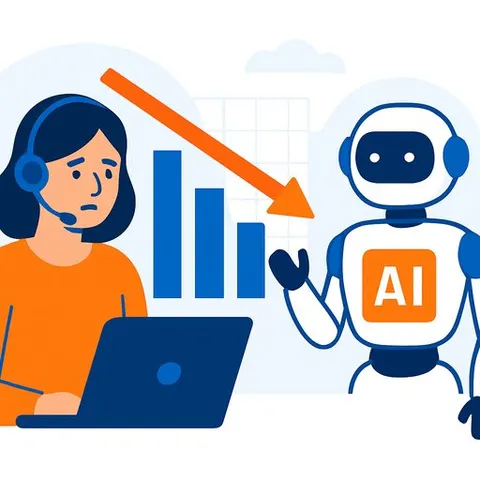
U.S. customer service job postings have fallen about 10% below pre-pandemic levels, according to Indeed Hiring Lab data, as AI takes a larger role in contact centers. Forrester research released last week predicts the customer service labor market will contract further over the next five years, though the impact varies sharply by job type - lower-level roles are vanishing while new, knowledge-intensive positions emerge.
Kate Leggett, VP principal analyst at Forrester, said, "Lower-level jobs are going away, those that can be automated. However, AI is unlocking more knowledge work, different types of jobs that didn't exist before."
AI's uneven impact on customer service jobs
Forrester predicts AI will eliminate half of customer service jobs by 2030, with retail and administrative support services absorbing the heaviest losses. These industries rely on representatives who handle routine, easily automated questions - order status, exchanges, returns - and require less specialized expertise. "There's much less knowledge work that you need than in like the mining industry, where you may even have highly educated reps doing that work," Leggett said.
Overall job postings remain above pre-pandemic levels, underscoring that the contraction is specific to customer service rather than a broad labor market shift. The data, published in the US Federal Reserve Economic Data, shows a decoupling of inquiry volume from headcount, meaning companies can handle more interactions without adding staff.
The shift toward higher-skilled roles
Customer service pay is also diverging. Forrester's analysis of frontline agent compensation found wages have stagnated, but the firm expects new, higher-paying manager roles to grow. These positions will center on managing AI rather than handling calls directly.
"You're going to need people that, for example, build your AI frameworks, that monitor your AI frameworks, that strategically pull insights out of customer interactions, whether they're automated or human assisted, and do something with them in terms of process changes or product changes," Leggett said. For professionals preparing for these emerging roles, an AI Learning Path for Call Center Supervisors provides targeted training on overseeing AI-driven contact centers.
Automation isn't inevitable for every contact center
Leggett cautioned that some organizations may never reach high automation rates due to messy data, missing back-office integrations, or overly variable processes. "Some contact centers may never reach the level of projected automation rates because they don't have well labeled machine readable knowledge, they don't have integrations into back office systems, they have processes that are too variable," she said. "So there's a lot of operational friction that is not a reflection on the state of AI technology."
Even when automation is possible, Leggett said companies must prioritize customer experience over cost savings to realize the full benefit. The decoupling of headcount from service volume allows instant responses that once required long waits, but only if the AI is implemented thoughtfully.
Why this matters for customer support professionals
The customer service labor market is splitting in two. Routine query handling is shrinking fast, while demand grows for people who can build, monitor, and improve AI systems. Frontline agents who stay in roles that resist automation will need deeper product knowledge and problem-solving skills, but the clearest path forward is moving into AI oversight and process improvement. Upskilling now - through resources like AI for Customer Support Courses & Certifications - can help professionals pivot before the market forces the change.