
AI news ·
US government and Musk's xAI successfully gut Colorado's AI anti-discrimination law
The Justice Department joined xAI's lawsuit against Colorado's AI anti-discrimination law, the first time the federal government has challenged a state AI regulation. Colorado repealed the law in May.
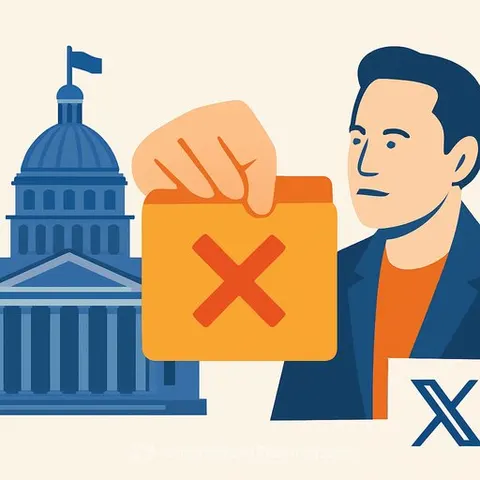
Justice Department Sides With Musk Against Colorado's AI Bias Law
The US Department of Justice joined Elon Musk's xAI in April to sue Colorado over its AI anti-discrimination law. The federal government is now actively working to block state protections against discriminatory AI systems.
This marks the first time the federal government has intervened in a lawsuit challenging a state AI law. The move is part of a broader effort to reframe AI consumer protections as ideological overreach.
What Colorado's Law Required
Senate Bill 205 focused on high-risk AI systems making consequential decisions: hiring, housing, and healthcare. The law required companies to conduct bias audits, perform impact assessments, and disclose how their systems worked.
Colorado revised the requirements in March before xAI filed its lawsuit, reducing transparency demands after business pushback. The state still required companies to check whether their AI systems produced unlawful discrimination and fix problems if found.
The Federal Government's Argument Doesn't Hold
The Justice Department called the law "state-mandated discrimination," claiming it forces companies to discriminate. This argument rests on a false premise: that AI systems using "neutral criteria" are objective and shouldn't be altered.
Research shows the opposite. A 2019 study in Science found a widely used healthcare algorithm assigned Black patients half the care of equally sick white patients. The algorithm used healthcare costs as a proxy for health needs, embedding existing inequities into clinical decisions. When researchers removed that proxy, racial bias disappeared and hospitals delivered more effective care.
Similar problems appear across other domains. Facial recognition systems perform worse on some populations due to underrepresentation in training data. Welfare allocation and college admissions algorithms have shown comparable bias patterns. When companies improved data representation, performance gaps nearly closed.
The "Winning the AI Race" Framing Misleads
The Justice Department frames AI regulation as a threat to competing with China for artificial general intelligence. This conflates frontier AI development with rules preventing discrimination in hiring and healthcare.
No mainstream evidence supports the claim that anti-discrimination rules harm business. Colorado's governor said "far more" firms are moving to Colorado than leaving. The Wall Street Journal cited Palantir as a possible example, but the company never stated the law was why it left for Florida.
Microsoft has flagged AI bias and discrimination as a material business risk. Companies using AI for hiring or healthcare without the capacity to check for discrimination lack the capacity to use it responsibly.
The Pressure Campaign Worked
On May 14, Governor Jared Polis signed a replacement bill (SB 189) that repealed SB 205. The new law eliminated requirements for proactive bias assessments, annual reviews, and reporting discrimination to the state.
What remains is weaker: companies must share technical documentation with deployers but not the public. Consumers get notice that AI was involved and can request human review-protections most won't know to invoke.
The Message to Other States
If the federal government can join a billionaire's lawsuit to kill a state consumer protection law, other states considering AI regulation now understand the cost. The message is direct: don't try.
States looking to protect residents from AI harms face federal opposition in the absence of federal rules. For government officials weighing AI policy, that's a significant constraint.
For more on how AI policy affects government operations, see AI for Government and AI for Legal.