
AI news ·
Verizon CEO says AI agents could displace a large percentage of customer service jobs
Verizon CEO Dan Schulman says AI agents will displace "a large percentage" of customer service jobs. The company's AI pilots show satisfaction rates 1,280 basis points higher than human reps.
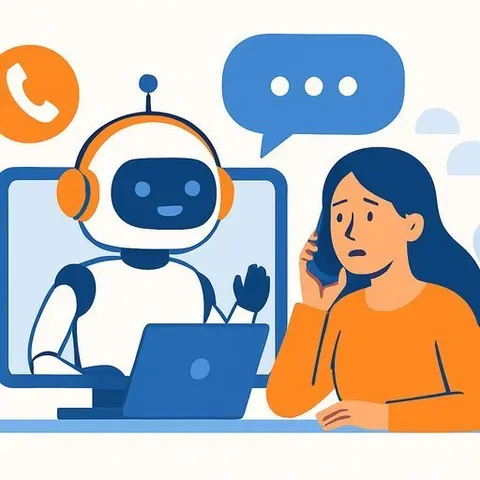
Verizon CEO Says AI Agents Will Displace 'A Large Percentage' of Customer Service Jobs
Verizon CEO Dan Schulman told Bloomberg TV that workforce disruption from AI agents in customer service is unavoidable, breaking from the more cautious messaging other executives have offered about the technology.
"For sure you're going to see disruption with AI in certain job functions. I don't see how that's not possible," Schulman said. When pressed on the scale, he added: "It can be a large percentage of customer service."
The comments stand out against a broader corporate narrative that frames AI as a tool to augment human workers rather than replace them. Most CX leaders and analysts emphasize that empathy, judgment, and relationship management still require human touch.
Verizon's AI Agents Are Already Outperforming Reps
Verizon has been testing AI agents in customer service for the past three months. Schulman said the agents are delivering customer satisfaction rates that are 1,280 basis points higher than previous results.
The company sees AI handling routine tasks-password resets, billing inquiries, basic account questions-while humans tackle more complex issues. "The rote stuff can be done by agents," Schulman said. "More complex is a combination of an agent and a human working hand in hand."
Schulman expects this pattern to expand across the company. "I'm going to lean heavy as I think all of my colleagues will. All of Fortune 100 will lean heavy on AI."
The Training Commitment
Schulman acknowledged that companies have a responsibility to help workers adapt. Verizon has allocated $20 million for training and reskilling employees affected by AI deployment.
The program ranges from basic AI literacy to building AI agents from scratch. Schulman's message to employees was direct: "You should not be scared of AI. You need to learn AI. You need to be able to use it in your work."
He described the $20 million investment as "the tip of the iceberg," suggesting larger efforts will follow.
Where the Debate Stands
Schulman's willingness to name displacement directly contrasts with how other leaders discuss the issue. Simon Thorpe, director at Pegasystems, acknowledged the board pressure companies face to deploy AI for cost savings, but argued the focus should be on removing low-value work, not eliminating people.
"The future of AI is not AI or humans, it's AI and humans," Thorpe said.
OpenAI CEO Sam Altman recently reconsidered his own assumptions about AI replacing jobs entirely. After trying to automate his email and Slack management, he concluded that personal communication matters too much to outsource. "The world has got to be built for people and be better for people," he said.
The central question for contact center leaders remains unanswered: which interactions should be automated, which should be augmented, and which should stay human? Verizon's early results suggest AI can outperform traditional models in specific areas. But Schulman's acknowledgement of workforce disruption signals the scale of the shift ahead.
For customer support professionals, the implication is clear-the skills that matter most going forward are those AI cannot easily replicate. Understanding where to use AI for Customer Support and where to keep human judgment in the loop will define who remains valuable in the contact center.