
AI news ·
Vietnam workers lead South-east Asia in daily AI use while Singapore employees show highest scepticism
Vietnam leads Southeast Asia with 36% of workers using generative AI daily. Yet only 15% of Singapore employees feel optimistic about its impact.
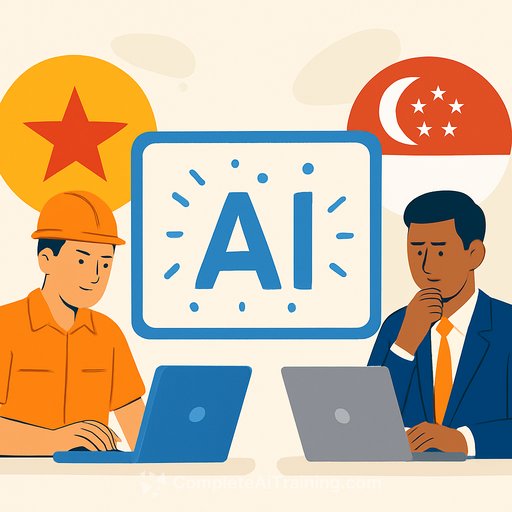
Vietnam has the highest rate of generative AI use in South-east Asia and the region's most optimistic workers about the technology's impact, while Singapore employees are the most sceptical and among the least confident about job security, according to a global workforce survey by ADP. The findings, drawn from more than 39,000 working adults across 36 markets, reveal a sharp divide in AI confidence that HR teams will need to address as adoption accelerates.
Adoption and optimism diverge sharply
ADP found that 36 per cent of workers in Vietnam use generative AI tools "nearly every day," the highest share in South-east Asia and second globally only to India's 41 per cent. By contrast, just 23 per cent of Singapore workers use these tools with the same frequency, slightly above the Philippines at 22 per cent. The lowest daily usage worldwide was in Japan, at 8 per cent.
The optimism gap is even starker. Only 15 per cent of Singapore workers strongly agreed that AI would have a positive effect on their job responsibilities in the coming year - the lowest among the five South-east Asian markets polled. Vietnam led at 29 per cent, followed by Thailand and Indonesia at 23 per cent each, and the Philippines at 19 per cent.
Jessica Zhang, ADP's senior vice-president for Asia-Pacific, said emerging economies tend to embrace AI more readily. "When a lot of things are new, you see people adapt to them faster," she said. "Workers in more mature markets like Singapore want to see proof that productivity is improving before confidence levels rise."
The productivity paradox
One global finding complicates the adoption narrative. Workers who use AI were four times more likely to report feeling less productive than those who do not. The data suggests that frequent users often feel they accomplish less through AI in daily tasks, raising questions about how the technology is integrated into workflows.
Zhang noted that "adoption alone does not guarantee meaningful workplace impact in Singapore," and that employers may need to set clearer performance expectations and invest more in AI-related skills training. That message lands in a region where workers are not convinced their employers are making those investments.
Job security fears mount
Across South-east Asia, anxiety about AI-driven job displacement is rising. Singapore recorded the lowest confidence in job security: only 15 per cent of workers strongly agreed their jobs are safe from replacement. That compares with 24 per cent in Thailand, 23 per cent in the Philippines, 20 per cent in Indonesia, and 18 per cent in Vietnam.
Knowledge workers in Singapore and the Philippines were the most uneasy. In both markets, 17 per cent of these employees strongly agreed their roles could be disrupted by AI. The numbers were lower among knowledge workers in Thailand (15 per cent), Vietnam (14 per cent), and Indonesia (9 per cent).
Singapore's national push to embed AI into its economic strategy - and its upcoming 2027 ASEAN chairmanship focused on regional AI adoption - adds pressure to address workforce concerns. The government has committed to anchoring the transition in upskilling and inclusivity, but workers' perception of employer support remains low. Just 13 per cent of Singapore employees strongly agree that their employer invests in the skills they need to advance, compared with 21 to 25 per cent in other South-east Asian markets surveyed.
Why this matters for HR professionals
The survey's findings directly challenge HR teams to bridge the gap between AI deployment and employee confidence. When frequent users feel less productive, it signals a need for clearer workflow design and tailored training - not merely broader access to tools. For HR leaders, the data from Singapore shows that even in a high-tech market, trust in employer-led skill development is fragile. Addressing that through structured upskilling can reduce anxiety and unlock real productivity gains. HR teams looking to build internal capability can explore AI for HR courses that focus on practical, role-specific applications. For managers shaping department-level AI strategies, an AI learning path for HR managers offers a step-by-step framework to align technology adoption with team development and retention goals.