
AI news ·
Vietnam's top math institute warns AI homework use risks intellectual decline in students
Vietnam's top math institute says students using AI to complete homework risk losing the ability to think independently. Professors have switched to oral exams to test whether students actually understand the material.
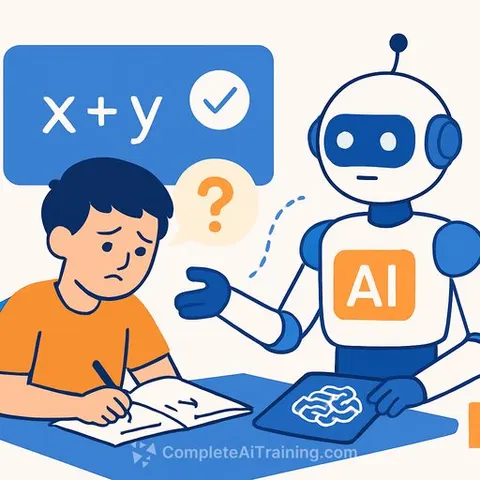
Vietnam's math institute warns students offloading homework to AI risk "intellectual decline"
Vietnam's top mathematics institute raised alarm on May 22 about students using AI chatbots to solve homework problems, saying the practice undermines learning and threatens to weaken students' thinking skills.
Professor Ho Tu Bao of the Vietnam Institute for Advanced Study in Mathematics (VIASM) tested how well an AI tool could explain a breakthrough mathematical proof. He asked it to describe how Ngo Bao Chau proved the Fundamental Lemma of the Langlands program - a problem that eluded mathematicians for decades until Chau solved it in 2008 and won the Fields Medal.
The AI produced an explanation that appeared to show understanding. In reality, Bao said, it was simply synthesizing information from datasets based on probability patterns.
Generative AI systems work on language models, not mathematical comprehension. They identify patterns and relationships within formulas but cannot grasp underlying mathematical concepts or connect them to real-world problems. "AI can understand the components of a mathematical formula and their relationships, but it lacks common sense and cannot connect mathematical knowledge to the stories of real life," Bao said.
Ta Ngoc Tri, deputy director of the Department of General Education at Vietnam's Ministry of Education and Training, expressed concern about how easily students now type homework problems into AI and receive instant answers.
This approach contradicts a principle from mathematician George Pólya's 1945 book "How to Solve It." Pólya argued that math teachers should act as guides, helping students discover solutions themselves. "A math teacher should play the role of a midwife, helping students neither too little nor too much. AI seems to be helping students far too much," Tri said.
The goal of math education is developing metacognition and higher-order thinking. Students need space to discover knowledge independently and preserve their creativity - something AI shortcuts eliminate.
A tool, not a replacement
Chau acknowledged that AI can serve as a powerful exploratory tool when teachers guide its use properly. The problem is that many students rely on it entirely to complete assignments, draining homework of its educational value.
Vietnam needs to rethink how it teaches, tests, and assesses students so AI becomes a learning aid rather than a way to avoid work. "Because without work, there can be no progress," Chau said.
Bao applies a personal rule: solve problems himself before consulting AI. He switched to oral exams at Foreign Trade University in Hanoi because direct conversation reveals whether students truly understand material. "We should require and train students to ask questions, not let them find answers immediately," he said.
New center launches to address AI challenges
VIASM launched a Center for Teaching and Learning Innovation to address how AI affects Vietnamese education. The center will conduct research on math teaching, train teachers, establish experimental classrooms, and develop a national math club system.
This year, the center plans two research projects on AI applications in math teaching and a teacher training program focused on developing metacognitive skills in students.
For more on how AI is shaping education and how generative AI and language models function, see related coverage.