
AI news ·
Voice AI offers efficiency gains for customer service but trust and accuracy risks require layered safeguards
Voice AI now handles full customer conversations across call and chat channels, but risks include hallucinations, voice cloning attacks, and brand damage when customers don't know they're talking to AI.
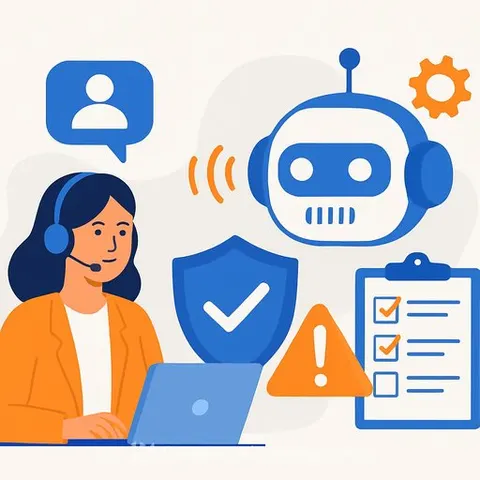
Voice AI in Customer Support: What You Need to Know About Risk and Trust
Voice AI is moving beyond chatbots. It's now an automated conversational interface that handles customer interactions across voice and text channels without losing context-starting a call, continuing in chat, triggering backend actions, and involving a human agent when needed, all while maintaining the conversation thread.
But voice AI carries real risks. Systems can hallucinate. They're vulnerable to voice cloning attacks. Data can be misused. And if customers don't know they're talking to AI, frustration with poor performance damages your brand.
For customer support teams deploying voice AI, understanding these risks-and how to mitigate them-determines whether the technology actually improves customer satisfaction or tanks it.
The main risks to address
Source verification and voice cloning. Voice cloning technology can replicate a person's voice with minimal input, making it hard to distinguish real communication from synthetic impersonation. When weaponized, this enables phishing schemes designed to trick people into sharing passwords or sensitive information. The voice sounds credible and familiar, which makes these attacks harder to detect.
Accuracy and hallucination. Voice AI systems can generate confident but factually incorrect responses. In financial, medical, or personal data interactions, unchecked inaccuracies create real liability. Your organization must validate outputs before they reach customers.
Transparency and consent. Customers have a right to know they're talking to AI. This becomes critical when the experience is degraded-lag, unnatural pacing, clunky conversation flow all signal the technology isn't ready. If customers don't know they're interacting with AI and the experience is poor, that frustration lands on your brand.
Technical safeguards that work
A layered architecture catches what individual controls miss. Key safeguards include:
- Input validation to detect manipulation attempts
- Independent output checking against your policies before responses reach customers
- Deterministic controls for high-stakes actions like refunds or account changes, routed through verification tools rather than AI judgment
- Pre-launch simulations with hundreds of test scenarios to catch edge cases before real customers encounter them
- End-to-end encryption, flexible data residency, PII redaction, and zero retention modes for sensitive data
Organizations that test extensively and implement these controls reduce failure rates significantly.
Building trust across four levels
Trust determines adoption speed. Your organization needs buy-in from customers, internal teams, enterprise infrastructure teams, and leadership. Each level has different requirements.
Customer trust. Rooted in interaction quality-voice quality, natural pacing, seamless handoffs to humans. Customers are increasingly aware they're talking to AI. Transparency and quality determine whether they engage or disengage. Consistency matters: the agent should behave the same whether customers call or chat. Configurable guardrails keep the agent on topic, following brand guidelines, and escalating when it reaches its limits.
Internal team trust. Support agents adopt AI when it makes their work better, not harder. Design agent workflows around escalation and collaboration. Route complex or sensitive interactions to humans with full context, so the handoff feels seamless rather than like starting over. Give agents and supervisors visibility into what the AI resolved, what it escalated, and why. Teams that use AI to handle routine volume can focus on higher-value interactions, reducing burnout while improving outcomes.
Enterprise trust. Determine what "enterprise-ready" means in practice-not just checkbox certifications but architecture that delivers security by design. Key considerations: regulatory compliance by industry (PCI DSS for financial services, HIPAA for healthcare, GDPR for European operations), data residency options, end-to-end encryption, zero retention modes for regulated workflows, and monitoring across every interaction. Platforms with vertically integrated stacks-where all models run in a single pipeline rather than chaining third-party services-deliver fewer data handoff points and stronger privacy by design.
Leadership trust. Connect CX improvements to business outcomes the C-suite cares about: churn reduction, revenue impact, lifetime value-not just average handle time. Unified analytics showing agent performance across every channel give leadership the data to justify scaling.
What customers actually think
A 2025 PolyAI report found 87 percent of customers are happy or willing to use AI voice agents for customer service. More than three-quarters of CX and customer service leaders believe AI voice agents could one day replace human representatives.
However, a 2026 Tempo AI analysis reported that 25 percent of customers didn't realize they were talking to AI until after completing the intake process, if at all. Among the 75 percent who recognized they were speaking with AI, only 12 percent asked to transfer to a human.
But customer acceptance has limits. A 2025 COPC survey found customers will accept limited empathy or a scripted tone if the interaction is effective. They will not accept unresolved issues or repeated effort. Satisfaction soars above 90 percent when resolution occurs without further steps. When AI fails to resolve the issue, Net Promoter Score drops by as much as 70 points.
Is voice AI right for your operation?
The ideal voice AI depends on your use case, brand identity, and audience. It must be authentic, localized, and capable of natural turn-taking without latency issues.
Voice AI is proving itself to have strong security provisions despite the scale and level of threat. Enterprise platforms are designed with encryption, access controls, audit logs, and strict privacy settings. But threats evolve. What works today must be continually upgraded to ensure the same level of protection in future.
For support teams considering voice AI, the decision hinges on whether you can implement proper safeguards, build trust across your organization, and commit to continuous monitoring. Done well, voice AI handles routine inquiries efficiently and frees your team for complex issues. Done poorly, it damages customer relationships and your brand.