
AI news ·
Wall Street banks demand law firms cut fees as AI speeds up routine legal work
Goldman Sachs, Morgan Stanley, and Citigroup are pressing elite law firms to lower fees, arguing AI now slashes the time for tasks like document review and contract analysis.
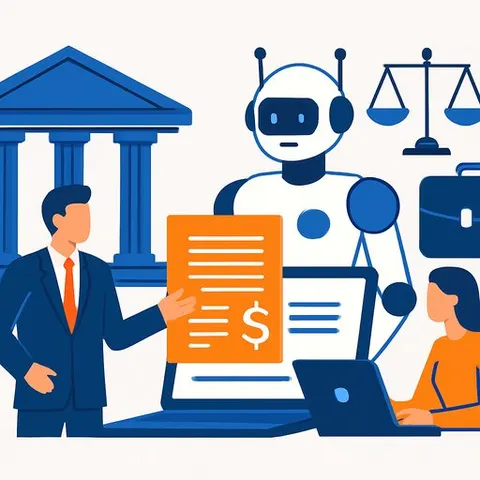
Three of Wall Street's biggest banks are demanding lower fees from elite law firms, arguing that artificial intelligence has sharply reduced the time required for routine legal work that once generated substantial billable hours. Goldman Sachs, Morgan Stanley and Citigroup are pressing outside counsel to cut costs as AI speeds up tasks including legal research, document review and contract analysis, according to the Financial Times.
"If the number of hours they're working on a matter has come down because of AI . . . our expectation is for costs to come down significantly per transaction," Adam Meshel, Citigroup's global head of legal, told the FT. The shift threatens a business model that has long made partners at top firms extraordinarily wealthy by billing clients for armies of junior associates - work that AI can now handle far more quickly.
The billable hour under pressure
Top lawyers have "for a long time been compensated on the foundation of [associates billing for long hours]," Morgan Stanley general counsel Eric Grossman told the FT. "Their compensation model is now extraordinarily unstable." Grossman added that AI's ability to speed up legal work could amount to "a fundamental altering of the revenue foundation for these mega firms."
Citi has begun asking law firms competing for its business to spell out how much they are saving by using AI. Meshel said a "different working model" would probably be in place within a year, adding that he wants the new arrangements developed collaboratively with the bank's outside lawyers. Morgan Stanley plans to put most of its outside legal work out for competitive bids by the end of the year and use alternatives to hourly billing such as fixed fees, while still paying top dollar for the judgment and expertise of leading attorneys.
Goldman Sachs has likewise asked outside firms for information about how much more efficiently they can perform work with AI and expects to share in the benefits, the FT reported, citing people familiar with the matter. Nearly half of large law firms surveyed this year by Citi's law firms group said AI had already affected how they price their work. So far, however, the disruption has been limited.
Clients expect to share the savings
Shama Hyder, a professor of practice at the Link School of Business, told the New York Post that the banks' demands are feasible even if law firms cannot measure every minute saved by AI. "Firms may not be able to calculate every minute AI saves, but they can compare similar matters based on total hours, staffing, turnaround time and cost," Hyder said. "Major banks have enough purchasing power to demand those numbers and make them part of competitive bidding."
Hyder said the technology could force a rethink of the billable-hour model because clients will resist paying the same amount for work that takes far less time. "If work that once took twenty hours can now be completed in five, clients are not going to keep paying as though it still takes twenty," she said. "Using AI to produce the same invoice faster is not going to satisfy clients."
The pushback comes as legal bills from the nation's largest firms have soared. Big Law's hourly charges have surged since 2023, with associate rates climbing 33% to an average $798 this year, according to Persuit data reported by the FT. Partners have seen a 29% increase during that period. Wall Street banks are particularly powerful customers for Big Law, relying on outside attorneys for work ranging from financing transactions and mergers and acquisitions to litigation and white-collar investigations.
Why this matters for legal professionals
The banks' demands signal that AI proficiency is becoming a competitive requirement, not a differentiator. For associates and partners alike, the ability to use AI tools for document review, contract analysis, and legal research is shifting from optional skill to baseline expectation. Law firms that cannot demonstrate efficiency gains risk losing business from clients who now expect to share in the savings. For paralegals and junior associates, following an AI learning path focused on legal automation may become essential as firms restructure staffing models around technology that handles gruntwork in a fraction of the time.