
AI news ·
Wealth management firms deploy agentic AI in contact centers to automate client services and compliance tasks
Wealth firms using agentic AI in contact centers cut human-handled calls by up to 26%. This shifts support staff to managing AI operations and resolving complex exceptions.
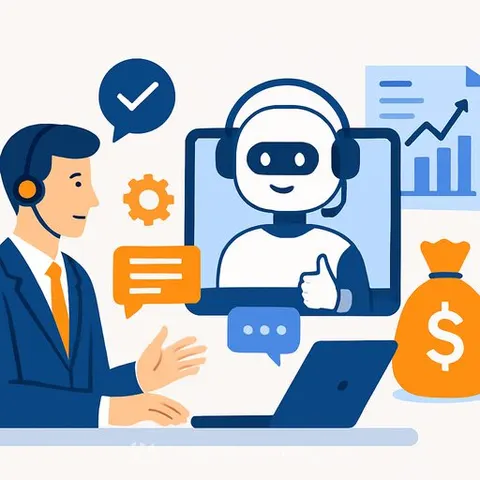
Wealth management firms are deploying agentic AI in customer contact centers at scale, with the technology moving beyond answering questions to taking independent action - resolving exceptions, sending proactive alerts, and cutting human-handled call volumes by up to 26%. The shift matters for customer support professionals because it redefines which tasks belong to machines and which require human judgment, changing daily workflows and the skills that contact center teams need.
What separates agentic AI from chatbots and copilots
Traditional automation follows predefined workflows. A chatbot matches keywords to scripted responses. A copilot suggests next steps but waits for a human to act. Agentic AI operates differently: it determines actions dynamically based on intent, context, and prescribed outcomes. It does not just recommend - it executes.
This distinction is central to the current wave of AI Agents & Automation in financial services. Where generative AI augments human work, agentic systems go further, handling tasks like validating identity documents during onboarding or triggering margin call alerts before a client ever picks up the phone. The goal is not advisor replacement. It is friction removal - ensuring clients reach the right human faster when complexity increases, while routine actions resolve without agent involvement.
Proactive engagement across the client lifecycle
Agentic AI proves its value in moments of urgency. During market volatility or major life events, the technology monitors accounts for issues and communicates with both clients and advisors preemptively - sending alerts about upcoming fees, tax-loss harvesting opportunities, or fee breakdowns. Voice channels remain critical during these high-anxiety moments, but the AI handles the monitoring and initial outreach.
In onboarding, agentic systems perform real-time Know Your Customer and Anti-Money Laundering checks, validating identity, address, tax, and employment data without manual review. Personalized onboarding journeys then adapt based on client profiles. Governance requirements - explainability, audit trails, consent-based data usage - must be embedded from the start to meet SEC and FINRA expectations.
AI agents can resolve 40-60% of exceptions autonomously, freeing advisor time for relationship-driven interactions. Virtual assistants provide real-time answers during service requests, reducing transfers and improving first-contact resolution rates.
Measurable business impact in contact centers
The operational numbers are stacking up across multiple deployments. Conversational AI has cut human-handled calls by 26% and service costs by up to 30%, with full-time equivalent reassignment achievable within 12-24 months. One AI voice assistant reduced billing call volume by 20% and shaved up to 60 seconds off customer authentication time.
Capgemini helped a British investment bank deploy an AI assistant that boosted chatbot containment from 30% to 65-70% while improving call routing. At a Dutch bank, the firm enabled a Gen AI customer assistant launch 25% faster than projected, cut cost to serve by 30%, and tripled response relevance. By mid-2026, a quarter of Gen AI-enabled contact-center interactions are projected to involve AI agents, and 25% of brands expect to increase self-service interactions by 10% - cutting average agent workloads by one hour per day.
Behind the scenes, the build process itself is accelerating. Gen AI-driven delivery has reduced analysis effort by up to 50%, build effort by 45-75%, and testing effort by over 50%, enabling faster deployment of multi-agent systems. These gains are reshaping AI for Customer Support operations, where technology stacks are shifting toward AI-first architectures and nontraditional CCaaS and CRM vendors are projected to capture 20% of global voice traffic in 2026.
Why this matters for customer support professionals
Agentic AI is not a pilot-stage experiment anymore. Contact center teams should expect their daily work to shift from handling routine inquiries to managing AI operations - overseeing escalation thresholds, reviewing confidence scores, and stepping in for complex or emotionally charged interactions. New roles are emerging: AI operations managers, conversational designers, prompt governance leads, and AI quality specialists. The professionals who build skills in AI oversight and exception handling now will be positioned for those roles as organizations move from testing to continuous AI ecosystems. The technology handles the predictable; humans own the moments that require judgment, empathy, and trust.