
AI news ·
West African sales executive releases free AI guide to help African SMEs compete in digital economy
A West African sales executive released his AI guide for free so small businesses across Africa could access tools they can't afford. Nigeria's 3MTT program now uses it as official training material.
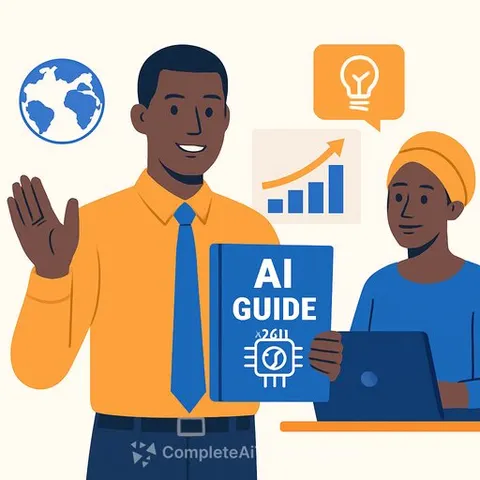
African Sales Leaders Push for Practical AI Adoption as Businesses Fall Behind
Kayode Kolawole spent nearly three decades building sales networks across West Africa. He watched competitors adopt new tools. He saw global markets shift. Then he realized most African salespeople had no practical way to learn AI.
Kolawole, a sales executive at a major sub-Saharan African distributor, released his book The Salesperson's Pocket Guide to Artificial Intelligence for free. His reasoning was simple: the people who need this knowledge most cannot afford to buy it.
"Knowledge without access is simply privilege," he said.
The Gap Between Theory and Daily Work
Across Africa, small businesses still rely on word-of-mouth, referrals, and instinct to survive. Yet global conversations about AI rarely address the realities facing sales teams in developing economies.
Kolawole noticed the disconnect early. "There is still a severe lack of practical and accessible frameworks that bridge the gap between complex AI theory and the day to day realities of sales execution in developing economies like ours," he said.
The book gained traction quickly. Nigeria's government-backed 3 Million Technical Talent programme (3MTT) now uses it as a training resource.
His decision to publish freely came from personal experience. Early in his career, mentorship and quality learning materials were hard to find. Young salespeople and fresh graduates competing against global standards faced the same barrier: cost.
A conversation with young sales professionals stuck with him. One asked: "Sir, where do we even learn these things without paying so much money?" That question pushed him to act.
How AI Strengthens, Not Replaces, Relationships
A common misconception holds that AI will eliminate the human element in sales. Kolawole rejects this framing.
"Sales have always been about building relationships, understanding customer needs and delivering value," he said. "The essence of sales has not changed, but the tools around it have evolved significantly."
AI's real advantage is efficiency. It handles routine tasks, freeing salespeople to focus on strategy and customer relationships. WhatsApp automation, CRM platforms, cloud accounting software, and AI-assisted customer service tools are already affordable and accessible in Lagos, Nairobi, Accra, and Kigali.
"Technology should support relationships, not replace them," Kolawole said.
SMEs Control Most African Jobs - But Lag on Tools
Small and medium-sized enterprises account for about 90% of African businesses and more than 80% of employment, according to the African Development Bank. Many still struggle with customer data management, inventory systems, and digital marketing.
Kolawole said one major misconception is that AI only matters to multinational corporations. "The question for African businesses is no longer whether they should adopt AI, but how quickly they can integrate it into their operations," he said.
Businesses that adopt AI will work more efficiently, close deals with greater precision, and deliver customer value at a higher level. Those that delay risk falling further behind.
Regional Challenges AI Can Address
Kolawole's experience overseeing sales across West Africa exposed persistent bottlenecks: customs delays, logistics gaps, payment challenges, language barriers, and financing constraints. These issues directly affect business survival and regional economic growth.
AI-powered systems offer solutions. Predictive logistics tools, digital payment systems, automated inventory management, and AI-assisted compliance processes are already improving operations across African markets.
Beyond efficiency, AI-powered sales skills could address Africa's youth unemployment challenge. Younger workers equipped with practical AI knowledge will compete more effectively in global markets.
People Still Buy From People They Trust
Fears that AI will eliminate sales jobs misunderstand how commerce works. "People still buy from people they trust," Kolawole said. "AI can automate tasks and improve processes, but it cannot replace empathy, listening, or genuine concern for a client's success."
His long-term vision extends beyond the book. He aims to help African businesses move from survival mode to sustainable growth through better sales leadership and wider access to digital knowledge.
"Africa is full of brilliant young people who simply need access," he said. "If we equip them with the right tools and practical knowledge, they will compete anywhere in the world."
For sales professionals looking to build these skills, resources like AI Learning Path for Sales Representatives offer structured guidance on applying AI to lead generation, CRM optimization, and revenue growth.