What Recent HR Tech Research Says About the Demand for Multilingual AI Assistants
AI has moved from side project to core HR infrastructure. The market backs it up: AI in HR was valued at USD 3.25 billion in 2023 and is projected to hit USD 15.24 billion by 2030 at a 24.8% CAGR. The broader HR software market is set to grow from USD 27.51 billion in 2024 to USD 60.52 billion by 2030, fueled by cloud HR, automation, and analytics. The takeaway: AI isn't optional in the next HR stack.
Global Hiring Has Outgrown One-Language HR
Distributed teams span North America, Europe, Asia, and Africa. Many employees don't share a native language with HQ, yet they still need clear, accurate answers on pay, benefits, leave, and compliance. For too many, that means decoding dense policy PDFs in a second language just to understand basic rights.
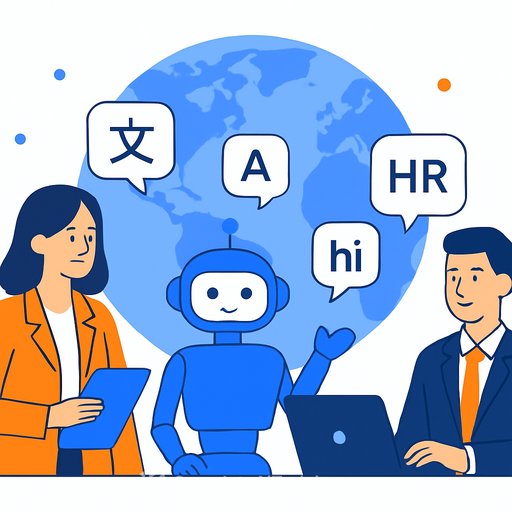
HR teams are responding with multilingual assistants across webchat, email, and IVR. Some are even piloting multilingual voice agents built on modern architectures like Falcon so one knowledge base serves every region without duplicating content by language. The result is consistent support with far less maintenance overhead.
Research on multilingual hiring shows a direct growth effect. Organizations that post jobs and communicate with candidates in multiple languages widen the funnel and improve conversion from views to applications because candidates can evaluate roles in a language they trust.
Why Multilingual AI Assistants Are Becoming the Default
HR tech trends point to AI assistants that run 24/7, handle routine questions, route tickets, and pre-screen candidates. IBM frames HR chatbots as tools that streamline services from FAQs to onboarding and benefits enrollment-practical, high-volume work that eats time on HR desks. See IBM's overview for a useful baseline.
Make those assistants multilingual and they do more than save time. They create fairness. Every employee can ask in their preferred language and get a consistent, policy-aligned answer without relying on a manager's informal translation.
This also improves accuracy and compliance. Answers come from a single source of truth, not ad-hoc interpretations. That reduces risk around overtime, leave eligibility, and benefits cutoffs-areas where small misunderstandings become real financial or legal exposure.
From Multilingual Hiring to Multilingual Employee Journeys
Once a candidate becomes an employee, the language gap doesn't disappear. New hires still need help with onboarding checklists, expense policies, security training, and health plan choices. A multilingual assistant can guide every step in their native language and keep them moving without tickets.
After onboarding, the same assistant can recommend learning modules, answer performance cycle questions, and point to local policies on remote work and time off. The "always available" helpdesk experience finally reaches every region, not just those fluent in the corporate language.
How to Roll Out a Multilingual HR Assistant (Practical Checklist)
- Start with the top 20 intents: pay dates, leave balances, holidays, benefits eligibility, onboarding steps, and policy lookups.
- Centralize the knowledge base: single policies, country addenda, and FAQs with clear version control and owners.
- Use retrieval-augmented generation (RAG) to keep answers source-linked and auditable; block the model from improvising policy.
- Prioritize language coverage by headcount and risk. Add human-in-the-loop QA for translations on legal and payroll content.
- Offer multiple channels: webchat, mobile, email, and IVR for deskless teams. Keep intents consistent across channels.
- Define escalation rules to HR or payroll when confidence is low or topics are sensitive (grievances, terminations, compliance flags).
- Instrument everything: track deflection, first-contact resolution, CSAT/eNPS, and policy adherence.
- Align with IT and Legal on data retention, PII handling, and audit logs. Limit access by role and region.
- Train managers and employee reps. Set expectations on what the assistant can answer and what it will route.
- Review weekly for drift and gaps; update the knowledge base as policies change.
Metrics That Matter
- Self-service deflection rate and first-contact resolution by language and channel.
- Average handle time for HR tickets and SLA response times pre/post assistant.
- Hiring conversion: views-to-apply and time-to-hire for multilingual postings vs. single-language.
- Onboarding completion time and checklist adherence by language.
- Compliance indicators: fewer policy misinterpretations on overtime, leave, and benefits.
- Employee satisfaction: CSAT for assistant interactions and eNPS changes by region.
Tooling Notes
Choose models with strong multilingual comprehension rather than relying only on machine translation. Use RAG with policy citations to keep answers grounded and consistent. For voice and IVR, pair real-time speech recognition with language detection and a safe fallback to human support for edge cases.
Keep your stack simple: one knowledge base, one orchestration layer, and consistent intent schemas across channels. The complexity lives in governance and QA, not in spinning up five different bots.
Scaling HR Fairly Across Borders
HR platforms are baking in AI. Analysts flag assistants as a core capability. Hiring data shows multilingual content widens and diversifies pipelines. Case studies prove assistants can automate routine work while improving response times and consistency.
For cross-border teams, multilingual AI assistants are the practical path to fair, 24/7 support. They keep policies consistent, reduce repetitive tickets, and give every employee a clear view of pay, benefits, and opportunity-regardless of language or time zone.
If your team is building skills to implement or govern these tools, explore practical training and certifications here: AI courses by job function.
Your membership also unlocks: