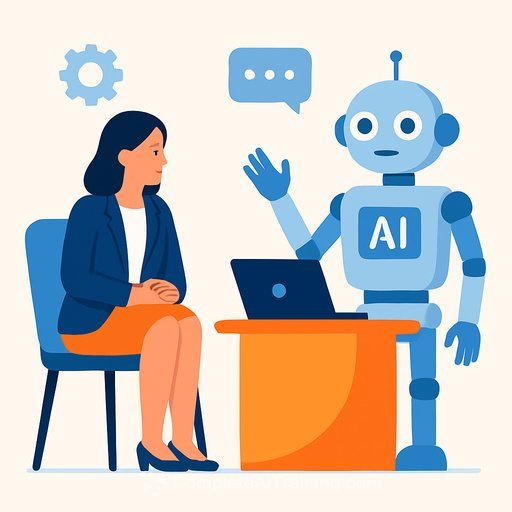
Why HR Must Be Involved in AI Strategy from Day One
Most companies talk big about AI. Few build the people engine to power it. A recent survey shows only 30% of HR leaders are involved from the start, while nearly half are looped in late during implementation. That's how good ideas stall.
"You're going to have a great vision, but you're not going to be able to execute on that vision because you don't have the human resources to do it," says Siobhan Calderbank, vice president, talent and performance at Element Fleet Management. She's right. No talent plan, no AI plan.
HR at the Start: The Difference Between Vision and Delivery
HR owns capabilities, workforce planning, and learning. That means HR must help define the AI ambition, assess current skills, and decide whether to build, buy, or redeploy the talent required. Rachel Wong, director of HR technology and people analytics at Symcor, puts it plainly: training is owned by HR, so HR needs a seat at the strategy table.
Skip this and the strategy cracks under talent gaps, change fatigue, and unclear accountability.
Make AI Strategy and Talent Strategy the Same Conversation
AI is reworking roles. New jobs appear. Existing jobs shift. Talent acquisition and development are no longer adjacent to AI-they are the core.
- Define the skills portfolio for AI-literate roles: data literacy, prompt quality, judgment, ethics, QA, and process thinking.
- Update job architecture and career paths to reflect AI-augmented work, not just titles.
- Hire for curiosity and comfort with AI tools. "Do candidates show creativity and are they using the tools?" says Calderbank. Build that into screening and interviews.
- Use skills-based assessments, portfolios, and job trials to validate capability-not just keywords.
Training, Guardrails, and Real Adoption
Employees are using AI with or without guidance. Many don't disclose it. Others never got training. That's a risk and a missed productivity boost. HR should lead with enablement and oversight that people actually trust.
- Learning program design: fundamentals, role-based use cases, hands-on labs, and refresher cycles every quarter.
- Bring in subject matter experts for live demos, Q&A, and office hours. Keep a safe, low-stakes sandbox for practice.
- Set clear rules: disclosure norms, data handling, privacy, bias checks, and approval paths for new tools.
- Create simple playbooks: prompts that work, QA checklists, and examples for common workflows.
As Calderbank notes, don't "roll out a platform, offer a short training, and walk away." Keep the reps going.
Build HR's Own AI Capability First
"As HR leaders, we need to know what is AI and we need to be AI users ourselves," says Wong. Credibility matters. If HR can't speak the language or demonstrate useful workflows, adoption stalls.
- Run weekly practice: draft policies, interview guides, learning plans, and analytics summaries with AI-then review for quality.
- Create a prompt and use-case library for HR tasks: requisitions, sourcing, screening summaries, job ad rewrites, candidate outreach, policy drafts, and survey insights.
- Partner with Legal, IT, and Security on safe tools, data boundaries, and vendor checks.
Mobilize Culture Champions
AI isn't a one-time project. It's a new way of working. Calderbank recommends mobilizing "culture champions" to keep learning active and honest.
- Nominate champions across functions and levels. Give them training first, plus time to coach peers.
- Run short, regular show-and-tell sessions: what worked, what failed, and what to try next.
- Collect feedback and route it back to HR for updates to training, tools, and policy.
This keeps energy high and prevents AI from becoming an isolated tech rollout.
Measure What Matters (and Share It)
Executives are confident in AI. Many still skip the hard work of task and skills analysis. HR can bring the proof.
- Adoption: active users, use cases per team, and disclosure rates.
- Quality: error rates, revision cycles, and stakeholder satisfaction.
- Speed: time-to-hire, time-to-fill, time-to-competency, time saved per workflow.
- Talent outcomes: internal mobility, critical skill coverage, retention of AI-skilled employees.
- Business outcomes: cost avoided, productivity gains, and impact on revenue-driving activities.
Link these metrics to decision-making. Bring workforce data and employee sentiment to balance optimistic projections with reality.
A 90-Day HR Action Plan
- Days 0-30: Map AI use cases by function, run a quick skills inventory, and agree on guardrails with Legal/IT. Launch an HR-led pilot with a few high-value workflows.
- Days 31-60: Stand up learning tracks by role, open a practice sandbox, and kick off culture champions. Publish disclosure and data guidelines.
- Days 61-90: Expand pilots, codify playbooks, and report early wins. Lock in metrics and a quarterly review rhythm with the exec team.
Keep People at the Center
AI may scale, but people still want connection and safety. "How do we make sure people feel valued, engaged, and safe to try-and fail-without being penalized?" asks Calderbank. That's HR's lane: change skills like adaptability, resilience, and continuous learning.
If HR isn't there from the start, you'll build tech without the pipeline to support it-and it will fall apart. If HR leads, you get skills, trust, and outcomes.
Where to Start If You Need Training Support
If your teams need structured, practical upskilling paths, explore role-based programs and certifications that match your org's goals.
AI strategy is now core HR strategy. Take the seat early. Build the capability. Keep the culture moving. That's how the vision turns into results.
Your membership also unlocks: