
AI news ·
Widely cited paper on ChatGPT learning benefits gets retracted
Springer Nature retracted a ChatGPT learning study after it amassed roughly 500,000 reads and hundreds of citations. Researchers say the paper combined incompatible studies and couldn't plausibly cover enough data in its 2.5-year window.
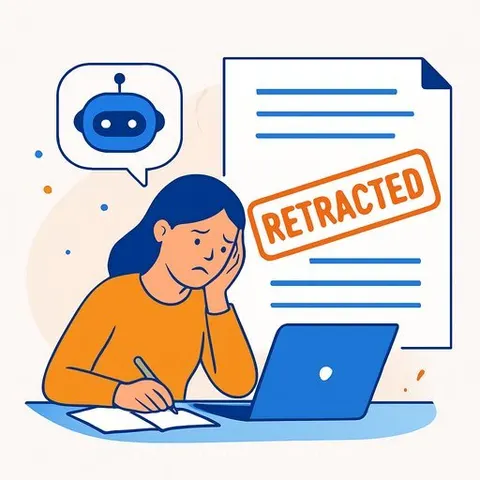
Major Education AI Study Retracted After Hundreds of Citations
A widely-cited paper claiming ChatGPT improves learning outcomes has been retracted by Springer Nature, undercutting claims that were treated as definitive evidence for AI in classrooms.
The paper accumulated roughly 500,000 reads and hundreds of citations before its removal. Ben Williamson, a senior lecturer at the Centre for Research in Digital Education at the University of Edinburgh, said the work "should not have been published in the first place."
Williamson identified several problems with the research. The authors appeared to synthesize low-quality studies and combined findings from research using incompatible methods, populations, and sample sizes. The timing raised red flags too: the paper was published just 2.5 years after OpenAI released ChatGPT in November 2022, making it implausible that dozens of rigorous studies on ChatGPT's learning effects could have been conducted and published in that window.
"It was treated by many on social media as one of the first pieces of hard, gold standard evidence that ChatGPT, and generative AI more broadly, benefits learners," Williamson said.
Schools Backing Away From Digital Learning
The retraction arrives as some education systems are reducing their reliance on digital tools. Sweden has begun cutting back on classroom technology, citing research on how screens disrupt learning.
Dr. Sissela Nutley, a neuroscientist at the Karolinska Institute in Stockholm, points to evidence that students lose concentration when watching peers use screens nearby. Research also shows that reading on digital devices makes it harder for children to process information, and heavy screen use may affect younger students' brain development.
The core issue is physical. Learning letters and numbers requires hand-eye-mind coordination. When machines handle the work, students don't.
For educators evaluating AI tools, the lesson is straightforward: claims about transforming learning require solid evidence, not social media momentum. The retracted paper's reach demonstrates how quickly unvetted research can influence decisions about classroom technology.
For guidance on implementing AI responsibly in education, see AI for Education or explore the AI Learning Path for Teachers.