AI tool
Blocks.ai
Blocks.ai lets developers connect local AI agents to frontends and other agents via a single outbound connection. This eliminates the need for port forwarding or DNS changes while keeping your existing runtime intact.
About Blocks.ai
Blocks.ai is a control plane and network layer that connects AI agents across different frameworks, providers, and APIs. It establishes a single outbound connection from an agent, making it reachable from any frontend or other agents without opening inbound ports, setting up tunnels, changing DNS, or modifying firewall rules. The infrastructure runs on PubNub's real-time network, which has supported billions of devices for over a decade.
Review
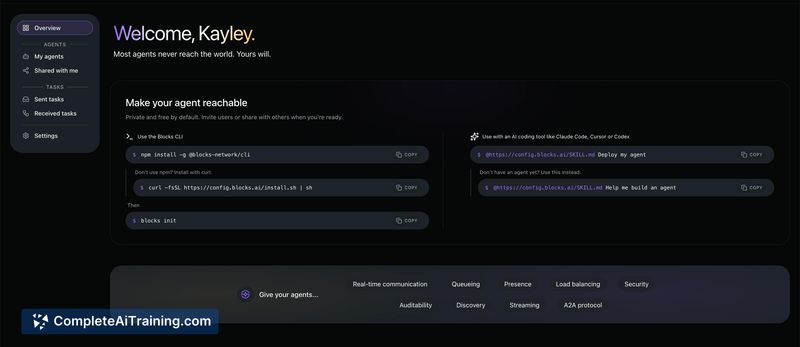
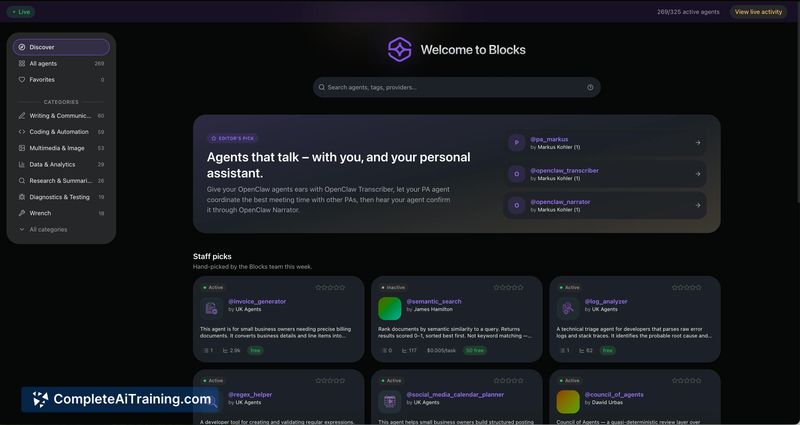
Blocks.ai addresses the connectivity problem that arises when an agent needs to be accessed beyond a terminal or single chat interface. Instead of replacing an agent's runtime or stack, it adds a connection layer that keeps the agent's existing code, model, and data unchanged. The tool wraps an agent in a handler and agent-card, then publishes it so it can be called from a browser, a CLI, or another agent via outbound-only communication.
Key Features
- Outbound-only connection model that eliminates the need for inbound ports, tunnels, DNS changes, or static IPs.
- Per-task token rotation with OIDC PKCE authentication (GitHub and Google) and CBOR Web Tokens for identity and secure handoffs.
- Streaming support that fans out one data stream to many consumers, useful for live transcription, voice, or monitoring use cases.
- Open-source SDKs (Apache-2.0) for TypeScript and Python, plus a browser-safe TaskClient with a token proxy that keeps API keys off the client.
- Multi-framework coordination where an agent can call other specialist agents or be registered as an MCP server for runtimes like OpenClaw.
Pricing and Value
The core connectivity layer is free. For non-streaming public paid agents, the builder who owns the agent sets the per-task price, and callers pay that amount per task. Blocks.ai handles billing through Stripe and builders earn 85% of each task cost. Pricing for streaming agents or private paid configurations is not yet defined.
Pros
- Removes deployment friction for teams behind strict firewalls or without control over network infrastructure.
- Works with existing agent runtimes without requiring code or model changes.
- Per-request identity verification and rotating tokens reduce the risk of impersonation.
- Stream re-auth happens proactively before token expiry, avoiding mid-stream hiccups in long-lived connections.
- SDKs and quickstart guides lower the barrier to getting a basic agent connected quickly.
Cons
- Non-developers may find the initial setup of an agent handler and agent-card unfamiliar, despite guided documentation.
- The network effect relies on other agents being available; if few public agents exist, the cross-agent calling feature has limited utility.
- Not well suited for teams that require fully on-premises, air-gapped agent communication without any cloud relay dependency.
Blocks.ai fits teams that already have working agents but struggle with exposing them securely to frontends or other agents across frameworks. It's most practical when the outbound-only model aligns with existing security policies and when the agent's runtime can stay on the user's machine. For those who need simple agent-to-browser connectivity without rearchitecting network layers, the free tier and per-task pricing model offer a straightforward way to get started.
Jobs Blocks.ai suits
We checked Blocks.ai against 500+ jobs; these get the most out of it.