About Execlave
Execlave is an AI Agent Governance and Enforcement platform (runtime AMP) that sits between autonomous agents and real systems. It evaluates every agent action against policy before execution, rather than reviewing logs after incidents. The platform is built for platform and security teams that need runtime policy enforcement, kill switches, and audit-ready trails for enterprise compliance frameworks like SOC 2, EU AI Act, and ISO 27001.
Review
Execlave launched this week as a runtime gate between AI agents and the systems they touch. It was created by a small founding team who built it in response to a specific gap: most agent observability tools record what happened after the fact, but none could refuse a call in the execution path. The platform's working assumption is that written governance policies only matter if something enforces them at the moment an agent acts.
Key Features
- Policy enforcement - 20 policy types evaluated synchronously before each agent action, with four enforcement modes: block, warn, monitor, and require_approval.
- Structured denials - When a policy blocks an action, the agent receives a structured violation array with policyId, policyName, policyType, message, and enforcementMode, so it can reformulate and re-submit rather than hitting a dead end.
- Distinct outcome taxonomy - Pre-execution decisions and post-execution outcomes are separate records correlated by trace ID. Outcome status is a closed enum (success, error, timeout, policy_blocked, limit_exceeded, flagged_for_review), with policy violations landing in a dedicated table.
- Fail-open provenance - Each policy has a failureMode (fail_open default, fail_closed opt-in). When governance is unreachable and an action runs anyway, the bypass event is marked with provenance (fail_open_network_error, fail_open_server_error, fail_open_circuit_breaker) and timestamped at the moment of bypass.
- Adversarial probe testing - Before an agent touches real infrastructure, Execlave runs a test suite of privilege escalation attempts, injection payloads, and out-of-scope actions against the policy engine. Promotion to the autonomous tier requires a minimum resilience score of 0.9 by default.
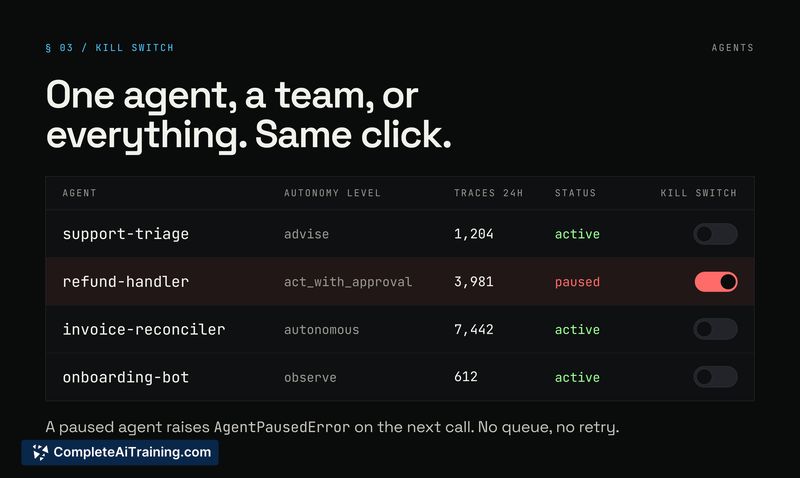
- Kill switch - One-click stop for a single agent, a team, or everything at once.
Pricing and Value
Execlave has a free evaluation plan covering one agent and 500 traces with no credit card required. That plan is non-commercial. Production access starts at $199 per month. The vendor notes that the first weeks with the platform involve defining what your agents are actually allowed to do, and states they ship 19 policy types with sensible defaults rather than pretending policy setup is automatic.
Pros
- Policy enforcement happens synchronously in the request path with sub-20ms latency, which is fast enough that teams won't disable it for performance reasons.
- Pre-execution decisions and post-execution outcomes are separate records, so "blocked by policy," "never reached the system," and "the system said no" are three distinct outcomes rather than collapsed into one log line.
- Denials carry enough structured context for agents to reformulate requests, and enforcement modes include warn and require_approval for steering behavior without halting runs.
- An "observe" tier evaluates every action in production traffic without blocking anything, so you can telemetry on what would have been stopped before enabling enforcement.
- Policy failure modes are explicit, including a recorded and timestamped bypass event when governance itself goes unreachable.
Cons
- The bypass event for fail-open scenarios is emitted client-side to your SIEM because, by definition, the Execlave server didn't receive the call. The ungoverned window is reconstructable but only if you wire the handler correctly.
- Distinguishing timeouts from errors depends on your integration's reporting code; Execlave enforces the taxonomy and rejects malformed outcomes, but your integration decides whether a failure was a socket timeout or a 503 response.
- Not well suited for teams without existing governance policies written down; the platform enforces what you give it, and the vendor explicitly notes your first week is spent deciding what your agents are actually allowed to do.
Execlave fits environments where agents take real actions against production systems and there is either an existing policy set or willingness to define one in the first week. It is most useful for platform teams, security engineers, and compliance officers who need to determine whether something happened, and an auditor will ask at 14:02 what happened. Teams with no governance process at all will likely struggle with the setup layer.
Open 'Execlave' Website
Your membership also unlocks: