AI tool
Parsewise API
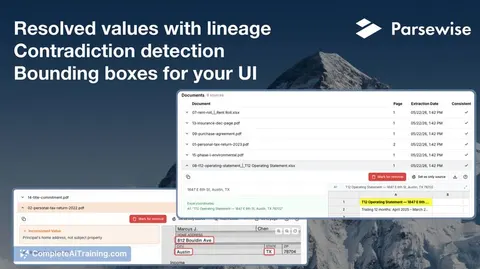
Parsewise API: one call replaces your document-processing pipeline, send documents + schema, get resolved values, flagged contradictions, and full lineage with word/page/doc bounding boxes for direct UI validation.
About Parsewise API
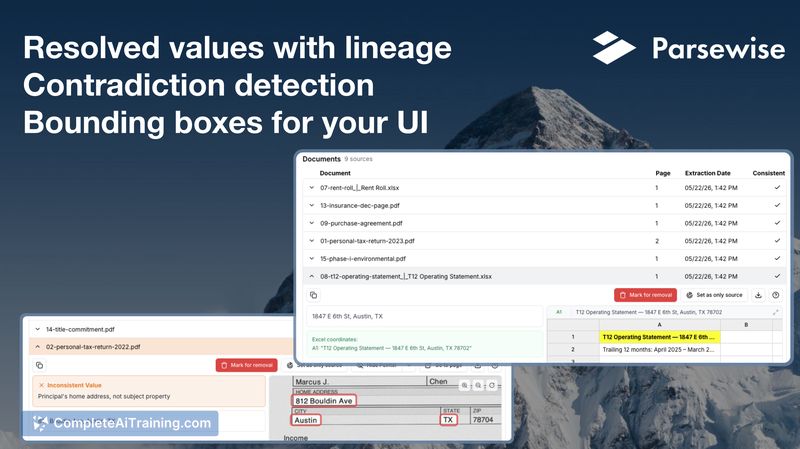
Parsewise API is an agentic multi-document processing API that accepts multiple files and a target output schema in a single call. It returns resolved values, flags contradictions, and provides full provenance down to source words, pages, and documents with bounding boxes suitable for embedding in your own UI.
Review
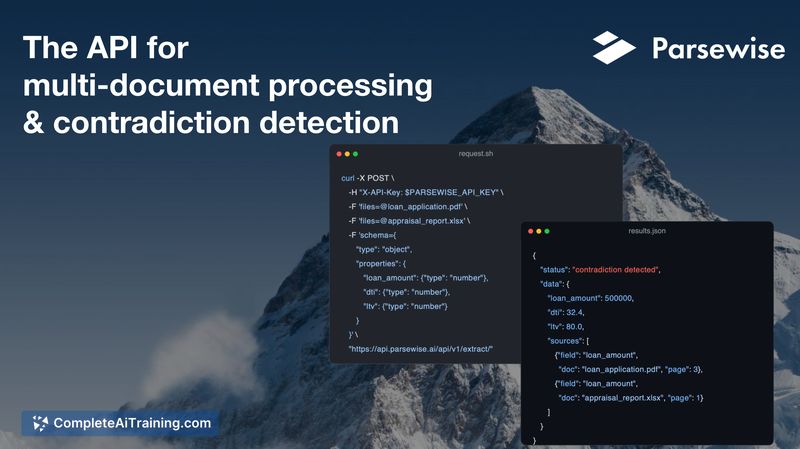

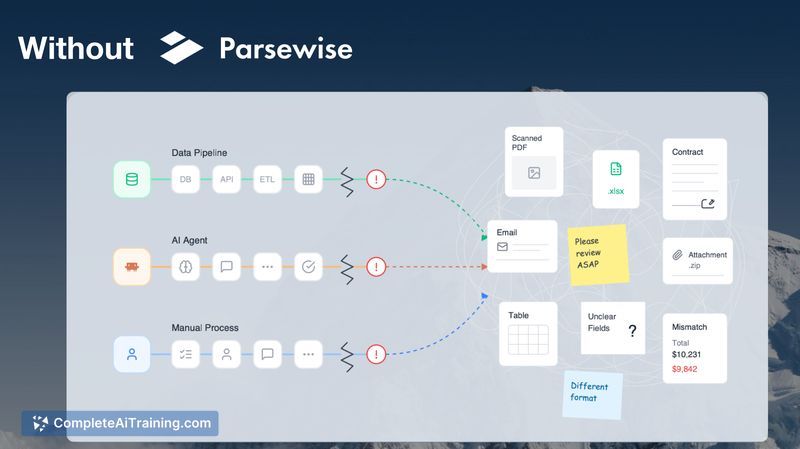
This review covers Parsewise API's core capabilities, integration workflow, and fit for teams that handle large-scale document processing. I evaluate its feature set, traceability mechanisms, pricing indications, and practical strengths and limitations.
Key Features
- Single-call multi-document processing that replaces an end-to-end pipeline of parsing, extraction, reconciliation, and verification.
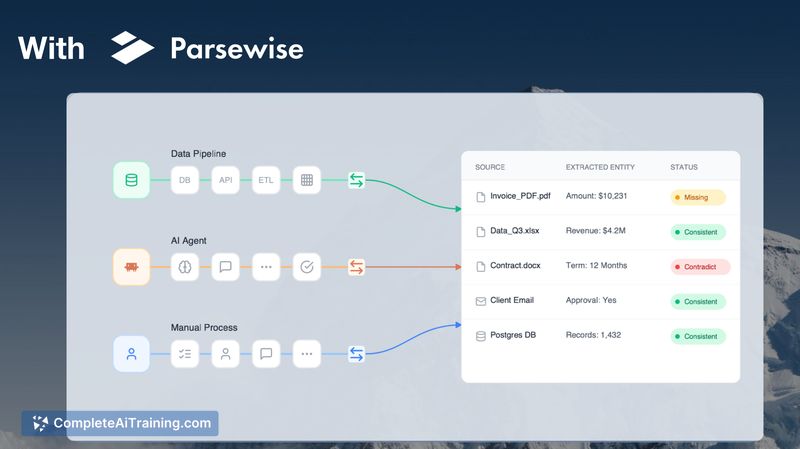
- Resolved output values with contradiction detection across all provided documents and pages.
- Full lineage and provenance down to source words, pages, and document-level locations, plus visual bounding boxes for PDFs and focused previews for spreadsheets (cell references).
- Support for mixed input formats (scanned PDFs, spreadsheets, plain text) within the same call and agentic reconciliation guided by editable rules.
- Public documentation and quickstart guides, plus a free tier/credits for initial testing and sandboxing.
Pricing and Value
Parsewise API offers a free tier with credits intended to let teams try the platform on a few thousand pages before committing. The product is delivered as an API-based usage model, so costs will scale with volume and complexity of processing. Its main value proposition is reducing engineering time by replacing custom pipelines and providing traceable outputs that are easier to validate operationally.
Pros
- Consolidates parsing, extraction, reconciliation, and verification into one API call, simplifying integration.
- Strong provenance and UI-friendly bounding boxes or cell references, which help with human validation and auditing.
- Cross-document contradiction detection and explicit reconciliation logic reduce manual reconciliation work.
- Works with mixed file types in the same request and provides public docs and quickstarts for faster onboarding.
Cons
- Relies on external model families for reasoning and extraction, which can introduce variability in latency, cost, or behavior depending on model choices.
- Lineage presentation differs by format (visual bounding boxes vs. cell refs vs. text offsets), which can require UI work to ensure consistent click-to-source experiences.
- Recently launched so independent reviews and long-term production case studies are still limited.
Parsewise API is well suited for teams in insurance, finance, M&A, or any operation that needs defensible, auditable decisions from many heterogeneous documents. For organizations building and maintaining complex document pipelines, it can save engineering effort and improve traceability; smaller teams with occasional single-document tasks may find a simpler extraction tool more cost-effective. Try the free credits and the public quickstart to evaluate how it fits your workflow: getting started and sign up.
Jobs Parsewise API suits
We checked Parsewise API against 500+ jobs; these get the most out of it.
Alternatives to Parsewise API
Other tools that do the same main job. Our AI compared Parsewise API with similar tools and kept the ones you could use instead.