MCP server · Gaming
Game Numerics MCP server
Let your AI read your game's xlsx balance tables, audit curves, and run battle or gacha simulations.
This is a helper for game designers who keep their balance numbers in spreadsheets. It lets your AI open those xlsx config tables, check whether your growth curves make sense, and run quick simulations of battles or gacha pulls. It is handy for solo designers and small teams who do roguelike, deckbuilder, or live-ops tuning work and do not want to wire anything into a game engine.
What is an MCP server? The 30-second version
On its own, your AI can only chat. An MCP server is a small helper program that gives your AI a new skill or a connection to something else. This one connects your AI to a set of number-crunching engines for game balance, so it can read your spreadsheet exports and do the math for you. You just ask in plain words, and the helper does the calculations behind the scenes.
What this MCP server does
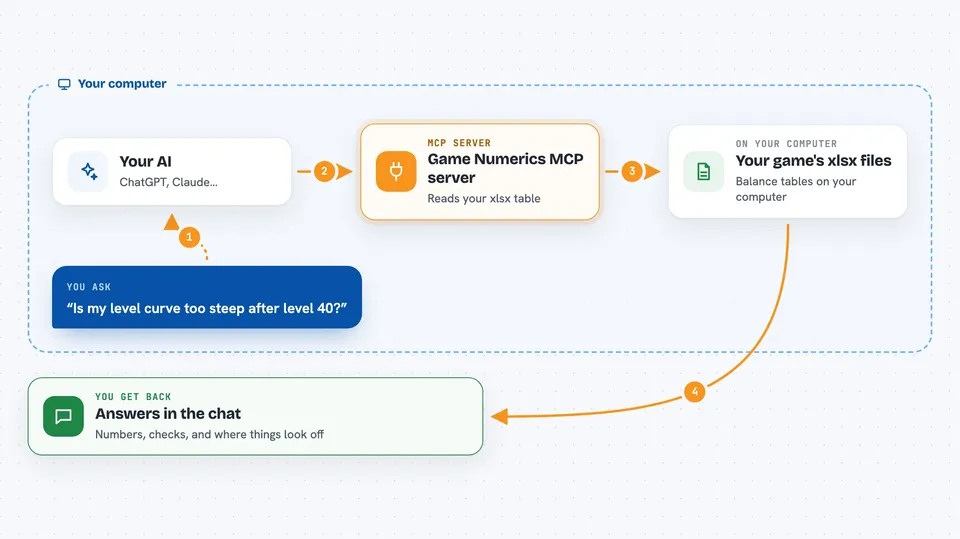
You ask your AI a question about your game's numbers, like whether your level curve is too steep. The AI uses this helper to open your xlsx config table and look at the columns. The helper runs the numbers through its own calculation engines, not through the AI's guesswork. Then it hands the results back to the AI, which explains them to you in the chat. Everything is read-only, so it looks and checks but does not change your files.
 Click to zoom
What you can do with it
- Import an xlsx config table and turn it into something your AI can read
- Audit a column of numbers to spot odd jumps or broken patterns
- Guess the rule behind a column, like a growth curve or a multiplier
- Run a battle simulation with your stats and see who wins
- Simulate gacha pulls to see your drop rates in practice
- Project how a stat grows across levels
- Check how your economy earns and spends resources over time
Try asking your AI
- “Here is my units.xlsx, can you check if the attack growth column looks healthy?”
- “Simulate 1000 gacha pulls with my current rates and tell me the average cost per rare”
- “My level curve feels too steep after level 40, can you look at the table and confirm?”
- “What formula is behind the HP column in my enemies sheet?”
What it gives back to you
You get answers in the chat, not files. That can be a short summary of what the helper found, a list of columns it checked, or numbers like average pulls, win rates, or projected stats. If something looks off, the AI will usually point at the row or column where it noticed the problem. Nothing in your spreadsheet gets changed.
Before you start
What you need
- Node.js 18 or newer installed on your computer
- An MCP host app like Claude Code, Cursor, or ZCode
- Your game config tables saved as an xlsx file
Good to know
It is read-only, so it will not change your files, but it does read the spreadsheets you point it at, so keep private or unreleased data in mind.
Install it with your AI
Add Game Numerics MCP server to your AI, no technical skills needed
You don't install anything by hand. You copy one prompt, paste it into an AI that can work on your computer, and it checks, installs and connects the server for you, asking you when it needs something.
Sign in to get the install prompt
Members get a ready-made prompt that lets the Claude desktop app check Game Numerics MCP server, install it and connect it for them, step by step. You don't need any technical skills: you copy, paste and answer a few questions. Your connected AI can also find and install any of the 4,361 MCP servers here for you.
Who it's for
Game designers and small teams doing balance work on roguelikes, deckbuilders, or live-ops games who already keep their numbers in spreadsheets.