MCP server · Research
1000 Genomes MCP server
by dnaerys
Ask your AI about human genetic variants from the 1000 Genomes Project and get real answers.
This is a helper that connects your AI to the 1000 Genomes Project, a big public collection of human DNA differences from over 3,000 people. It is handy for anyone curious about genetics, whether you work in a lab, study biology, or just want to look something up. You ask in normal words, and the AI goes and finds the data for you.
What is an MCP server? The 30-second version
On its own, your AI can only chat with you using what it already learned. An MCP server is a small helper program that gives your AI a new skill or a connection to an outside service. This one connects your AI to the 1000 Genomes Project dataset, which lives online. So when you ask a question about genetic variants, your AI can actually go look them up instead of guessing.
What this MCP server does
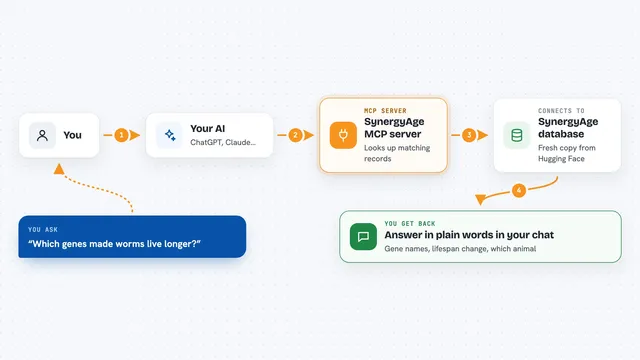
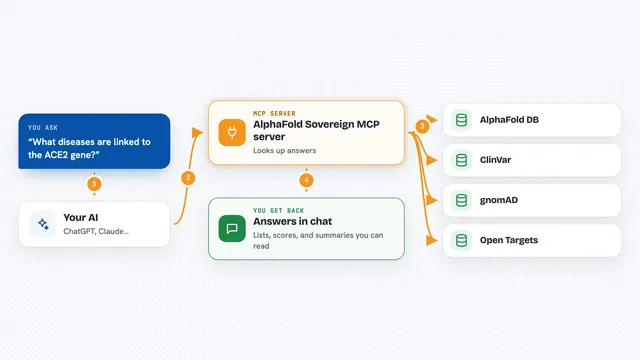
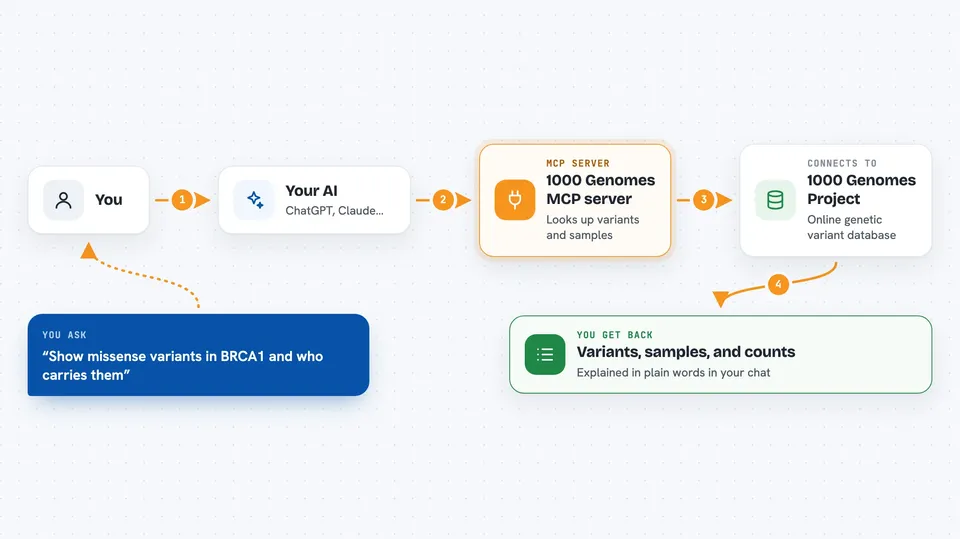
You type a question in plain English, like asking which variants exist in a certain gene or which people carry them. Your AI sends that request to this helper. The helper talks to the online 1000 Genomes database and pulls back the matching variants, samples, and notes. Then your AI explains what it found in the chat, in words you can read. You never have to learn a query language or a special website.
 Click to zoom
What you can do with it
- Look up genetic variants by position, gene, or annotation
- Find which samples carry a particular variant
- List populations and superpopulations in the dataset
- Get basic facts about a sample, like its population and family links
- Filter variants by impact, clinical significance, or predicted effect
- Compute simple statistics like average AlphaMissense scores or variant burden
- Check how closely related two samples are
Try asking your AI
- “How many variants are in the 1000 Genomes Project?”
- “Show me missense variants in the BRCA1 gene and which populations carry them.”
- “Find samples from the African superpopulation and list their populations.”
- “What is the average AlphaMissense score for variants in TP53?”
What it gives back to you
You get back lists of variants or samples, short summaries, and numbers like counts or averages. The AI writes these out in the chat as a table or a paragraph, whichever fits. If you asked for something like variant burden, you get a number with a short explanation. Nothing is changed on your computer; it is all read-only information coming back to you.
Before you start
What you need
- An MCP client that can connect to a remote server, like Goose or another tool that supports remote MCP
- An internet connection
Good to know
This server is read-only, so it will not change or delete anything, but the genetic data it returns is for research and learning, not medical advice.
Install it with your AI
Add 1000 Genomes MCP server to your AI, no technical skills needed
You don't install anything by hand. You copy one prompt, paste it into an AI that can work on your computer, and it checks, installs and connects the server for you, asking you when it needs something.
Sign in to get the install prompt
Members get a ready-made prompt that lets the Claude desktop app check 1000 Genomes MCP server, install it and connect it for them, step by step. You don't need any technical skills: you copy, paste and answer a few questions. Your connected AI can also find and install any of the 4,361 MCP servers here for you.
Who it's for
Anyone curious about human genetics, including students, lab researchers, and people in biology or medicine who want quick answers without learning a database.