MCP server · Research · official
SynergyAge MCP server
by longevity-genie · official
Lets your AI look up how combining genes changes lifespan in worms, flies and mice.
This is a small helper that connects your AI assistant to SynergyAge, a research database about how genes affect lifespan. It is handy if you read or write about aging research and want quick answers without digging through papers yourself. You just ask in plain words, and the AI looks it up for you.
What is an MCP server? The 30-second version
On its own, your AI can only chat with you using what it already knows. An MCP server is a small helper program that gives your AI a new skill or a connection to an app or service. This one connects your AI to the SynergyAge database, so it can look things up there when you ask. You do not need to understand how it works inside; you just add it once and then talk normally.
What this MCP server does
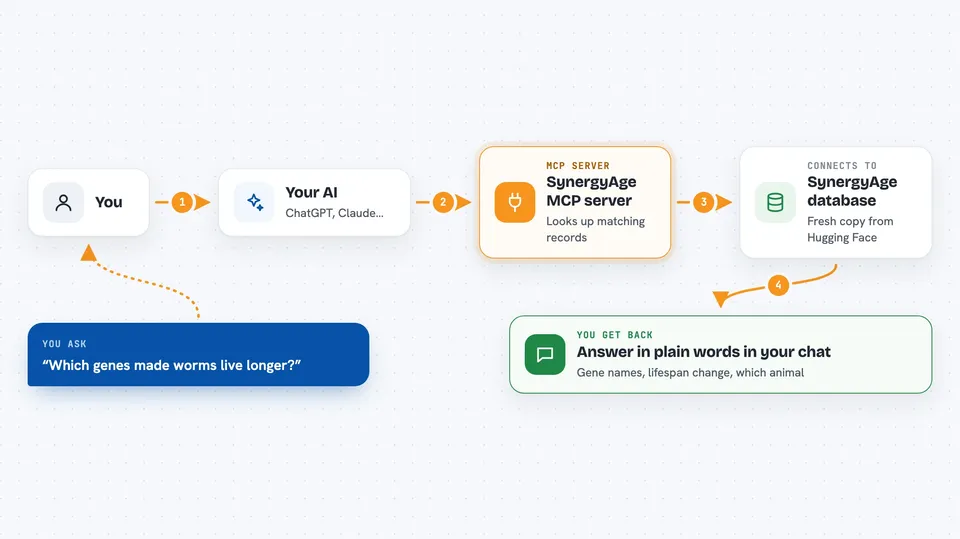
You ask your AI a question about genes and lifespan, in normal words. The AI turns that into a database lookup and sends it to this helper. The helper fetches the matching records from the SynergyAge database, which is downloaded fresh from Hugging Face so it stays current. Then the AI reads the results and gives you the answer in the chat, in plain language. It only reads data, it never changes anything.
 Click to zoom
What you can do with it
- Find genes linked to longer or shorter lifespan in worms, flies or mice
- Check whether two genes work together or cancel each other out
- Compare how the same gene behaves across different animals
- See the measured size of a lifespan effect, in percent
- Look up details of a specific experiment or intervention
- Get an overview of how many studies exist for a given gene
Try asking your AI
- “Which genes gave the biggest lifespan increase in C. elegans?”
- “Are there any synergistic interactions between daf-2 and other genes?”
- “Show me genes with antagonistic effects on lifespan in mice”
- “What is the average lifespan effect of insulin pathway genes across organisms?”
What it gives back to you
You get answers written in normal sentences, often with a short list or table of genes, effects and organisms. The AI can show the numbers it found, like a percentage change in lifespan, and name the study details behind them. If you ask for a comparison, it can lay the results out side by side. Everything appears right in the chat, like any other reply.
Before you start
What you need
- The uv tool installed on your computer (a free installer for Python programs; the README shows a one-line command)
- An MCP client such as Claude Desktop, Cursor, Windsurf or VS Code with Copilot
- An internet connection the first time, so it can download the database
Good to know
It only reads the database, so it cannot change or delete anything, but the answers are only as good as the research data behind them.
Install it with your AI
Add SynergyAge MCP server to your AI, no technical skills needed
You don't install anything by hand. You copy one prompt, paste it into an AI that can work on your computer, and it checks, installs and connects the server for you, asking you when it needs something.
Sign in to get the install prompt
Members get a ready-made prompt that lets the Claude desktop app check SynergyAge MCP server, install it and connect it for them, step by step. You don't need any technical skills: you copy, paste and answer a few questions. Your connected AI can also find and install any of the 4,361 MCP servers here for you.
Who it's for
Researchers, students and writers who work with aging or genetics and want fast answers without opening a dozen papers.